


Tóm Tắt Nội Dung Bài Viết
The Diagram Label Completion task in the IELTS Reading test is a unique challenge that requires candidates to fill in blanks on a diagram, technical illustration, or chart describing a process or object. The primary goal of this task is to test your ability to locate specific details, understand the relationships between components or steps in a system/process, and identify paraphrased information within the text.
If you are looking for tips on how to tackle this question type, don’t miss this article from ECE English!
1. What is Diagram Label Completion?
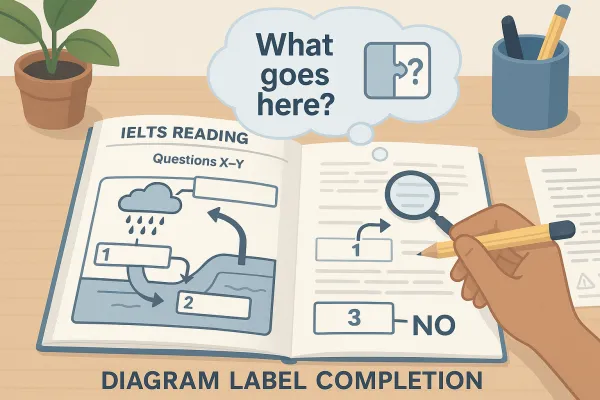
This question type asks you to fill in blanks on an illustration (diagram), such as:
- A technical drawing: Describing the structure of a machine or piece of equipment (e.g., a turbine or pump).
- A process flow chart: Illustrating the steps of a natural phenomenon (e.g., the water cycle) or an industrial process.
- A component diagram: Pointing out the parts of an object.
Typically, you will see a diagram with lines pointing to blank spaces. Your task is to read the passage, locate the information describing those specific parts, and fill in the blanks while adhering to the word count limit.
2. Common Challenges with Diagram Label Completion
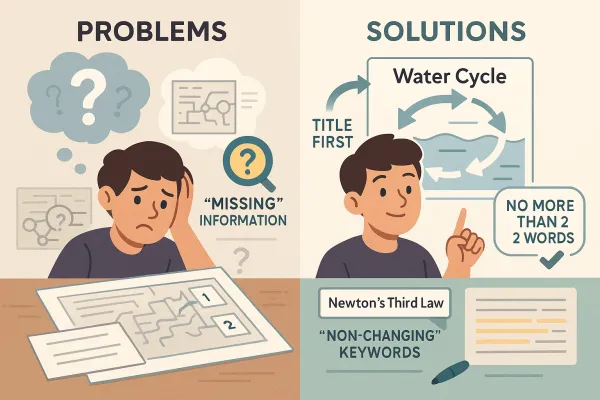
This task can be tricky for many candidates. Here are the most common issues and how to overcome them:
- Not understanding the technical content of the diagram:
– Issue: Many diagrams are highly technical (e.g., describing engine mechanisms or complex biological systems), which can confuse candidates who aren’t familiar with the terminology or operating principles.
– Solution: Don’t try to master every technical detail or look up every specialized term. Instead, focus on locating information in the text and finding keywords that fit the blanks. Technical terms are rarely paraphrased heavily, making them easy to scan for. More importantly, focus on understanding the relationship between the parts being described.
- Difficulty locating the information:
– Issue: Keywords on the diagram might be paraphrased or described contextually in the passage, making it hard to find the relevant paragraph.
– Solution:
- Read the diagram title: This is a key “anchor” to grasp the general topic and narrow down which paragraph contains the information.
- Use “fixed keywords”: Focus on proper nouns, numbers, and specific component names, as these are rarely paraphrased.
- Observe existing labels: Labels already provided on the diagram can offer clues about where to look in the text.
- Confusion regarding the word limit:
– Issue: The instructions always specify a word limit (e.g., “NO MORE THAN TWO WORDS”). Exceeding this is a common mistake that leads to an immediate loss of points.
– Solution: Always read the instructions carefully from the start. Keep the limit in mind while finding and writing your answer. Note: hyphenated words (e.g., “state-of-the-art”) are usually counted as one word.
- Time management:
– Issue: This task requires precision and can be time-consuming if you can’t find the information quickly.
– Solution: If a question is too difficult, skip it and move on. Once you have finished the easier ones, you can return to it. By then, you will have a better overview of the passage, making it easier to find the answer or determine if the information is missing (though “Not Given” is rare in this specific task type).
3. Detailed Steps to Solve Diagram Label Completion
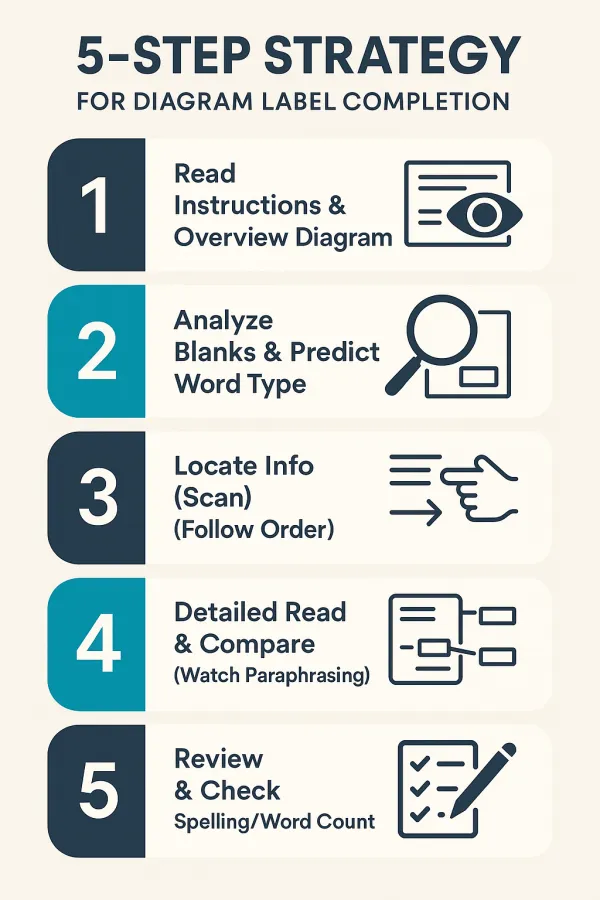
To approach this task systematically, follow these steps:
Step 1: Read the instructions and observe the diagram
- Read the word limit carefully: “Choose NO MORE THAN [NUMBER] WORDS from the passage for each answer.” Strictly follow this limit.
- Read the diagram title: This helps identify the topic and narrow down the relevant section of the text.
- Observe the diagram as a whole: Understand the main parts and the general process (inputs, outputs, sequential steps). Note any pre-existing labels, as they are important clues.
Step 2: Analyze the questions (blanks) and predict the word type
- For each blank, look at the surrounding words to predict the part of speech (noun, adjective, verb) and whether it should be singular or plural.
- Identify key terms in the question or notes near the blank. Prioritize keywords that are hard to paraphrase (proper names, numbers, technical terms).
Step 3: Locate information in the passage (Scanning)
- Use the keywords identified in Step 2 to scan the passage. Your goal is to find the paragraph or sentence that describes that specific part.
- Note the order of information: In most cases, Diagram Label Completion questions follow the order of information in the text. This means the answer to question 2 will likely appear after question 1 and before question 3. Use this rule to speed up your search, but stay alert, as the order can occasionally be scrambled or information may be scattered. If you can’t find an answer in order, be flexible and expand your search area.
- Watch for linking words like first, next, then, finally, however, also, in addition, as they often signal steps in a process or supplementary information.
Step 4: Detailed reading and comparison
- Once you have narrowed down the relevant paragraph, read it in detail.
- Compare the information in the text with the blank on the diagram. Look for words or phrases that match in meaning. Remember that the information may be paraphrased.
- Select the most appropriate word or phrase, ensuring it does not exceed the word limit.
Step 5: Review
- After filling in the blanks, read the full label on the diagram (with your chosen words) and compare it with the passage to ensure accuracy, grammar, and logical flow.
- Check your spelling to ensure there are no typos.
4. Illustrative Example
Apply the steps above to the passage and diagram below to solve this Diagram Label Completion task:
READING PASSAGE
You should spend about 20 minutes on Questions 1-5 which are based on Reading Passage below.
The Operation of a Desalination Plant
Water scarcity is a growing global concern, prompting many regions to invest in desalination technology to convert seawater into potable (drinkable) water. One common method is Reverse Osmosis (RO), a process that involves forcing saline water through a semi-permeable membrane.
The process begins with the intake of seawater from an ocean source. This raw seawater often contains large debris, sand, and marine life. To prevent damage to the delicate membranes later in the process, the water undergoes several stages of pre-treatment. This typically involves screening to remove large solids, followed by filtration through sand or multimedia filters to eliminate smaller suspended particles. Chemical dosing, such as the addition of coagulants, might also be employed to help particles clump together, making them easier to remove.
Once pre-treated, the water is then pumped at high pressure through the Reverse Osmosis membranes. These membranes are the core of the desalination process, designed to allow water molecules to pass through while rejecting salt ions and other impurities. The pressure applied must be sufficient to overcome the natural osmotic pressure of the saline water.
The water that successfully passes through the RO membranes is known as permeate, which is essentially desalinated water. This permeate often requires further post-treatment to adjust its pH, add essential minerals (as RO removes most minerals, making the water too pure or corrosive), and ensure it meets drinking water standards.
Conversely, the concentrated salt solution that does not pass through the membranes is called brine. This brine, which is much saltier than the original seawater, is then typically discharged back into the ocean, carefully managed to minimize environmental impact. The efficient operation of these plants relies heavily on consistent maintenance and monitoring of all stages.
Questions 1-5 Complete the diagram below. Choose NO MORE THAN TWO WORDS from the passage for each answer. Write your answers in boxes 1-5 on your answer sheet.
Diagram: Basic Reverse Osmosis Desalination Process
(Diagram will be provided here, with arrows showing flow and labels pointing to different stages/components, some of which are blank)
- Seawater intake
- Pre-treatment: Screening and ____________________
- High-pressure pump forcing water through ____________________
- Desalinated water (Permeate) undergoes post-treatment
- Concentrated salt solution (____________________) discharged
Answer Analysis and Explanation:
1. Seawater intake
- Analysis: This blank is already filled as an example; it is the first part of the process.
- Keywords: “intake”, “seawater”.
- Locating: The very first sentence of paragraph 2: “The process begins with the intake of seawater from an ocean source.”
- Answer: (Provided, used for orientation)
2. Pre-treatment: Screening and ____________________
- Analysis: This blank is part of the “Pre-treatment” stage, following “Screening”.
- Keywords: “Pre-treatment”, “Screening”.
- Locating: Paragraph 2, after the sentence about intake: “To prevent damage… the water undergoes several stages of pre-treatment. This typically involves screening to remove large solids, followed by filtration through sand or multimedia filters…”
- Comparison: The text lists “screening” and “filtration” as two steps in pre-treatment.
- Answer: filtration (NO MORE THAN TWO WORDS)
3. High-pressure pump forcing water through ____________________
- Analysis: This blank is the main component that the high-pressure pump forces water through.
- Keywords: “High-pressure pump”, “forcing water through”.
- Locating: Paragraph 3: “Once pre-treated, the water is then pumped at high pressure through the Reverse Osmosis membranes.”
- Comparison: Matches the phrase “Reverse Osmosis membranes”.
- Answer: RO membranes (or Reverse Osmosis membranes, though “RO membranes” fits the word limit better)
4. Desalinated water (Permeate) undergoes post-treatment
- Analysis: This blank is already filled; it is a subsequent stage for the desalinated water.
- Keywords: “Permeate”, “post-treatment”.
- Locating: Paragraph 4: “The water that successfully passes through the RO membranes is known as permeate… This permeate often requires further post-treatment…”
- Answer: (Provided, used for orientation)
5. Concentrated salt solution (____________________) discharged
- Analysis: This blank is the term used for the “concentrated salt solution”.
- Keywords: “Concentrated salt solution”, “discharged”.
- Locating: The final paragraph: “Conversely, the concentrated salt solution that does not pass through the membranes is called brine. This brine… is then typically discharged back into the ocean…”
- Comparison: The text clearly defines “concentrated salt solution” as “brine”.
- Answer: brine
5. Useful Tips for Success
- Practice visualization: When reading process descriptions, try to visualize how each step occurs or how the components are arranged. This helps you link the text to the diagram easily.
- Expand your process/structure vocabulary: Learn verbs and nouns related to describing processes, functions, and components (e.g., consist of, comprise, flow through, convert, remove, attached, located, facilitate).
- Utilize scientific/technical reading materials: These types of texts often contain diagrams. Practice with them to get used to the language style and information organization.
- Be patient and meticulous: This task requires high precision. Don’t rush; take the time to carefully compare information between the text and the diagram.
ECE wishes you effective practice and success in conquering the Diagram Label Completion task in IELTS Reading!





 Khai giảng Khóa học Hè cực HOT.
No comments yet!