


Tóm Tắt Nội Dung Bài Viết
On the journey to conquering the IELTS exam, vocabulary acts as the “backbone” that determines a candidate’s ability to express themselves and grasp complex ideas. A rich, precise, and flexible vocabulary will help you confidently showcase your skills and achieve high scores across all four sections: Listening, Speaking, Reading, and Writing.
Understanding this importance, author Rawdon Wyatt created the book “Check your English Vocabulary for IELTS”, a valuable resource that helps IELTS learners consolidate and develop their vocabulary in a structured and effective way. This review will delve into the content, pros and cons, target audience, and best practices for using “Check your English Vocabulary for IELTS” so you can gain a comprehensive overview and make an informed decision for your exam preparation.
1. Overview of “Check your English Vocabulary for IELTS”
“Check your English Vocabulary for IELTS” is part of the renowned “Check Your English Vocabulary” series by author Rawdon Wyatt, published by Bloomsbury Publishing. Rawdon Wyatt is an experienced author and educator in the field of English language teaching and IELTS preparation. He has authored numerous highly regarded IELTS prep books that are widely used across the globe.
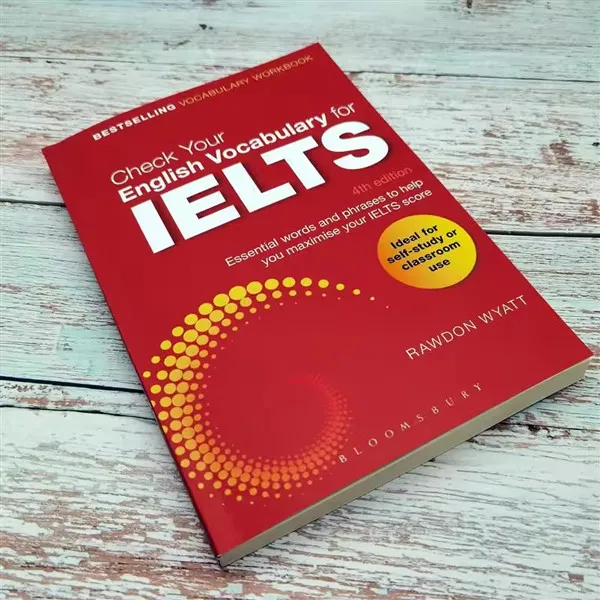
“Check your English Vocabulary for IELTS” is specifically designed for English learners preparing for the IELTS exam, focusing on providing and reinforcing the essential vocabulary needed for all test sections. The book is presented in a scientific, logical manner with a diverse system of exercises that closely mirror the actual IELTS test format, helping learners not only build their vocabulary but also become familiar with the exam structure.
The latest edition is regularly updated to reflect changes in the IELTS exam and includes new vocabulary topics as they emerge. Additionally, the book comes with a detailed answer key, allowing learners to self-check and track their progress.
2. Target Audience
The book “Check your English Vocabulary for IELTS” is suitable for the following groups:
- IELTS candidates: This is the primary audience for the book. It provides a wealth of vocabulary covering common IELTS topics, helping students boost their scores and reach their target band.
- English learners looking to improve their vocabulary: Even if you aren’t planning to take the IELTS, those looking to expand their English lexicon, especially academic vocabulary, will find this a useful resource.
- English and IELTS teachers: “Check your English Vocabulary for IELTS” is a great reference for teachers when designing lesson plans and providing practice exercises. The book offers a system of vocabulary categorized by topic, accompanied by varied exercises, helping teachers save time on lesson planning and improve teaching quality.
- Intermediate learners and above: To use this book effectively, learners should have a foundation in grammar and vocabulary at an intermediate level (roughly B1, IELTS 4.0-5.0). If you are at a lower level, it is recommended to strengthen your English foundation before starting with this book.
See also: Best books for learning IELTS vocabulary
3. Content Overview of “Check your English Vocabulary for IELTS”
“Check your English Vocabulary for IELTS” is divided into several sections, each focusing on a specific vocabulary theme commonly found in the IELTS exam. Here is an overview of the content:
- Introduction: An overview of the IELTS exam, test structure, and scoring criteria. This section helps learners better understand the exam and set appropriate study goals.
- Units: The book includes approximately 50 units, each focusing on a specific vocabulary theme such as:
- General Vocabulary: Basic, common vocabulary used in various fields like Education, Family and Friends, Health, Media, Transport, etc.
- Topic-specific Vocabulary: Specialized vocabulary related to common IELTS topics such as Environment, Technology, Arts, Culture, Business, etc.
- Academic Vocabulary: Academic terms often found in reading and writing tasks, including verbs, nouns, adjectives, adverbs, and collocations.
- Exam Practice: Each unit concludes with practice exercises designed in the IELTS format, helping learners apply the vocabulary in context and get used to the test structure. Exercise types typically include:
- Matching: Matching words with definitions, synonyms, or antonyms.
- Gap-fill: Filling in the blanks in sentences or paragraphs.
- Multiple choice: Selecting the correct answer.
- Word formation: Changing word forms from given roots.
- Sentence completion: Completing sentences with provided words/phrases.
- Short-answer questions: Answering questions concisely.
- Writing tasks: Some units provide short writing exercises to help learners practice using vocabulary in a writing context.
- Answer Key: Detailed answers for all exercises, allowing learners to self-assess and track their learning progress.
- Word List: An alphabetical list of all vocabulary appearing in the book, making it easy for learners to look up and review.
>>Download the book for free: Here
4. Pros and Cons of “Check your English Vocabulary for IELTS”
4.1. Pros
- Rich content, closely aligned with the IELTS exam: The book provides a large amount of vocabulary covering most topics commonly found in the IELTS exam, from general subjects to specialized academic topics.
- Diverse and effective exercises: The exercises are varied and simulate actual IELTS test formats, helping learners not only study vocabulary but also hone their test-taking skills.
- Scientific, logical, and easy-to-understand layout: The book is clearly organized with well-divided sections, making it easy for learners to follow and absorb information.
- Detailed answer key: The detailed key allows learners to self-check and assess their progress, enabling them to adjust their study methods accordingly.
- Suitable for a wide audience: The book is appropriate for both students preparing for IELTS and those simply looking to improve their general English vocabulary.
- Reputable and experienced author: Rawdon Wyatt is a respected figure in English language teaching and IELTS preparation, ensuring the quality of the book’s content.
4.2. Cons
- Requires a certain English foundation: Learners need a grammar and vocabulary base at an intermediate level or higher to use the book effectively.
- Lacks Speaking practice: The book focuses primarily on vocabulary for Listening, Reading, and Writing, with limited coverage of specialized vocabulary for Speaking. Learners should combine this with other materials to practice this skill.
- No detailed grammar explanations: The book focuses mainly on vocabulary and does not provide detailed explanations of related grammar points.
- Price can be a bit high: Compared to some other IELTS vocabulary books, the price may be slightly high for some students.
- Can be boring if not used correctly: Learning vocabulary can become tedious if learners simply memorize lists without applying them in specific contexts.
See more here: IELTS Writing Task 1 vocabulary compilation
5. How to use “Check your English Vocabulary for IELTS” effectively
To maximize the value of “Check your English Vocabulary for IELTS”, you should apply the following study methods:
- Set clear study goals: Before starting, clearly define your target IELTS band and the time you have for preparation. This will help you create a suitable study plan and focus on the most important topics.
- Study by topic: Instead of learning vocabulary randomly, study unit by unit, focusing on one specific topic at a time. This will help you link words together and remember them more easily.
- Learn vocabulary in context: Don’t just memorize word lists. Pay attention to the examples in the book and try to understand how the vocabulary is used in specific contexts. You should also look for additional examples from other sources like newspapers, movies, books, etc.
- Take careful notes: Use a notebook or note-taking software to record new words, definitions, examples, synonyms, antonyms, pronunciation, etc.
- Review regularly: Vocabulary is easily forgotten if not reviewed often. Dedicate time each day to review what you’ve learned using methods like flashcards, Quizlet, or self-quizzing.
- Complete all exercises: The exercises in the book are a crucial part of reinforcing your knowledge and honing your test-taking skills. Complete them seriously, then check your answers and learn from your mistakes.
- Combine with other materials: To boost your learning efficiency, combine “Check your English Vocabulary for IELTS” with other IELTS prep materials, especially Speaking practice books and mock test sets.
- Use a dictionary: Always look up words when you encounter new terms or are unsure of a meaning. Use reputable dictionaries like the Oxford Advanced Learner’s Dictionary or the Cambridge Advanced Learner’s Dictionary.
- Create a study environment: Find a quiet, comfortable space to study. You can also join study groups or online forums to exchange knowledge and experiences with other learners.
- Apply to real life: Try to use the vocabulary you’ve learned in daily communication, by writing journals, emails, etc. Applying vocabulary in real life will help you remember it longer and use it more naturally.
- Set small goals and be persistent: Learning vocabulary is a long-term process that requires persistence and effort. Set small, specific goals—such as learning 5 new words per day—and stick to them.
Conclusion:
“Check your English Vocabulary for IELTS” by Rawdon Wyatt is a useful and highly recommended book for anyone preparing for the IELTS exam, especially those looking to improve their vocabulary. With its rich content, alignment with the exam, diverse exercises, and scientific layout, this book will be a reliable companion on your path to conquering the IELTS.
However, to achieve the best results, learners need a suitable study method, should combine it with other materials, and must practice consistently. We hope this detailed review from the ECE Language Center has provided you with useful information about “Check your English Vocabulary for IELTS” and helps you make an informed decision for your exam preparation. Good luck!
Check out: IELTS English Courses at ECE Language Center.




 Khai giảng Khóa học Hè cực HOT.
No comments yet!