


Tóm Tắt Nội Dung Bài Viết
Reported speech is a key topic that frequently appears in English proficiency exams. Mastering the rules of backshifting in reported speech is essential if you want to score maximum points on these types of questions. Let’s review this topic together with ECE English!
A 4-Step Guide to Converting Direct Speech to Reported Speech
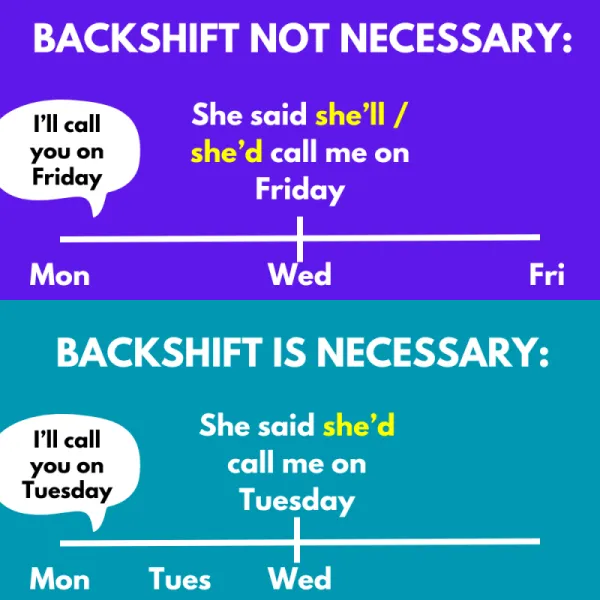
As you know, reported speech (also known as indirect speech) is used to recount what someone else has said or what has happened. Simply put, it involves converting a direct quote into an indirect statement. To make this conversion, you need to follow these 4 steps:
Step 1: Choose the reporting verb
Commonly used reporting verbs include:
- Say
- Said (past tense of say)
- Tell
- Told (past tense of tell)
Besides “said” and “told,” you can also use other verbs with similar meanings, such as “asked,” “denied,” “promised,” “suggested,” and so on.
When converting from direct to reported speech, these verbs are usually in the past tense. Depending on the writer’s preference, you may include the conjunction “that” after these verbs.
Step 2: Backshifting in reported speech
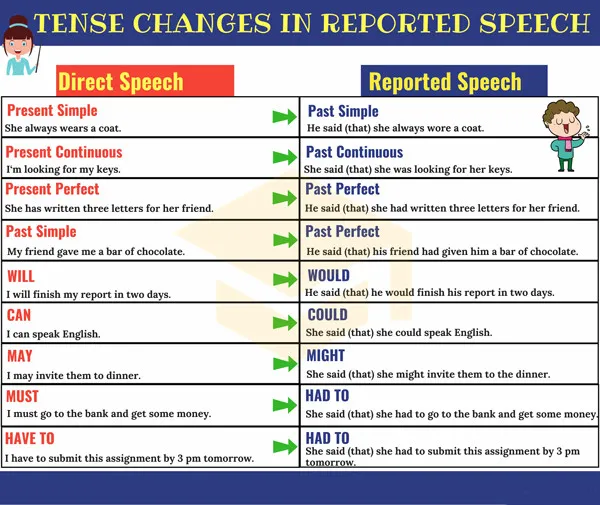
This is considered the most important step in the conversion process. The main verb in the sentence must be shifted one tense back from the original direct speech. Refer to the backshifting table below:
| Direct Speech | Reported Speech |
| Present Simple | Past Simple |
| Present Continuous | Past Continuous |
| Present Perfect | Past Perfect |
| Past Simple | Past Perfect |
| Past Continuous | Past Perfect Continuous |
| Past Perfect | Past Perfect |
| Future Simple | Present Conditional |
| Future Continuous | Conditional Continuous |
Backshifting for modal verbs:
| Can | Could |
| May | Might |
| Must | Must/had to |
Step 3: Convert pronouns and possessive adjectives
Beyond backshifting, personal pronouns, possessive pronouns, and possessive adjectives must also be adjusted accordingly.
| Direct Speech | Reported Speech | |
| Personal Pronouns | I | She, He |
| You | I, We | |
| We | They | |
| Possessive Pronouns | Yours | Mine, ours |
| Ours | Theirs | |
| Mine | His, her | |
| Possessive Adjectives | Ours | Their |
| Your | My, our | |
| Mine | His, her | |
| Object Pronouns | You | Me, Us |
| Me | Her, him | |
| Us | Them |
Note: In reported questions, these pronouns may not change depending on the context.
Step 4: Change adverbs of time and place
The final step is to update adverbs of time and place. The rules are as follows:
| Direct Speech | Reported Speech |
| This | That |
| These | Those |
| Here | There |
| Now | Then, at the time |
| Today | That day |
| Ago | Before |
| Yesterday | The previous day, the day before |
| The day before | Two days before |
| Last day | The day before |
| Last week | The week before, the previous week |
| This week | That week |
| Next week | The week after, the next/following week |
| Tomorrow | The day after, in two days’ time |
Key Backshifting Rules to Remember
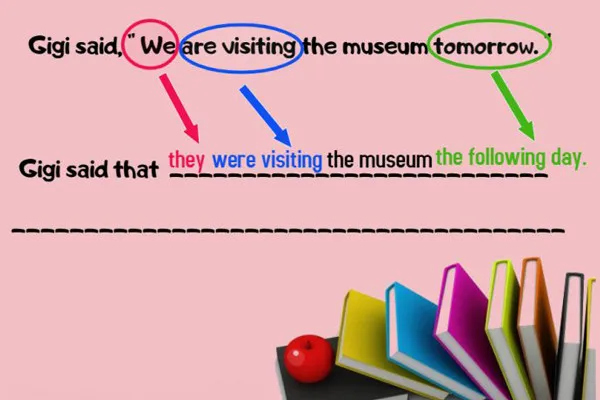
When converting to reported speech, keep these basic rules in mind:
If the reporting verb is in the present or future tense, do not backshift the verb in the reported clause.
If the reporting verb is in the past tense, backshift the verb according to the following structure:
- Present Simple becomes Past Simple (or Past Perfect if applicable).
- Present Continuous becomes Past Continuous (or Past Perfect Continuous if applicable).
- Present Perfect becomes Past Perfect.
- “Will” becomes “would.”
Exceptions: When NOT to backshift
Besides the standard rules, note these special cases:
- Modal verbs like “should,” “would,” “could,” “might,” and “ought to” do not change.
- Do not backshift when reporting a general truth or scientific fact.
- Do not backshift if the reporting verbs “say” or “tell” are in the present tense.
Ex: Jay said: “I can go swimming tomorrow.”
=> Jay said that he could go swimming tomorrow.
Reported Speech Exercises
Exercise 1: Convert the following sentences into reported speech.
- Jack asked his friend: “Who gave you that book?”
- My sister told me: “Prepare dinner before your father comes home.”
- Lisa said: “Jack’s not at school.”
- Jay said: “I must go home to do homework.”
- Henry said: “Don’t get your T-shirt dirty, boys.”
Exercise 2: Choose the best answer to fill in the blanks.
1. He asked me……………
A. When do you return home?
B. When I returned home
C. when did I return home
2. My mother…….her to take more exercise.
A. tell
B. have told
C. told
3. Adam told me that his grandfather……a race horse.
A. owns
B. owned
C. A & B
4. Linda rang Minhee in Japan yesterday, and she said it…….. raining there.
A. was
B. is
C. has been
5. The last time I saw my daddy, she looked very relaxed. He explained he’d been on holiday the………week.
A. next
B. previous
C. following
Exercise 3: Rewrite the following sentences in reported speech:
1. My mom said: “Don’t stay up late, Lisa.”
=> My mom told Lisa……………………
2. He asked me: “Can you meet me at the airport?”
=> He asked me……………………………..
3. The teacher asked: “Who answers this question?”
=> The teacher wanted to know…………………..
4. “Can I borrow your umbrella, Jack?” asked Mary.
=> Mary asked………………………….
5. Henry said: “I want a big cake for my birthday.”
=> Henry said that……………………………..
Answer Key
Exercise 1:
- Jack asked his friend who he had given that book to.
- My sister told me to prepare dinner before my father came home.
- Lisa said that Jack was not at school.
- Jay told me that he had to go home to do homework.
- Henry told the boys not to get his T-shirt dirty.
Exercise 2:
- B
- C
- C
- A
- B
Exercise 3:
- My mom told Lisa not to stay up late.
- He asked me if I could meet him at the airport.
- The teacher wanted to know who answered that question.
- Mary asked Jack whether/if she could borrow his umbrella.
- Henry said that he wanted a big cake for his birthday.
Types of Reported Speech in English
Beyond backshifting, you should also master the different types of reported speech and their structures.
1. Reported Statements
Reported statements are very common and are used to recount what someone has said.
Structure: S + say/said/tell/told + (that) + S + V
Example: Jack said: “I love Lisa very much.”
=> Jack said that he loved Lisa very much.
Structure: S + said to + O => told + O
Example: My mother said to me: “I like pizza more than hotdogs.”
=> My mother told me she liked pizza more than hotdogs.
Structure: says/to say + O => tells/to tell + O
Example: My friend says to me: “The trees are green.”
=> My friend tells me the trees are green.
2. Reported Commands
This form is used to report commands or requests. It often uses verbs like “advise,” “tell,” “ask,” “remind,” “instruct,” “warn,” etc.
Full structure: S + told + O + to-infinitive
Example: I said: “Please, pick me up at the hospital gate, David.”
=> I told David to pick me up at the hospital gate.
Negative form: S + told + O + not + to-infinitive
Example: “Don’t talk in class”, the teacher said to us.
=> The teacher told us not to talk in class.
3. Reported Speech with “If” Clauses
Zero Conditional
When converting to reported speech, the verbs in the conditional clause remain unchanged, even if the reporting verb is in the past tense.
Structure: S + said/told + (that) + If + S + V(s/es) + O, S + V(s/es) + O
Example: David said: “If I’m sick, I take medicine.”
=> David said that if he is sick, he takes medicine.
First Conditional
When converting the first conditional to reported speech, apply the backshifting rule, effectively turning it into a second conditional.
Structure: S + said/told + (that) + If + S + V(ed) + O, S + would + V + O
Example: Leon said: “If I have money, I will buy a new laptop.”
=> Leon said that if he had money, he would buy a new laptop.
Second and Third Conditionals
In these cases, we do not backshift; the verbs remain as they are.
Structure:
S + said/told + (that) + If + S + V(ed), S + would + V + O
S + said/told + (that) + If + S + V(P2), S + would + have + V(P2)
Example:
- I said that if I had superpowers, I would go back to yesterday.
- Adam said that if he had known about the bad weather, he would not have gone on the picnic.
4. Reported Wh-Questions
To convert direct Wh-questions into reported speech, follow the 4 steps mentioned earlier, keeping these points in mind:
- The question word is repeated after the reporting verb.
- Change the word order from question form to statement form (Subject + Verb).
Structure: S + asked + O + Wh-question + S + verb
Example: Eva asks: “Where do you buy your dress?”
=> Eva asked me where I bought my dress.
As you can see, the grammar of backshifting in reported speech can be complex. However, if you master the rules, understand the exceptions, and practice regularly, this topic will help you score perfectly. Don’t rush—stay consistent and keep practicing every day!




 Khai giảng Khóa học Hè cực HOT.
No comments yet!