


Tóm Tắt Nội Dung Bài Viết
Do you hold a PET certificate and want to know what it equates to in terms of an IELTS band score? Or are you torn between taking the PET or the IELTS exam? This article will answer the question, “What is the IELTS equivalent of a PET certificate?” while providing a detailed comparison of the two exams to help you determine the right study path to achieve your goals.
1. Overview of the PET (Preliminary English Test)
The PET (Preliminary English Test), organized by Cambridge Assessment English, is a general English proficiency exam at the B1 (Intermediate) level according to the Common European Framework of Reference for Languages (CEFR). Earning a PET certificate demonstrates that you can use English for everyday communication, travel, study, and work at a basic level.
1.1. Who is the PET for?
- Middle and High School Students: The PET is an important milestone in English language learning, helping students assess their proficiency and prepare for higher-level exams like the FCE (B2 First) or IELTS.
- University Students: Some universities may require a PET or equivalent for admission or graduation in non-English major programs.
- Working Professionals: The PET proves your ability to use English in an international work environment, particularly for roles involving basic communication, customer service, tourism, and more.
- Those Seeking Immigration or Study Abroad: Although the PET is not as widely used as the IELTS, some countries or organizations may accept it for these purposes, though requirements can vary.
- Anyone wanting to assess their English level: The PET provides an objective, internationally recognized assessment of English proficiency at the B1 level.
1.2. PET Exam Structure
Reading (45 minutes):
- Part 1 (Multiple choice): Read 5 short texts (notices, signs, etc.) and choose the correct answer (A, B, C).
- Part 2 (Matching): Read descriptions of 8 people and 5 short texts. Match the people to the appropriate text.
- Part 3 (True/False): Read a long text and determine whether the given statements are True or False.
- Part 4 (Multiple choice): Read a long text and choose the correct answer (A, B, C, D).
- Part 5 (Multiple-choice cloze): Read a text with 6 gaps and choose the correct word/phrase (A, B, C, D) to fill them.
- Part 6 (Open cloze): Read a text with 6 gaps and fill in the missing words yourself.
Writing (45 minutes):
- Part 1 (Email): Write an email of about 100 words based on provided information (usually a reply).
- Part 2 (Article/Story): Choose 1 of 2 options: write an article or a story of about 100 words.
Listening (30 minutes, including 6 minutes for transferring answers):
- Part 1 (Multiple choice): Listen to 7 short conversations and choose the correct image/answer (A, B, C).
- Part 2 (Multiple choice): Listen to a longer conversation and choose the correct answer (A, B, C).
- Part 3 (Gap-fill): Listen to a monologue and fill in the missing information.
- Part 4 (True/False): Listen to a conversation and determine whether the given statements are True or False.
Speaking (10 – 12 minutes per pair of candidates):
- Part 1 (Interview): The examiner asks candidates questions about themselves, their interests, family, etc.
- Part 2 (Situational role-play): Candidates are given a situation and must discuss it with their partner to reach a decision.
- Part 3 (Describe a picture): Each candidate is given a picture and describes it for about 1 minute.
- Part 4 (Discussion): Candidates discuss topics related to the picture from Part 3 with each other.
1.3. PET Scoring and the CEFR:
- 160 – 170 (Pass with Distinction): Equivalent to C1 (Advanced) level. Demonstrates that the candidate’s English proficiency exceeds the requirements of the B1 exam.
- 153 – 159 (Pass with Merit): Achieves B1 level. The candidate can use English effectively in familiar situations.
- 140 – 152 (Pass): Achieves B1 level. The candidate can use English in basic situations.
- 120 – 139 (Level A2): Does not meet B1 level. The candidate needs further improvement to reach B1.
2. What is the IELTS Equivalent of a PET Certificate?
Converting a PET score to an IELTS band is not an exact science because:
- Different Objectives: The PET assesses English usage in everyday situations, whereas the IELTS evaluates academic and more specialized English proficiency.
- Different Exam Structures: The IELTS features more complex tasks that require analytical, synthesis, and evaluation skills.
- Different Difficulty Levels: The IELTS is more challenging than the PET, particularly in the Writing and Speaking sections.
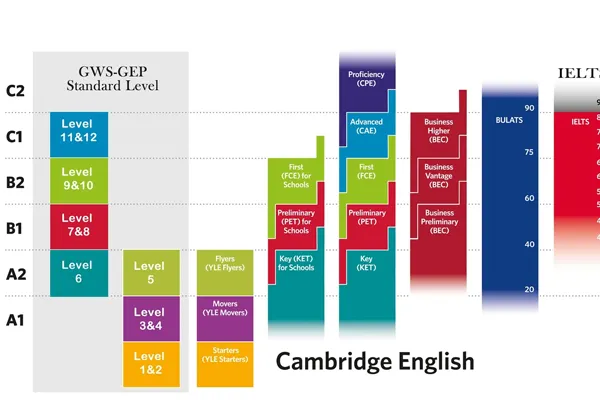
However, for a rough estimate, you can refer to the comparison table below:
| PET Score | CEFR Level | IELTS Equivalent (Estimated) | Detailed Description |
| 160 – 170 | C1 | 5.5 – 6.5 |
Exceeds PET requirements. Capable of using English flexibly and effectively in many situations. Can understand complex texts and express ideas fluently. However, to reach IELTS 6.5, one needs to improve grammatical accuracy, academic vocabulary, and the ability to develop ideas.
|
| 153 – 159 | B1 | 4.0 – 5.0 |
Meets PET requirements. Can communicate in familiar situations and understand simple texts. However, to reach IELTS 5.0 or higher, one needs to expand vocabulary, improve grammar, practice essay writing, and develop more coherent and logical speaking skills.
|
| 140 – 152 | B1 | 4.0 – 5.0 |
Meets the minimum PET level. Can use basic English. To reach IELTS 4.0 – 5.0, significant effort is required to improve all four skills.
|
| 120 – 139 | A2 | 3.0 – 3.5 |
Does not meet B1 level. English proficiency is limited. You should focus on foundational English courses before considering the IELTS.
|
Detailed analysis of corresponding IELTS bands:
- IELTS 3.0 – 3.5: Candidates have very limited English proficiency and can only communicate in the simplest situations.
- IELTS 4.0 – 4.5: Candidates can communicate at a basic level but still make many errors and struggle to express ideas.
- IELTS 5.0 – 5.5: Candidates can communicate relatively fluently in familiar situations but are still limited in vocabulary, grammar, and idea development.
- IELTS 6.0 – 6.5: Candidates can use English quite well, participate in discussions, write simple essays, and understand moderately complex texts.
3. Why Study for IELTS After Earning a PET? (Benefits and Goals)
Holding a PET certificate is an advantage, proving you have a solid foundation in English. However, the IELTS offers superior benefits, especially if you have the following goals:
- Study Abroad: Most universities and colleges in English-speaking countries (UK, Australia, USA, Canada, etc.) require an IELTS score (usually 6.0 or higher) for admission.
- Employment: The IELTS is a major plus on a resume, especially for multinational companies or positions requiring frequent English communication.
- Immigration: Many countries require an IELTS (or equivalent) for immigration application processing.
- Personal Development: Studying for the IELTS not only helps you achieve a high score but also significantly enhances your English proficiency, expands your vocabulary, improves grammar, and develops critical thinking and communication skills.
- Increased Confidence: When you are confident in your English abilities, you will find it easier to integrate into international environments, communicate effectively, and succeed in your studies and career.
4. Frequently Asked Questions (FAQ)
Question 1: “I already have a PET certificate; do I still need to take the IELTS?”
Detailed Answer: Whether or not you need to take the IELTS depends entirely on your personal goals and the specific requirements of the school, organization, or program you are targeting.
If your goal is:
Studying abroad: Most universities and colleges in English-speaking countries (UK, Australia, USA, Canada, New Zealand, etc.) mandate an IELTS (or TOEFL) certificate to prove your English proficiency is sufficient for their academic programs. Required IELTS scores typically range from 6.0 to 7.5 or higher, depending on the institution and field of study. A PET certificate is generally not accepted for this purpose.
Working at international companies: The IELTS is a significant advantage on your resume, especially for roles that require frequent English communication or working in an international environment. While the PET can demonstrate basic English ability, the IELTS (with a higher band score) demonstrates superior and more professional proficiency.
Immigration: Many countries require an English certificate like the IELTS (or PTE, TOEFL) for immigration applications. Score requirements vary by country and visa category.
Proving English proficiency for personal reasons: If you only want a certificate to assess your English level at B1, the PET is sufficient. However, if you want to prove your English ability at a higher level (B2, C1, C2), the IELTS is a more suitable choice.
In summary: If you only need a B1-level English certificate for non-specialized purposes (e.g., daily communication, travel, working in an environment that doesn’t require high-level English), the PET may suffice. However, if you have higher goals (studying abroad, professional work, immigration), the IELTS is a mandatory choice.
Question 2: Where should I start studying for the IELTS after getting my PET?
Detailed Answer:
- Assess your current IELTS level:
Take a full IELTS mock test: This is the most important step. Take an official IELTS practice test (e.g., Cambridge IELTS Practice Tests) under exam conditions (timed, quiet environment, no study materials). This helps you determine your exact current score and get familiar with the test structure.
Analyze your results: Carefully review your scores for each skill (Listening, Reading, Writing, Speaking). Identify your strengths and weaknesses. Pay attention to the types of questions you find difficult and your common mistakes.
- Define your IELTS goal:
What IELTS score do you need? This goal will dictate your study path and the time you need to invest.
- Create a study plan:
Based on your mock test results and your IELTS goal, create a detailed study plan, including:
Schedule: Allocate reasonable time for each skill. Focus more on the skills where you are weakest.
Study materials: Choose materials appropriate for your level and goals.
Study methods: Find effective study methods for each skill.
Milestones: Break your big goal down into smaller, more achievable targets.
- Seek support (if needed):
Join an IELTS course: If you feel self-study isn’t effective, consider joining an IELTS English course to be guided by experienced teachers.
Find a tutor/study partner: Studying with others will give you extra motivation and opportunities to practice.
Join an IELTS community: Exchange experiences, get your questions answered, and find study materials.
Question 3: “Is the IELTS hard? How does its difficulty compare to the PET?”

Detailed Answer: The IELTS is significantly harder than the PET. The reasons are:
Assessment objective: The PET assesses English usage in everyday, familiar situations. The IELTS assesses academic, specialized English usage in university and professional work environments.
Exam structure: The IELTS features more complex tasks that require analytical, synthesis, and evaluation skills, as well as the ability to construct tight arguments.
Vocabulary: The IELTS requires a broader vocabulary, including academic vocabulary.
Grammar: The IELTS requires the ability to use grammar accurately and flexibly, including complex grammatical structures.
Writing: IELTS Writing requires candidates to write essays with tight structures, logical arguments, and academic language. PET Writing only requires writing informal letters and short pieces (stories/articles).
Speaking: IELTS Speaking assesses fluency, coherence, the use of diverse vocabulary and grammar, and standard pronunciation. PET Speaking focuses on basic communication situations.
Length and time: IELTS exams (especially Reading and Writing) are generally longer, have more questions, and have higher requirements than the PET.
However, if you already have a PET (B1) foundation, you have a certain advantage. You are already familiar with taking English exams and have basic grammar and vocabulary knowledge. The important thing is to have the right study method, persistence, and effort to improve your proficiency.
Question 4: “Should I self-study for the IELTS?”
Answer: Self-studying for the IELTS is entirely feasible, especially if you have experience with the PET and high self-discipline. However, self-study has its own pros and cons:
Pros of self-study:
- Flexibility: You can study anytime, anywhere.
- Cost-effective: You don’t have to pay tuition fees for centers or tutors.
- Autonomy:
You are free to choose the materials and study methods that suit you best.
Cons of self-study:
- Easy to lose motivation: Without a guide, you may easily get discouraged when facing difficulties.
- Hard to assess your level: You may not know where you stand and what you need to improve.
- Lack of interaction: You don’t have the opportunity to practice Speaking with others or get your Writing corrected.
- Easy to go in the wrong direction: Without the right study method, you may waste a lot of time without achieving the desired results.
If you decide to self-study, ensure you:
* Have a clear plan.
* Have high-quality, reliable study materials.
* Have a scientific study method.
* Seek support when needed (e.g., join an IELTS community, ask friends or acquaintances with experience).
There is no single, exact answer to “What is the IELTS equivalent of a PET certificate?”, but this article has provided detailed comparisons and estimated band scores for your reference. More importantly, the PET is a great foundation for you to go further on your journey to conquering the IELTS. By setting goals, assessing your level, creating a scientific study plan, seeking support, and practicing persistently, you will achieve your dream IELTS band score and open up new opportunities for the future.
The ECE Language Center is always ready to accompany you on your path to conquering the IELTS with high-quality courses and a dedicated team of teachers.





 Khai giảng Khóa học Hè cực HOT.
No comments yet!