


Tóm Tắt Nội Dung Bài Viết
Paraphrasing is a vital skill in IELTS Writing, allowing candidates to demonstrate a diverse range of vocabulary and grammar while avoiding the repetition of original ideas. Mastering various paraphrasing techniques will significantly boost your scores in criteria such as Lexical Resource and Task Achievement.
Defining Paraphrasing

Paraphrasing is the act of expressing an idea, sentence, or paragraph in your own words while maintaining the original meaning. Beyond helping you avoid plagiarism, it is an essential skill for effective writing and daily communication.
In the context of IELTS Writing, paraphrasing is the ability to restate the prompt or main ideas without simply copying the wording from the question. This skill not only helps you score higher in vocabulary assessment but also showcases your linguistic flexibility.
Why is paraphrasing necessary in IELTS Writing?
1. Enhancing linguistic flexibility and vocabulary range
In the IELTS Writing test, the ability to use language flexibly and creatively is highly valued. Paraphrasing allows you to convey the same idea using synonyms, different sentence structures, or varied word arrangements.
For example, instead of copying the prompt, you can use synonyms or alternative structures. This demonstrates both a rich vocabulary and the ability to think flexibly in English.
2. Avoiding repetition of the prompt
A common mistake many candidates make is copying the prompt verbatim in their introduction. This makes the writing feel rigid and unoriginal, causing you to miss the chance to impress the examiner.
By paraphrasing, you can make your introduction more engaging. For instance, instead of writing, “Many people believe that technology has improved our lives,” you could express it as: “It is widely thought that advancements in technology have brought significant benefits to modern life.”
3. Improving your Band Score in Task Achievement and Lexical Resource
Task Achievement: Paraphrasing helps you address the prompt directly and comprehensively, avoiding the trap of simply repeating the question. This is crucial for achieving a high score in Task Achievement.
Lexical Resource: Paraphrasing skills allow you to showcase vocabulary variety. Using synonyms, alternative phrases, and diverse expressions helps you make a strong impression on the examiner. For example, instead of repeating the word “important,” you could use “crucial,” “vital,” or “essential.”
Furthermore, altering sentence structures demonstrates grammatical flexibility. For example, you can switch from active to passive voice or use relative clauses to enrich your expression.
Related article: How to write an Agree or Disagree essay for Writing Task 2
Steps to paraphrase
1. Understand the content thoroughly
The first and most important step is to accurately grasp the meaning of the sentence or paragraph you intend to paraphrase. Misunderstanding the original content can lead to errors and compromise the accuracy of your writing.
For example: When you encounter the sentence, “Some people think that global warming is the most pressing issue of our time,” you need to identify key terms like “global warming,” “pressing issue,” and “our time” to ensure you don’t alter the intended meaning.
2. Identify keywords and structures to change
Analyze the original sentence to identify key words or phrases. Then, find ways to replace them with synonyms or modify the sentence structure to create a new version.
For example: With the sentence above, “global warming” can be replaced with “climate change,” and “pressing issue” can be replaced with “urgent problem.”
3. Use synonyms or equivalent structures
Find suitable synonyms or alternative phrases. Additionally, you can change the sentence structure to refresh the expression.
For example: The sentence “Some people think that global warming is the most pressing issue of our time” can be paraphrased as: “Certain individuals believe that climate change represents the most urgent challenge in contemporary society.”
4. Review for meaning
After rewriting, read the new sentence and compare it with the original to ensure the meaning remains intact. Also, check for grammar and natural flow.
If necessary, ask someone else to review it or use tools like a thesaurus or grammar checker to ensure quality.
See more: How to answer Yes/No questions in IELTS Speaking and Reading
Common paraphrasing methods to score points in IELTS Writing
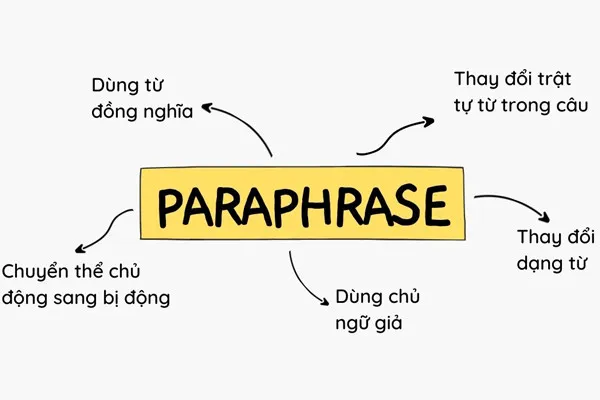
1. Using synonyms
Using synonyms is the most fundamental paraphrasing method. This requires a rich vocabulary and a clear understanding of word context to avoid misuse.
Strengths:
- Refreshes the sentence while keeping the meaning intact.
- Demonstrates a rich and diverse vocabulary.
Important notes:
- Not every synonym can be used in every context. For example, “big” and “large” both mean “to lớn,” but in the phrase “big mistake,” you cannot replace it with “large mistake.”
- Avoid using unfamiliar or overly complex words, as this can make your writing sound forced or confusing.
Example:
Original: The graph shows the number of visitors to the museum.
Paraphrased: The chart illustrates how many people visited the museum.
2. Changing grammatical structure
Changing grammatical structure makes your writing more flexible and creates a positive impression on the examiner. You can:
- Switch from active to passive voice.
- Use relative clauses.
- Change the order of sentence components.
Strengths:
- Shows your ability to use grammar flexibly.
- Increases the complexity and academic tone of your writing.
Example:
- Original: Many people believe that education is the key to success.
- Paraphrased: It is widely believed that success lies in education.
Changing with a relative clause:
- Original: Education plays a crucial role in shaping one’s future.
- Paraphrased: It is education, which plays a crucial role, that shapes one’s future.
3. Using different expressions
Instead of focusing only on synonyms or structure, you can completely change the way an idea is expressed while keeping the original meaning. This requires creativity and strong linguistic thinking.
Strengths:
- Creates variety in how ideas are presented.
- Helps the writing sound more natural.
Example:
Original: There has been a significant increase in the population.
Paraphrased: The population has grown considerably.
Developing more detail:
Original: Traffic congestion is a growing problem in urban areas.
Paraphrased: Increasing traffic in cities has become an escalating issue.
4. Splitting or combining sentences
Splitting a complex sentence into two simple ones or vice versa is an effective way to paraphrase without losing coherence. This is especially useful when you want to emphasize a specific point or clarify information.
Strengths:
- Increases logic and clarity.
- Shows your ability to use various sentence types.
Example:
Original: Although the economy is growing, unemployment remains high.
Paraphrased (split): The economy is growing. However, unemployment is still high.
Paraphrased (combined): Despite economic growth, unemployment continues to be a significant issue.
Another application:
Original: Technology has revolutionized communication, allowing people to connect instantly.
Paraphrased (split): Technology has revolutionized communication. It now enables people to connect instantly.
Paraphrased (combined): Communication has been revolutionized by technology, enabling instant connections.
When applying these four methods, practice regularly to achieve accuracy and natural expression. This will not only improve your paraphrasing skills but also boost your scores in Lexical Resource and Grammatical Range and Accuracy in IELTS Writing.
Detailed guide to paraphrasing for IELTS Writing Task 2
The Introduction in IELTS Writing Task 2 requires you to introduce the topic, which usually involves paraphrasing the question or statement provided. This is a crucial step to show you have understood the requirements and can use language flexibly from the start.
Steps to effectively paraphrase a Task 2 prompt:
-
Identify the main components of the prompt:
Main Topic: What is the core issue being discussed? (e.g., technology, education, environment, work…)
Specific Aspect/Scope: Which part of the topic is the prompt focusing on? (e.g., a specific effect of technology, a type of education, a particular environmental problem…)
Task Instruction: What are you required to do? (e.g., Discuss both views, Agree or Disagree, Causes and Solutions, Advantages and Disadvantages…)
-
Paraphrase each component:
Use synonyms and equivalent phrases to replace keywords in the topic and specific aspect.
Change the grammatical structure compared to the original sentence. You can switch from active to passive, use different clauses, or change word order.
Restate the task instruction naturally, usually at the end of the introduction or integrated into the general opening sentence.
-
Combine into a complete introduction: Merge the paraphrased parts into one or two smooth, logical sentences. Ensure the introduction covers the main content of the prompt.
Example:
Original prompt: “Some people believe that unpaid community service should be a compulsory part of high school programmes. To what extent do you agree or disagree?”
Analysis:
- Main Topic: Unpaid community service
- Specific Aspect: Compulsory part of high school programmes
- Task: To what extent do you agree or disagree?
Paraphrase:
- “Unpaid community service” -> “Voluntary work without payment”, “Mandatory volunteering”, “Engaging in unpaid work for the community”
- “Compulsory part of high school programmes” -> “a required element in the secondary school curriculum”, “something all high school students must do”, “an obligatory component of high school education”
- “Some people believe” -> “It is argued by some”, “There is a viewpoint that”, “Certain individuals contend that”
- “To what extent do you agree or disagree?” -> “This essay will discuss the extent to which I concur or challenge this notion.”, “The level of agreement or disagreement with this perspective will be examined in this essay.”
Complete Paraphrased Introduction (example): “It is argued by some that incorporating mandatory volunteering into the secondary school curriculum is necessary. This essay will evaluate the extent to which this viewpoint is valid.” (Or) “The notion that high school students should be required to undertake unpaid work for the community is a topic of discussion. This essay agrees/disagrees with this idea to a significant extent.”
Common mistakes when paraphrasing
1. Changing the meaning
Causes:
- Using synonyms that don’t fit the meaning or nuance.
- Changing the sentence structure in a way that loses the original meaning.
Example of a mistake:
- Original: The government should invest more in renewable energy.
- Paraphrased (incorrect): The authorities need to spend less on alternative power sources.
→ “Spend less” and “invest more” are opposites, changing the original meaning.
How to fix:
- Understand the original sentence and verify synonyms in context.
- Double-check your paraphrased sentence to ensure the meaning hasn’t shifted.
2. Copying words verbatim
Causes:
- Failing to change vocabulary or structure, making it look like copying.
- Lack of vocabulary or creativity.
Example of a mistake:
- Original: The chart shows the percentage of people who own cars.
- Paraphrased (incorrect): The chart shows the proportion of people who own cars.
→ Using “shows” and “who own cars” exactly as in the original leads to plagiarism.
How to fix:
- Change vocabulary using synonyms or similar phrases.
- Correct example: The graph illustrates the share of individuals possessing vehicles.
3. Overusing synonyms
Causes:
- Using too many synonyms without considering natural flow or logic.
- Resulting in a sentence that is difficult to understand or incoherent.
Example of a mistake:
- Original: The economy is experiencing rapid growth.
- Paraphrased (incorrect): The financial system is undergoing swift expansion.
→ Replacing every single word makes the sentence sound unnatural.
How to fix:
- Only change key words; keep simpler words to ensure clarity.
- Correct example: The economy is witnessing a significant increase in growth rate.
4. Grammatical errors
Causes:
- Changing structure without checking for grammatical correctness.
- Combining new vocabulary without consistency in tense, form, or word order.
Example of a mistake:
- Original: Children benefit greatly from extracurricular activities.
- Paraphrased (incorrect): Extracurricular activities is benefit children greatly.
→ Grammatical error in “is benefit” and incorrect word order.
How to fix:
- Check grammar thoroughly and read the sentence aloud after paraphrasing.
- Correct example: Extracurricular activities provide significant benefits to children.
ECE invites you to check out details about our IELTS course – A course designed to help you confidently conquer the IELTS exam.
Paraphrasing Paragraphs
Beyond paraphrasing individual sentences, the ability to restate the main idea of an entire paragraph is vital, especially when summarizing information or demonstrating a deep understanding of complex topics. This skill requires you to grasp the main message and supporting points, not just change words.
Steps to effectively paraphrase a paragraph:
- Read and understand the original paragraph: Identify the main idea and supporting points. Don’t just focus on individual sentences; grasp the overall message.
- Note down key ideas and keywords: Use your own words to record the core points you have understood.
- Rewrite the main idea: Start by restating the topic sentence or the central idea of the paragraph.
- Restate supporting points: Rewrite the arguments, examples, or explanations using synonyms, structural changes, and different expressions. Try to reorder the points if it helps the new paragraph flow better without changing the meaning.
- Compare and edit: Read your new paragraph, compare it with the original to ensure the meaning is preserved, no important information is missing, and no new ideas are added. Check grammar, vocabulary, and flow.
Example:
Original paragraph: “The rapid development of technology has significantly impacted communication methods. People can now connect instantly across vast distances via email, instant messaging, and video calls. While this offers convenience, some argue it has led to a decline in meaningful face-to-face interactions, potentially weakening social bonds.”
Paraphrased paragraph: “Technological advancements have dramatically changed how individuals communicate. Instantaneous connection over long distances is now possible through tools like email, chat apps, and video conferencing. Although highly convenient, this shift is sometimes criticized for potentially reducing the quality of in-person conversations and thereby possibly eroding strong social relationships.”
Note: When paraphrasing a paragraph, the goal is to restructure and express the entire block of information, not just mechanically replace words in each sentence.
Useful phrases for paraphrasing in Task 2
To make paraphrasing the prompt and expressing ideas in Task 2 easier and more natural, you can use the following phrases and structures:
1. Introducing general topics/views:
- It is often argued/claimed/suggested that…
- Many people believe/contend/assert that…
- There is a common belief/view that…
- The issue/question/topic of [topic] has sparked considerable debate.
- Nowadays, [topic] is a topic of widespread discussion.
2. Replacing “Advantages/Disadvantages”:
- Benefits / Drawbacks
- Pros / Cons
- Merits / Demerits
- Positive aspects / Negative aspects
- Upsides / Downsides
- Strengths / Weaknesses
3. Replacing “Agree/Disagree”:
- Support / Oppose the view that…
- Concur with / Challenge the notion that…
- Be in favour of / Be against the idea that…
- Hold the view that… / Reject the argument that…
4. Replacing “Causes/Effects/Solutions”:
- Reasons for / Consequences (or Impacts) of…
- Factors contributing to / Outcomes resulting from…
- Ways to address/tackle/solve…
- Measures to mitigate/prevent…
5. Alternative sentence structures:
- Active -> Passive:
- Original: Technology causes significant changes.
- Paraphrased: Significant changes are caused by technology.
- Nominalization:
- Original: The government invested heavily in infrastructure, which improved the economy.
- Paraphrased: The government’s heavy investment in infrastructure led to economic improvement.
- Using subordinate clauses:
- Original: The city is polluted. This affects residents’ health.
- Paraphrased: The pollution in the city affects the health of its residents. / The city’s pollution is detrimental to residents’ health.
Practicing these phrases and structures will help you paraphrase Task 2 prompts accurately and naturally, showcasing a rich vocabulary.
Exercises and Answer Key
Exercise: Paraphrase the following sentences:
- Technology has made our lives easier in many ways.
- The bar chart compares the sales figures for three different products over a year.
- Some people argue that homework is unnecessary for students.
- Traveling allows individuals to broaden their horizons and gain new perspectives.
- The table presents data about the population growth in five major cities.
- Social media platforms have revolutionized how people interact and share information.
- The government must address the issue of air pollution to improve public health.
- Online education offers a flexible learning environment for students.
- The pie chart shows the distribution of expenses in a typical household.
- Reading books can enhance one’s imagination and creativity.
- Many believe that renewable energy is the future of sustainable development.
- Exercise is crucial for maintaining a healthy lifestyle.
- The graph indicates the trends in smartphone usage over the past decade.
- Learning a second language opens up new career opportunities.
- The report highlights the challenges faced by small businesses in recent years.
Answer Key:
- Our lives have become more convenient in various aspects due to technological advancements.
- The bar graph illustrates the yearly sales of three distinct items.
- It is claimed by some that students do not need to do homework.
- Exploring new places helps people expand their views and acquire fresh insights.
- The table displays information on the increase in population across five key urban areas.
- Platforms like social media have transformed the way individuals connect and exchange information.
- Authorities should tackle air pollution to ensure better health for the public.
- Virtual learning provides students with a more adaptable educational experience.
- The pie diagram illustrates how a typical family allocates its spending.
- Engaging with books can boost creativity and foster imaginative thinking.
- Renewable energy is widely regarded as the key to sustainable progress.
- Staying active is essential for keeping a healthy way of living.
- The chart shows how smartphone usage has evolved during the last ten years.
- Acquiring an additional language provides access to various job prospects.
- The document outlines the difficulties encountered by small enterprises in recent times.
Mastering paraphrasing skills not only makes your writing richer and more creative but also increases your chances of achieving a high score in IELTS Writing. Apply these methods flexibly to your writing to achieve the best results in your exam.




 Khai giảng Khóa học Hè cực HOT.
No comments yet!