


Tóm Tắt Nội Dung Bài Viết
In every debate, conversation, or even when forming your own personal opinions, we all want our arguments to be understood and accepted. To achieve this, it is not enough to simply present well-structured points; you must also know how to engage with differing perspectives. This is where the Counter Argument truly proves its power.
If you think counter-arguments are only for heated debates, you are missing out on an incredibly powerful thinking tool. From writing a persuasive essay or presenting a business idea to resolving conflicts in relationships, the ability to identify and address counter-arguments is key to not only defending your position but strengthening it significantly.
What Is a Counter Argument?

Simply put, a counter-argument involves presenting a viewpoint, reasoning, or piece of evidence that contradicts your main argument, and then refuting it in a logical and persuasive manner.
In other words, when you provide a counter-argument, you are stepping into the shoes of an “opponent” or considering a potential opposing view. You present why someone might disagree with you, and then explain why those reasons are not strong enough, are inaccurate, or can be countered by other evidence or logic.
For example: If you are arguing that “online learning is less effective than in-person learning,” a counter-argument might be: “However, some argue that online learning offers greater flexibility and easier access to materials.” You would then refute this by pointing out that “despite the flexibility, the lack of direct interaction and the ease of distraction in an online environment can diminish the quality of learning and practical application.”
The Structure of an Effective Counter Argument
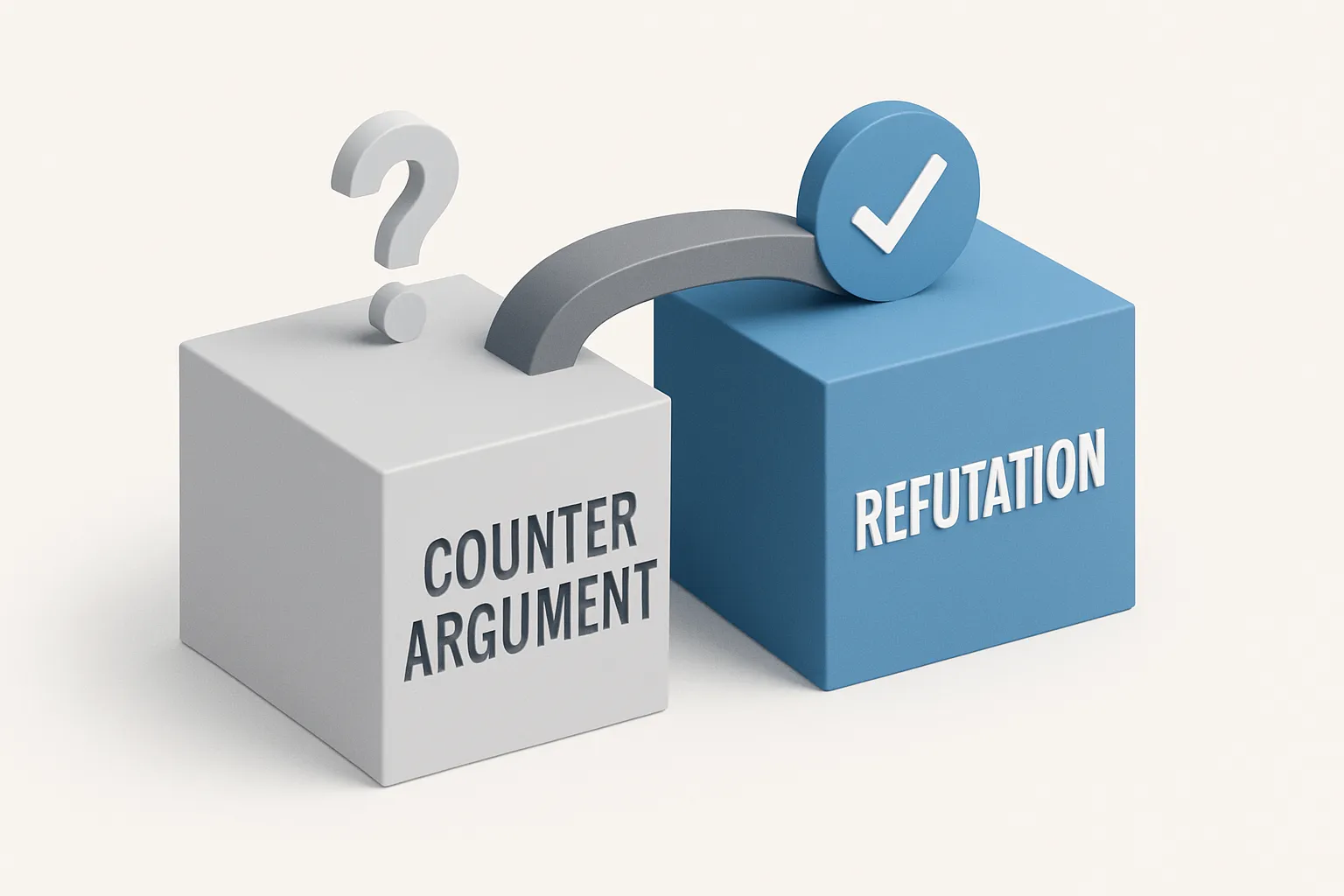
A counter-argument is typically built using two main parts:
The Counter Argument
This is where you clearly and objectively present a viewpoint that opposes your main argument. It is crucial to show that you understand this perspective, even if you do not agree with it.
- Goal: Introduce the opposing view fairly so that the reader/listener sees that you have considered different angles of the issue.
- How to express it: Commonly use phrases such as: Some people argue that…; It is often suggested that…; Critics may claim that…; While it is true that…; Opponents might believe that…
The Refutation
This is the core section where you debunk, clarify the shortcomings of, or minimize the impact of the counter-argument by providing your own persuasive reasoning and evidence.
- Goal: Prove why the opposing view is not entirely correct, is incomplete, or is less convincing than your own argument.
- How to express it: Commonly use phrases such as: However, this argument overlooks…; Nevertheless, this perspective fails to consider…; While this may seem reasonable, it is important to note that…; This view, however, is not without its flaws because…; In reality, this claim is undermined by…
Importance Beyond the IELTS Exam

While the counter-argument is an extremely useful technique highly valued in academic exams like IELTS Writing Task 2, its importance extends much further:
- Developing Critical Thinking
To provide an effective counter-argument, you must put yourself in someone else’s shoes and view the issue from multiple angles. This process forces you to analyze more deeply, find weaknesses in opposing arguments, and strengthen your own. This is the essence of critical thinking—the ability to analyze information objectively and form well-founded judgments.
- Increasing Persuasiveness and Credibility
When you proactively introduce and refute opposing views, you demonstrate that you have researched the issue thoroughly and are not just looking at it from one side. This builds trust and credibility, showing the reader/listener that you are knowledgeable and objective. Your writing becomes more nuanced, profound, and harder to challenge.
- Anticipation and Preparedness
In a real-world debate, anticipating potential counter-arguments from the other side helps you prepare your responses in advance. This turns a “confrontation” into a “prepared dialogue,” helping you maintain the upper hand.
- Improving and Strengthening Your Main Argument
The process of finding and refuting counter-arguments sometimes helps you identify holes in your own reasoning. This is an opportunity to adjust, add evidence, or clarify ideas, making your original argument more robust. Sometimes, the counter-argument itself acts as a catalyst for developing new and unique ideas.
- Demonstrating Respect and Objectivity
Acknowledging the existence of other viewpoints, even when you disagree, shows respect for the listener/reader and the topic at hand. This helps you avoid being perceived as stubborn, one-sided, or narrow-minded.
How to Use a Counter Argument Effectively?
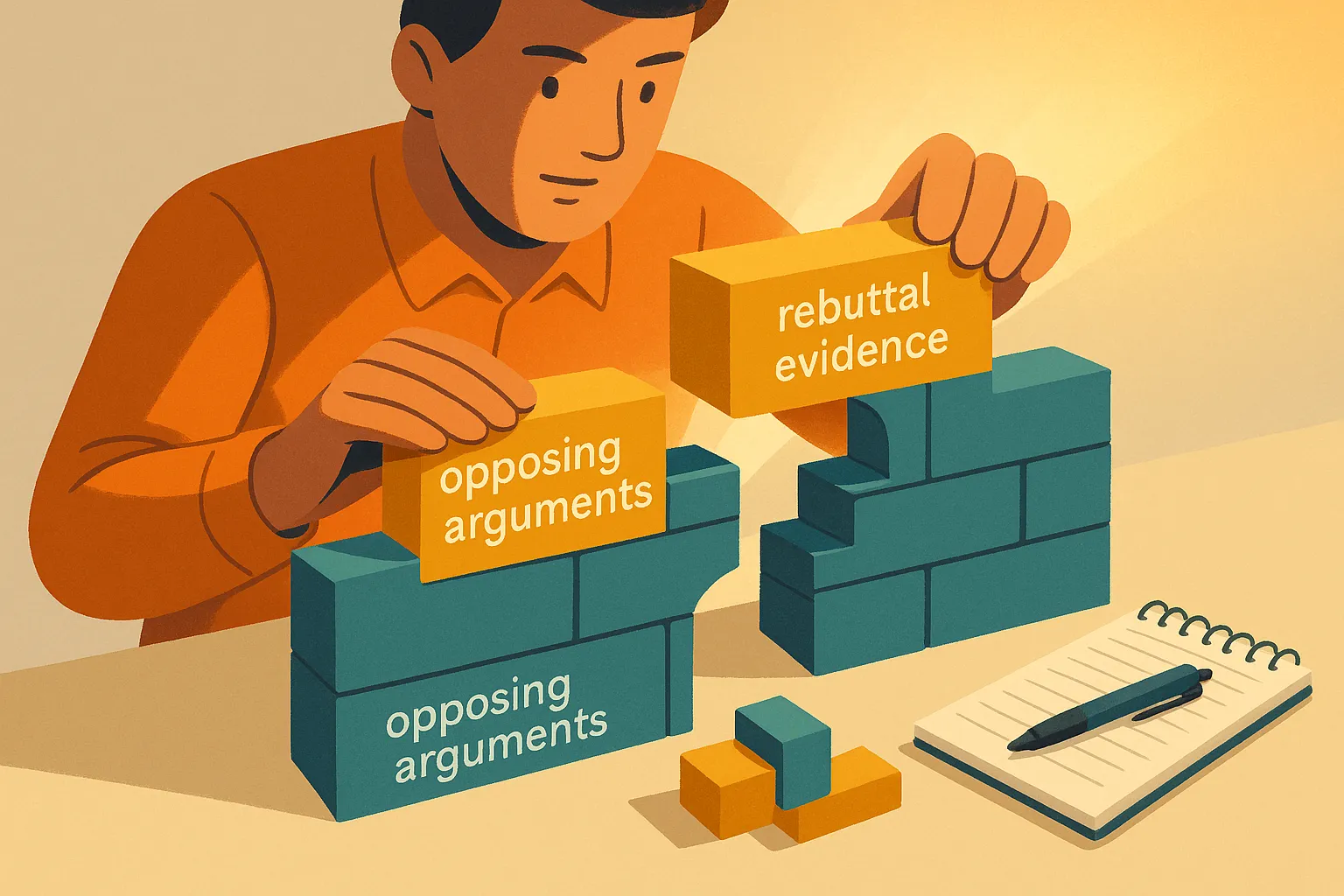
For a counter-argument to be truly effective, it is not just about placing it in the right spot; it requires finesse in how you execute it:
Research and Understand the Opposing View
Before you can refute a point, you need a deep understanding of it.
- Ask yourself: Why do others believe this? What is their evidence? Where are the strengths of that argument?
- Note: Avoid presenting a weak or easily dismissed counter-argument just to “check a box.” A strong, fairly presented counter-argument makes your own position look much more impressive when you successfully refute it.
Identify Gaps or Weaknesses
Once you understand the opposing view, find its weak points:
- Lack of evidence: Is the argument based on incomplete, outdated, or biased information?
- Flawed logic: Are there leaps in reasoning? Do the premises actually lead to the conclusion they claim?
- Narrow scope: Does the argument ignore other important aspects of the issue? Is it only true in specific cases rather than generally?
- Negative consequences: Even if the argument makes sense, does it lead to undesirable or worse outcomes?
Refute Directly and Specifically
Don’t just say “that view is wrong.” Point out exactly why it is wrong or unconvincing by providing your own evidence, examples, or logical explanations.
- Use data, statistics, and scientific research.
- Provide specific examples to illustrate your reasoning.
- Clearly explain cause-and-effect relationships.
Maintain Coherence and Flow
Ensure that the counter-argument and refutation are integrated smoothly into your writing. Use appropriate linking words and phrases to transition between ideas.
Stay Focused on Your Main Point
The purpose of a counter-argument is to reinforce your position, not to distract you or make you waver. After refuting the point, reconnect with your main argument and reaffirm its strength.
Common Mistakes to Avoid
Using a counter-argument incorrectly can undermine your writing. Here are some common mistakes to avoid:
- Not refuting strongly enough: Presenting a counter-argument without a clear refutation, or providing a weak, unconvincing rebuttal. This may lead readers to think the opposing view still holds weight.
- Going off-topic: Refuting something that is irrelevant or not central to the opposing argument.
- Ad Hominem attacks: Attacking the person making the argument rather than the argument itself. This is not only unethical but also damages your own credibility.
- Getting lost in an endless debate: Sometimes, focusing too deeply on a minor counter-argument can cause you to lose sight of the main point. Remember, the goal is to strengthen your argument, not to “defeat” every single opposing opinion.
- The “Straw Man” fallacy: Presenting a distorted or weak version of an opposing view to make it easier to refute. This is a logical fallacy and will reduce your persuasiveness.
Conclusion
A counter-argument is not just a writing technique or an academic exam requirement; it is an essential part of critical thinking and effective communication. Mastering how to build and use counter-arguments with finesse will help you:
- Present your views clearly, logically, and persuasively.
- Demonstrate a deep understanding of the issue and the ability to see multiple perspectives.
- Build credibility and trust in every conversation and debate.
Always remember that the goal of a counter-argument is not to “win” a debate at all costs, but to make your argument more robust, objective, and reliable in the eyes of others.
If you have any further questions or topics you’d like us to cover, don’t hesitate to reach out to ECE!




 Khai giảng Khóa học Hè cực HOT.
No comments yet!