


Tóm Tắt Nội Dung Bài Viết
IELTS Reading is often seen as the easiest section to score points, even a “lifesaver” to improve your overall score. However, for beginners, facing a wealth of academic knowledge and diverse question types can be quite challenging. But don’t worry too much! With effective learning methods from ECE and perseverance, you can absolutely master this skill and improve day by day.
This article is shared by Ms. Nguyen Hong Nhat. Ms. Hong Nhat is a full-time IELTS teacher at ECE, with an overall IELTS score of 8.0, including a perfect 9.0 in Reading.
IELTS Reading: Structure and Challenges for Beginners
To better understand this test section, let’s explore the test structure and common challenges you might encounter. This will help you prepare thoroughly and avoid common mistakes.
Structure of the IELTS Reading Test
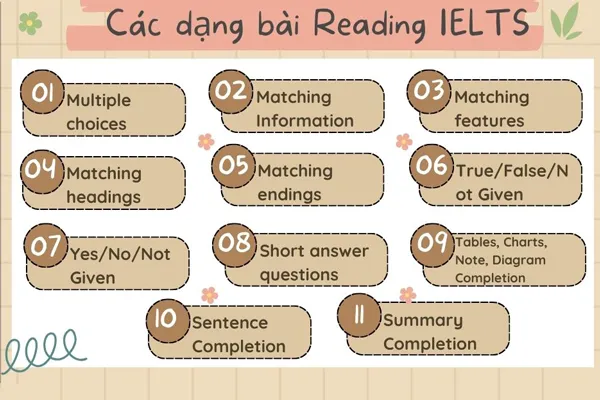
IELTS Reading is a test that assesses your ability to comprehend academic texts. The test lasts for 60 minutes and consists of 3 long passages, extracted from academic books, newspapers, and magazines. Candidates must answer 40 questions across various question types, specifically:
- Multiple Choice: Candidates select one or more correct answers from a list of options based on the passage content. This type tests the ability to understand details or the main idea of the text.
- Identifying Information (True/False/Not Given): Candidates determine whether the given information is true (True), false (False), or not mentioned (Not Given) in the passage. This type assesses the ability to identify specific information.
- Identifying Writer’s Views/ Claims (Yes/ No/ Not Given): Candidates determine whether the author’s views or claims are presented in the passage by choosing Yes, No, or Not Given. This type tests the ability to recognize the author’s perspective or opinion.
- Matching Information: Candidates find and match specific information (such as details, examples, reasons) with the corresponding parts of the passage. This type requires scanning skills to locate specific details.
- Matching Headings: Candidates select the most suitable heading for each paragraph from a given list. This type assesses the ability to identify the main idea of each paragraph.
- Matching Features: Candidates match a set of information or features with a list of options, such as matching inventions with their inventors. This type tests the ability to recognize relationships between pieces of information in the passage.
- Matching Sentence Endings: Candidates complete incomplete sentences by choosing the appropriate ending from a given list. This type assesses the ability to understand the main idea of the passage.
- Sentence Completion: Candidates fill in the missing word(s) or phrase(s) in sentences based on the passage content. This type tests the ability to find detailed information.
- Summary/Note/Table/Flow-chart Completion: Candidates fill in the missing word(s) or phrase(s) in a summary, note, table, or flowchart based on information from the passage. This type assesses the ability to understand details and the main idea of the passage.
- Diagram Label Completion: Candidates label parts of a diagram based on descriptions in the passage. This type tests the ability to connect descriptions with visuals.
- Short-Answer Questions: Candidates answer short questions using information from the passage. This type assesses the ability to find and understand detailed information.
Source: https://ielts.org/take-a-test/test-types/ielts-academic-test/ielts-academic-format-reading
Challenges for Beginners
With such a diverse range of question types, learners need not only to grasp the structure but also to become familiar with how to answer each type. This is particularly difficult for those who are just starting, as their reading comprehension skills may be limited and their test-taking speed not yet optimized.
Some common challenges include:
- Lengthy texts with dense information can be overwhelming and distracting, especially for those new to long reading passages.
- Limited academic vocabulary, making it difficult to understand the content of the passages.
- Grammar limitations, which make it hard for candidates to identify relationships between sentences or correctly understand complex sentence structures in the reading passages.
- Difficulty developing necessary reading skills, from general comprehension (skimming) to grasp the main idea, to in-depth reading (scanning) to find specific information or analyze deeper meanings of the text.
- Lack of time management skills, leading to an inability to complete all 40 questions within the 60-minute time limit.
Effective IELTS Reading Study Plan and Methods for Beginners
These difficulties are unavoidable at the beginning stage. However, each skill can be improved if you establish a reasonable study plan and flexible learning approach.
1. Extensive Reading
IELTS Reading passages can be up to 900 words long, covering challenging academic topics. The best way to face this challenge is to read extensively every day outside of IELTS practice materials.
You can start with accessible resources suitable for your initial level. Websites like BBC Learning English, Breaking News English, or blogs on topics you enjoy are ideal starting points.
If you prefer books, the Oxford Read & Discover series is a great suggestion. Although aimed at younger learners, it’s extremely useful for building vocabulary by topic. Once you’re comfortable, you can move on to reading newspapers like The Guardian, National Geographic,…
Start with 15-20 minutes each day to build a habit. Don’t try to read too much at once; focusing on quality and consistency will help you increase your stamina and ability to grasp information quickly.
2. Accumulate Vocabulary by Topic
A lack of academic vocabulary is why many candidates fail to understand the passage content or answer questions incorrectly. Therefore, you should build your vocabulary in real-world contexts with familiar IELTS Reading topics, such as:
- Science & Technology
- Education & Learning
- Culture & Society
- Environment & Nature
- History & Archaeology
- Economy & Business
- Health & Lifestyle
- Arts & Media
- Transport & Travel
- Natural Sciences
No need to look far; select vocabulary from familiar topics during your extensive reading and note it down in a notebook or online tool, categorized as follows:
- New words to record and their part of speech (noun, verb, adjective, etc.)
- Word structure (if applicable)
- Meaning in the context of the text being read
- Example sentence from the original text and a sentence you create yourself (translate if necessary)
Tip: Take notes in Vietnamese if needed, but ECE encourages you to add brief English definitions to get accustomed to using words in real contexts.
Example:
grapple (v) + with sth:
- to struggle with something, to try hard to find a solution to a difficult problem.
- to try hard to find a solution to a problem
Ex 1 (in the passage): Characters often grapple with questions of who they are and who they want to become.
➜ Characters often struggle with questions about their identity and who they aspire to become.
Ex 2 (self-created): The government has yet to grapple with the problem of air pollution.
➜ The government has yet to address the problem of air pollution.
Later, when practicing IELTS Reading tests, pay close attention to the vocabulary in both the questions and the passages. An effective way to memorize and recognize synonyms is to create a Paraphrase Table. This method will help you solve two problems simultaneously: expanding your vocabulary and improving your keyword scanning skills.
After underlining keywords in the question and finding the corresponding information in the passage, create a table with two columns:
| Keywords in questions
(Từ khóa trong câu hỏi) |
Similar words in the passage
(Từ đồng nghĩa trong bài đọc) |
|
| … | … |
Example: In Cambridge 10 Test 1 Reading Passage 1 “Stepwells”, question 6 has the following vocabulary:
| No. | Keywords in questions
(Từ khóa trong câu hỏi) |
Similar words in the passage
(Từ đồng nghĩa trong bài đọc) |
| 6 | provide shade | shelter from the relentless heat |
3. Practice Sentence Analysis
Complex grammar is a major obstacle when reading long academic texts. Sentences with multiple clauses, relative clauses, conditional sentences, or passive voice can easily lead to misinterpretation.
The solution is to spend time analyzing sentence structures in sample reading passages. Try breaking down sentences into smaller clauses and understanding the function of each part. This not only helps you understand correctly but also makes it easier to remember sentence structures.
4. Understand and Combine Various Reading Skills
In IELTS Reading, you need more than just skimming and scanning to quickly find information. These are foundational skills, but to understand deeply and answer accurately, you need to add advanced skills like predicting and critical reading.
Predicting helps you anticipate the content of a passage based on the title, images, or introductory sentences. This skill guides your reading and helps you focus. It’s particularly useful for question types like Matching Headings and Multiple Choice – when you need to grasp the overall meaning to select the correct answer or heading.
Critical reading is the skill that helps you analyze and evaluate the author’s viewpoint, especially for Identifying Writer’s Views/Claims (Yes/No/Not Given). Instead of just skimming, ask yourself: Is the author supporting or opposing this idea? Is this statement a fact or just a personal opinion? This skill helps you avoid traps and understand the deeper meaning of the text.
Finally, don’t just read a passage once. Go back to analyze and reflect after answering the questions; you’ll discover many interesting insights and significantly improve your reading skills.
5. Allocate Time Appropriately for Each Passage During Practice
60 minutes for 40 questions is a real challenge. New test-takers often make the mistake of reading too slowly or spending too much time on a single question, leading to incomplete answers.
To overcome this, practice with a timer, focusing on reading speed. Allocate specific time for each passage and monitor your time management with each practice session. Remember, not every question requires absolute accuracy – skip difficult ones and return later if time permits.
In summary, conquering IELTS Reading is not an insurmountable task if you have a correct and effective study plan. Hopefully, the insights shared by Ms. Nguyen Hong Nhat – an IELTS 8.0 teacher at ECE with extensive experience in IELTS Reading preparation and teaching – will provide you with a comprehensive overview and useful tips for effective IELTS Reading study.
If you are looking for a high-quality and reputable course, don’t hesitate to explore the IELTS courses at ECE Language Center. With a team of experienced and highly qualified teachers, along with advanced teaching methodologies, ECE is committed to accompanying you on your journey to conquer IELTS and achieve your desired results. Wishing you success!





 Khai giảng Khóa học Hè cực HOT.
No comments yet!