


Tóm Tắt Nội Dung Bài Viết
IELTS 5.0 is one of the most common goals for beginners or those currently building their English foundation. This band score marks a significant step up from lower levels and opens many doors in both academics and career development. So, what does an IELTS 5.0 actually mean, what benefits does it bring, and how can you achieve it? This article from ECE provides a comprehensive overview.
1. What is IELTS 5.0? What is the Equivalent Proficiency Level?
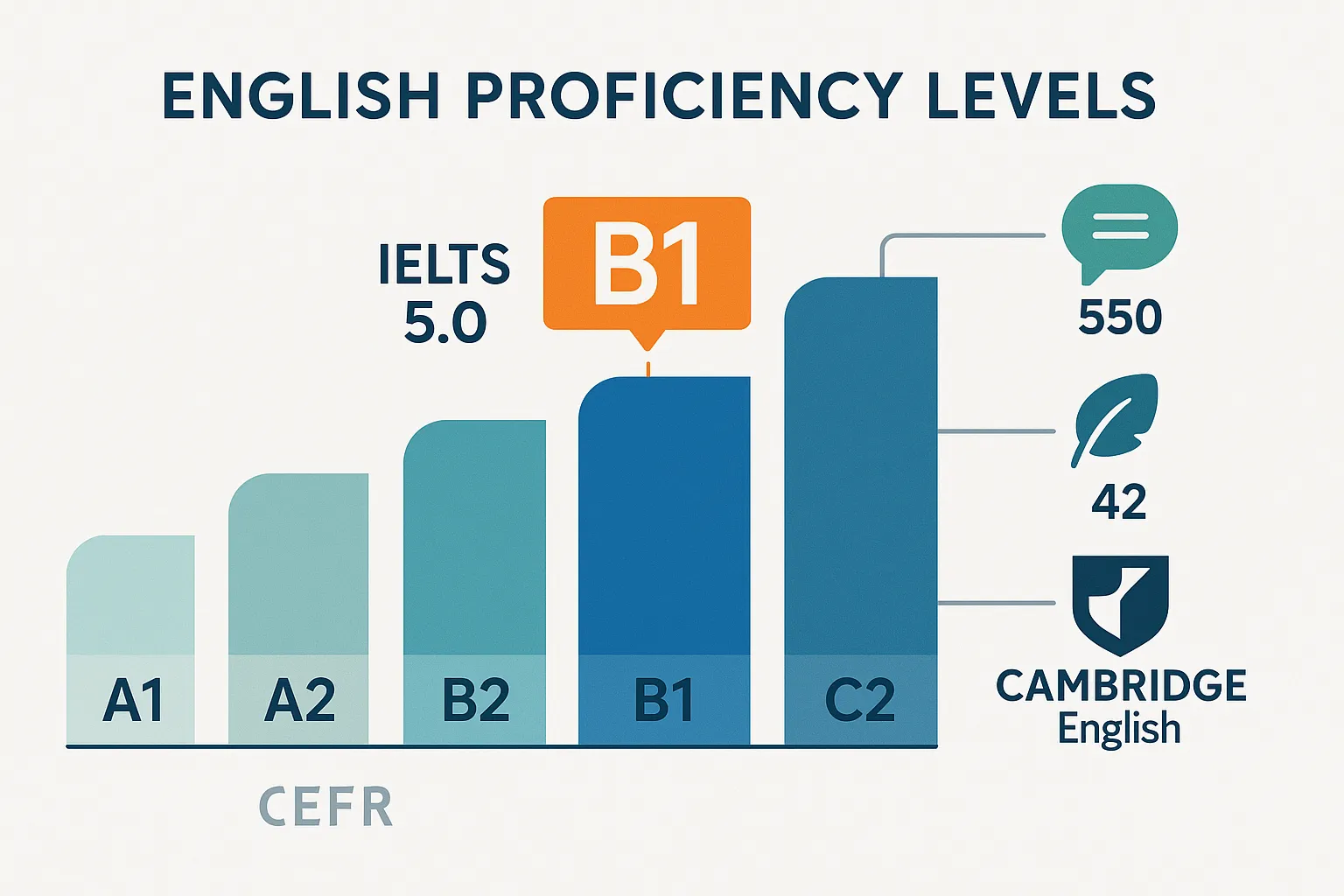
On the IELTS scale of 1.0 to 9.0, a band 5.0 is considered Intermediate. It is a key milestone, indicating that you can use English independently at a basic level across a variety of familiar situations.
According to the Common European Framework of Reference for Languages (CEFR), IELTS 5.0 is equivalent to a B1 level.
When converted to other international certifications, IELTS 5.0 is roughly equivalent to:
- TOEIC: Approximately 365 – 500 points (Note: Various sources provide different conversion ranges, from 365-440, 450-500, to 500-550. These conversions are only relative references between tests with different structures and assessment purposes).
- TOEFL iBT: Approximately 32 – 64 points.
- TOEFL Paper-based (PBT): Approximately 477 – 510 points.
- TOEFL Computer-based (CBT): Approximately 153 – 180 points.
- Cambridge English: Equivalent to the PET (Preliminary English Test).
- PTE (Pearson): Approximately 30 – 36 points.
An IELTS 5.0 holder is capable of:
- Communicating relatively fluently in familiar situations, expressing main ideas clearly despite occasional errors or the need for self-correction.
- Understanding main ideas and key details in slightly longer, more complex spoken or written texts, especially within their own field of expertise.
- Using a broader range of vocabulary and grammar than lower bands, though still limited when discussing abstract or complex topics.
- Writing relatively well-structured paragraphs that convey ideas with some cohesion, even if the writing is not yet perfect or contains errors.
In short, a 5.0 indicates that you can use English effectively in many daily situations and familiar topics.
Related article: When should you start learning IELTS?
2. Is Band 5.0 Hard to Achieve? Who Can Self-Study Effectively?
IELTS 5.0 is considered a very achievable goal and not overly difficult, especially for those who already have a basic grasp of English. It is often the “first milestone” that many IELTS learners aim for.
The difficulty level depends on:
- Starting level: If you are starting from scratch, the journey will require more time and perseverance. If you already have an intermediate foundation, reaching 5.0 will be easier.
- Study method: A clear roadmap, suitable materials, and effective study techniques (e.g., focusing on core skills, regular practice) will help you progress faster.
- Study intensity: Consistent daily practice (e.g., 1-2 hours/day) is a key factor.
Regarding effective self-study at home:
Those who already have a certain foundation in English (around A2 level or higher) can definitely self-study to reach 5.0 if they have:
- Accurate self-assessment: A clear understanding of their own strengths and weaknesses.
- Personalized study roadmap: The ability to build or find a suitable plan and stick to it.
- Discipline and perseverance: Self-motivation to study consistently without giving up.
However, if you are starting from absolute zero, self-study can be challenging. In this case, seeking guidance from a teacher or joining a course at a center can help you save time and ensure better results.
3. How Long Does It Take to Reach IELTS 5.0 from Scratch?

The time required to go from zero to IELTS 5.0 depends on many personal factors such as your starting level, study intensity, and methodology. Below is an estimated timeline based on the roadmap shared in our internal ECE materials:
- Phase 1: Reaching band 3.0 (from scratch)
- Study time: 3 months
- Estimated total study hours: 48 hours
- Focus on building a foundation of vocabulary, basic grammar, simple listening/reading practice, and pronunciation.
- Phase 2: Reaching band 4.0 (from band 3.0)
- Study time: 9 weeks (about 2+ months)
- Estimated total study hours: 45 hours
- Continue expanding vocabulary, grammar (learning compound sentences), listening/reading with longer and more complex texts, and improving pronunciation.
- Phase 3: Reaching band 5.0 (from band 4.0)
- Study time: 10 weeks (about 2.5 months)
- Estimated total study hours: 60 hours
- Expand vocabulary through dictation/paraphrasing, get familiar with IELTS Listening/Reading/Speaking/Writing formats (easy level), and intensive pronunciation practice via shadowing.
In total, to go from scratch to IELTS 5.0 following this roadmap, you will need approximately 7.5 to 8 months with a total of about 153 study hours.
Note that this is an estimate based on a specific roadmap. Other sources may provide different time estimates (e.g., some suggest 2-4 months if you already have a foundation, or 6 months to 1 year if you are starting from scratch). The most important factors are perseverance and sticking to your planned roadmap.
For more information on our roadmap and IELTS course fees for 4.0 – 5.0 at ECE, please feel free to reach out.
4. What Are the Benefits of Reaching IELTS 5.0?
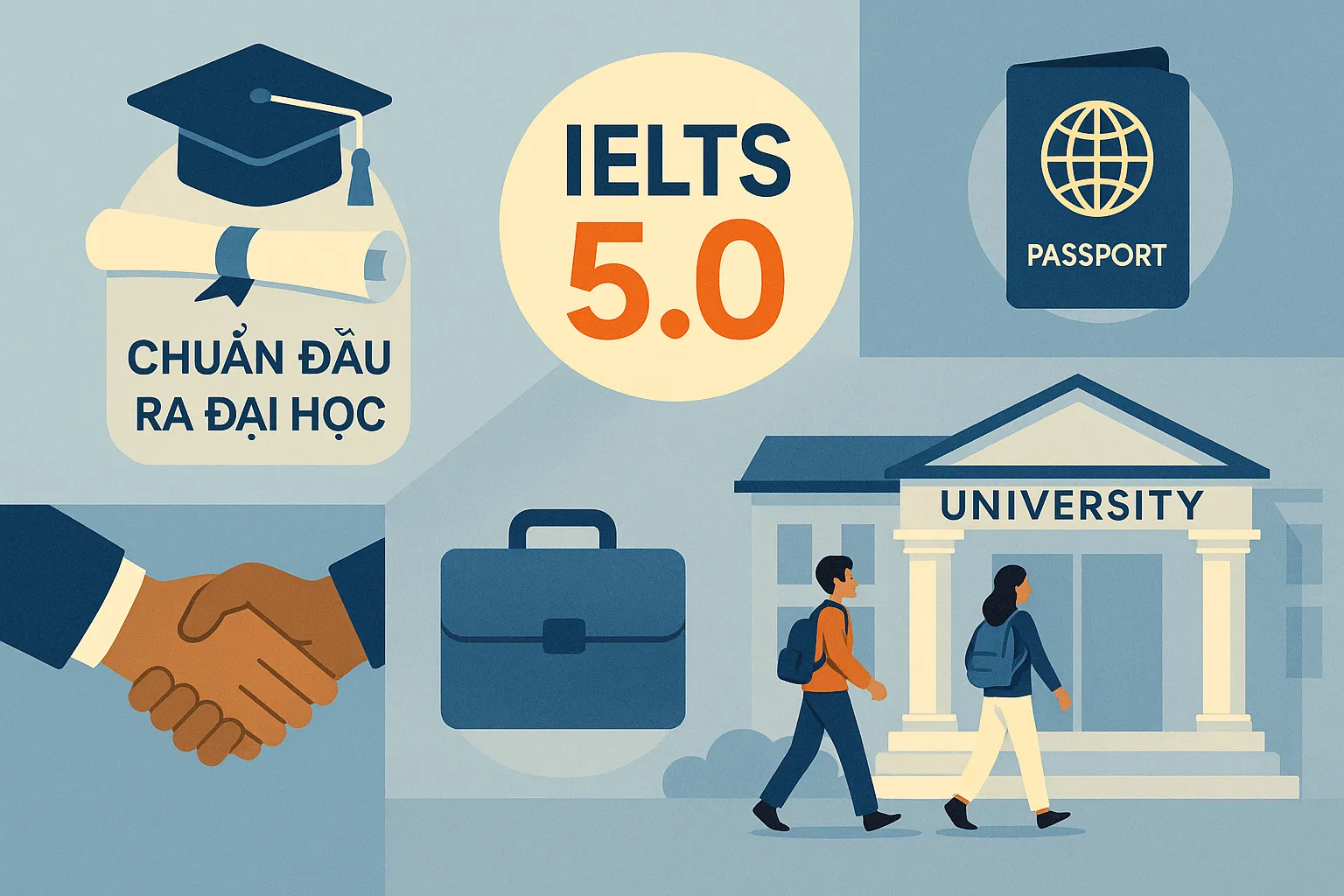
Holding an IELTS 5.0 certificate opens up significant opportunities in both education and your career:
- High School Graduation English Exam Exemption: According to Ministry of Education and Training regulations, candidates with an IELTS score of 4.0 or higher are exempt from the English portion of the National High School Graduation Exam and are awarded a perfect 10 score.
- University Admission Opportunities (Combined): Many universities in Vietnam prioritize admission or offer combined admission using IELTS scores (usually 5.0+) alongside high school exam results or academic transcripts. This is a major advantage that increases your chances of getting into your desired school and major, including some top-tier universities.
- Study Abroad Eligibility (Minimum): An IELTS band 5.0 is often considered the minimum score required to qualify for a student visa and admission into certain programs/courses at colleges, high schools, or English foundation courses in some English-speaking countries (e.g., some high schools in the US, certain schools in Switzerland). However, note that 5.0 is usually not enough for direct entry into most mainstream undergraduate programs, especially at reputable universities in the UK, US, Australia, or Canada. These programs typically require 6.0-6.5 or higher.
- Meeting University English Exit Requirements: Many universities in Vietnam require students to meet an English exit standard equivalent to IELTS 5.0 (or TOEIC 450-500) to graduate. Achieving 5.0 early helps reduce the pressure of studying English during your university years.
- Expanded Job Opportunities: With IELTS 5.0, you can impress employers for positions that do not require advanced English or full-time communication. Strong English skills can help you stand out on your CV, provide an advantage when applying for internships in professional environments, and may even lead to salaries 18-22% higher than candidates with only technical expertise.
- A Solid Stepping Stone for Higher Goals: Reaching 5.0 proves you have a firm foundation and are ready to conquer higher bands like 5.5, 6.0, or 6.5 to serve your goals of studying abroad or working at multinational corporations.
5. Specific Criteria to Reach Band 5.0 for Each Skill
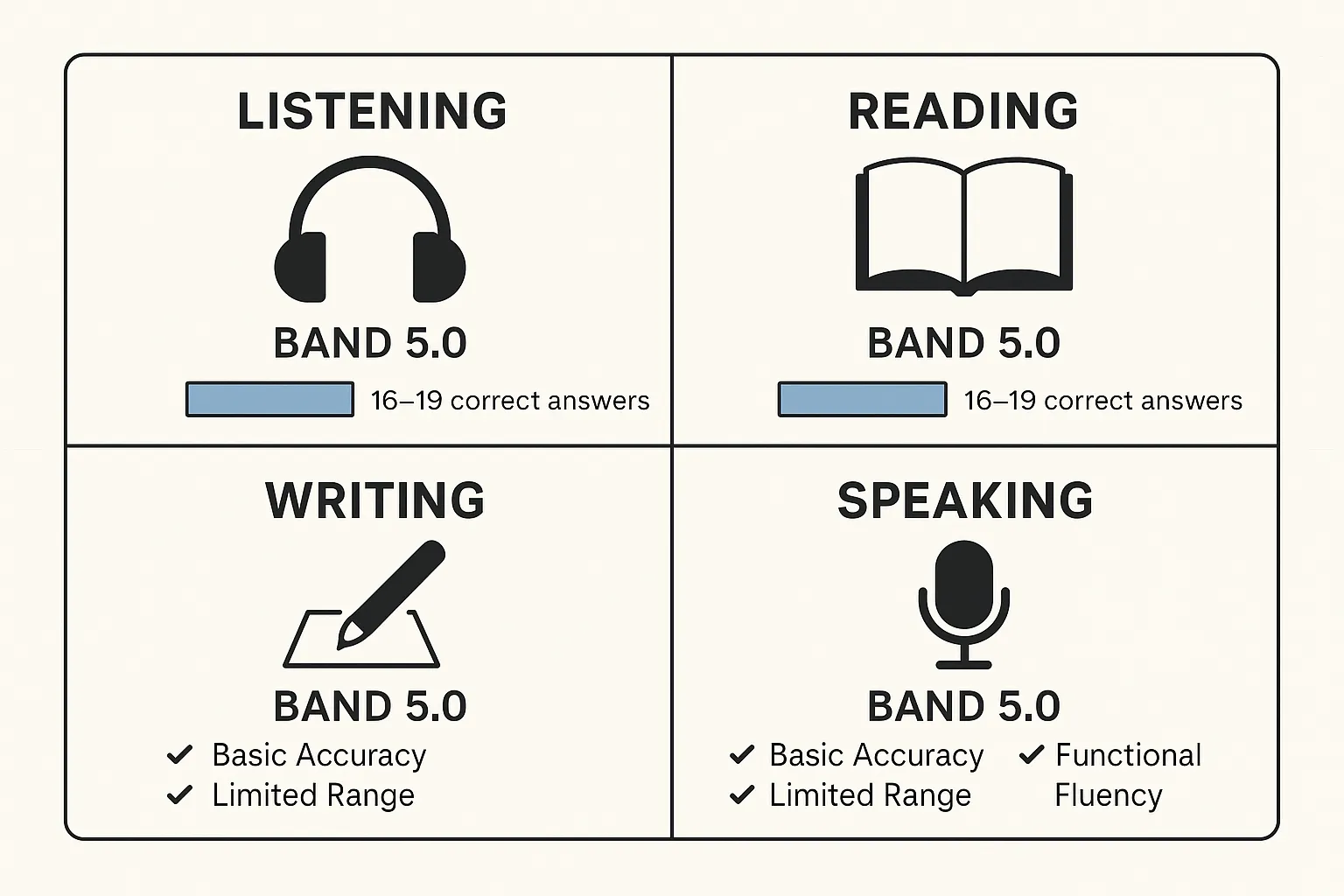
To achieve an Overall 5.0, the average of your 4 skills must reach this level. Below are the specific requirements for each skill at band 5.0 (sub-criteria are usually graded in whole numbers, so an average of 5.0 can be formed from 5.0 and 4.0 scores):
- Listening: You need to answer 16-19/40 questions correctly. At this level, you can listen and quickly grasp the main content and key details in listening tasks with familiar topics. Focusing on performing well in the first two parts of the Listening test (the first 20 questions) is crucial to achieving this band.
- Reading: You need to answer 16-19/40 questions correctly. (Applies to both Academic & General Training). At band 5.0 Reading, you can read and understand the overall meaning of texts, grasp main information and some details, despite still making errors. You need to master common reading question types (True/False/Not Given, Matching Headings, Multiple Choice…).
- Speaking: Assessed based on 4 criteria. To reach 5.0 Speaking:
- Fluency & Coherence: You can provide relatively coherent answers, but may occasionally repeat yourself, stumble, or slow down when searching for words/structures. You can maintain a steady speaking pace on familiar topics.
- Lexical Resource: You have enough vocabulary for familiar topics and attempt to expand on ideas, but accuracy or depth is lacking. Paraphrasing ability is limited.
- Grammatical Range & Accuracy: You use basic grammatical structures well, but struggle with complex sentences and make common errors that affect clarity.
- Pronunciation: Your pronunciation is clear enough to convey meaning, but errors in stress, word endings, or intonation sometimes cause confusion.
- Writing: Assessed based on 4 criteria. To reach 5.0 Writing:
- Task Achievement/Response: You can present an overview and main features in Task 1, or provide a viewpoint and basic ideas in Task 2, but it is not entirely clear or lacks important details.
- Coherence & Cohesion: You have a relative structure, but ideas or information are not entirely coherent and may lack links between sentences and paragraphs. Use of linking words is limited or contains errors.
- Lexical Resource: Vocabulary is limited, with frequent repetition, spelling errors, or word formation issues that make it difficult to read.
- Grammatical Range & Accuracy: You use basic grammatical structures well, but are limited when applying complex structures and make basic grammar errors that affect readability.
6. Common Challenges When Aiming for Band 5.0
To reach band 5.0, learners often face the following difficulties:
- Weak foundational knowledge: Despite having some knowledge, grammar (more complex tenses, clauses, conditionals) and academic vocabulary remain weak.
- Lack of variety in expression: Difficulty in expanding ideas, leading to repetitive vocabulary and grammatical structures.
- Limited ability to link ideas: Speaking/writing may lack coherence due to not knowing how to use linking words or pronouns flexibly.
- Inaccurate and unnatural pronunciation: Errors in stress, intonation, and word endings occur frequently, reducing communication effectiveness.
- Lack of deep familiarity with test formats: Even if you know the structure, applying test-taking techniques (skimming, scanning, note-taking…) for more complex tasks remains confusing.
7. Roadmap & Effective Study Tips to Reach IELTS 5.0

To conquer band 5.0, you need a detailed study plan, perseverance, and effective methods:
- Assess Level & Plan: Always start by taking a placement test to identify your exact starting point. Then, build a study roadmap (about 7.5-8 months if starting from zero, or 2-4 months if you have a foundation) with specific goals for each phase (e.g., building foundation, getting familiar with the test, intensive practice).
- Consolidate & Expand Foundation:
- Grammar: Master and use English tenses fluently. Start practicing more complex structures like passive voice, conditionals, and simple relative clauses.
- Vocabulary: Expand your vocabulary across more diverse topics (education, environment, health, technology…). Learn collocations to use language more naturally.
- Pronunciation: Continue practicing standard vowels and consonants, paying special attention to word endings, word stress, and sentence intonation to make your speech clearer and more natural. Practice using the shadowing method.
- Get Familiar & Practice Skills Intensively:
- Listening/Reading: Focus on mastering common question types in Listening Parts 1 & 2 and basic Academic/General Training Reading tasks. Improve your ability to listen/read and understand longer, more complex passages. Focus on reviewing your work, analyzing errors, and understanding the “why” behind them.
- Writing: Master the structure of Task 1 and Task 2. Practice writing slightly more complex sentences, using a variety of tenses and linking words. Focus on fully answering the prompt and presenting ideas logically. Ensure correct spelling and basic grammar.
- Speaking: Practice answering Part 1 and Part 2 questions more confidently and fluently, trying to expand your ideas. Start trying Part 3 on familiar topics. Practice using linking words and basic grammatical structures naturally.
- Use Suitable Materials: Choose study books for the Intermediate level (e.g., Destination B2, Cambridge IELTS 1-6, Complete IELTS Band 5-6.5). Utilize reputable online sources, articles, and English podcasts to stay exposed to the language regularly.
- Practice Regularly & Seek Feedback: Dedicate daily time to all 4 skills. Regularly take mock tests, record your speaking, write essays, and ask experienced people to correct your errors for rapid improvement.
Conclusion
IELTS 5.0 is a very important band score, representing significant progress in using English at an intermediate level. This band is not only an achievable goal for many but also opens up numerous opportunities for education (high school exam exemption, university admission, university exit requirements) and employment. While 5.0 may be the minimum for some study abroad programs, it is a solid stepping stone and a fantastic foundation for you to continue developing and conquering higher band scores in the future.




 Khai giảng Khóa học Hè cực HOT.
No comments yet!