


Tóm Tắt Nội Dung Bài Viết
In IELTS Writing Task 2, the “Discuss Both Views” essay type (often referred to in full as “Discuss Both Views and Give Your Opinion”) is one of the most common and challenging formats. This task requires candidates not only to analyze and discuss two opposing viewpoints on a specific issue but also to provide their own personal opinion.
To achieve a high score, candidates must demonstrate logical reasoning, deep analysis, and a clear stance. In this article, the ECE language center provides a comprehensive overview of the “Discuss Both Views” essay type, covering its definition, how to identify it, essay structure, effective development strategies, common pitfalls, and a sample essay for reference.
1. Understanding the “Discuss Both Views and Give Your Opinion” Essay Type in IELTS Writing Task 2
1.1. Definition
The “Discuss Both Views” essay type (or “Discuss Both Views and Give Your Opinion”) requires candidates to present and analyze two conflicting opinions on a social, economic, or educational issue. Afterward, candidates must state their personal stance on the matter, either by supporting one of the two views or by offering a balanced perspective.
Example:
Some people believe that it is best to accept a bad situation, such as an unsatisfactory job or shortage of money. Others argue that it is better to try and improve such situations.
Discuss both these views and give your own opinion.
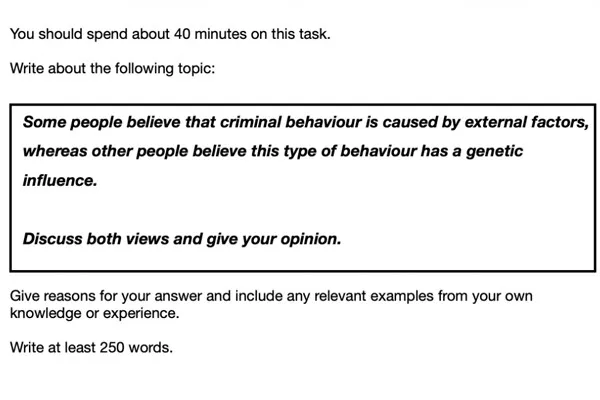
This essay type often features specific identifying phrases in the prompt, such as:
- Discuss both views and give your own opinion.
- Discuss both these views and give your opinion.
- Discuss both sides of this argument and then give your own opinion.
- Discuss these viewpoints and give your own opinion.
- Discuss the advantages and disadvantages and give your own opinion. (Sometimes, this type also asks you to discuss advantages and disadvantages, which essentially represent two sides of an issue.)
Note:
- The prompt may not use these exact phrases but still requires you to discuss two viewpoints and provide your own opinion. Read the prompt carefully to identify the requirements correctly.
- Sometimes the prompt may be phrased differently, for example: “What are the advantages and disadvantages of…?” or “To what extent do you agree or disagree?”. However, if the prompt mentions two conflicting viewpoints, you still need to apply the structure and development method for the “Discuss Both Views” essay type.
Related article: IELTS Writing Band 9: Secrets to Achieving the Maximum Score
2. Structure and Development Strategy for High-Scoring “Discuss Both Views” Essays
To achieve a high score in a “Discuss Both Views” essay, you need a clear, logical structure and a persuasive way to develop your ideas. Below is the structure and step-by-step guidance for each part of the essay:
2.1. Essay Structure
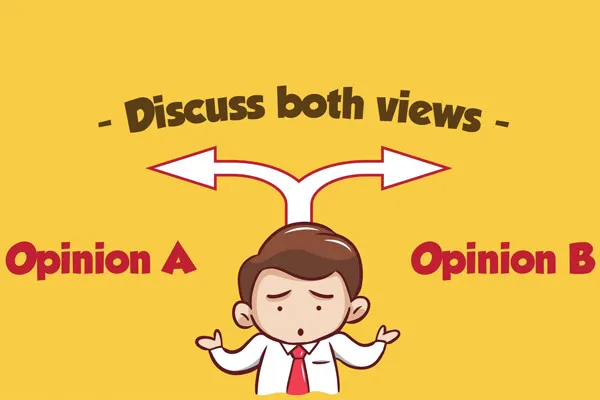
A “Discuss Both Views” essay typically consists of 4 main parts:
- Introduction: Introduce the topic and clearly state the two opposing views. Briefly state your personal opinion.
- Body Paragraph 1: Analyze and discuss the first viewpoint.
- Body Paragraph 2: Analyze and discuss the second viewpoint.
- Conclusion: Summarize both viewpoints and reaffirm your personal opinion.
2.2. Detailed Development for Each Section
2.2.1. Introduction
Your introduction needs to accomplish two main tasks: introduce the topic and clearly state the two opposing views to be discussed. At the same time, you must show the examiner that you will provide your personal opinion in the essay.
Step 1: Paraphrase the prompt (General Statement): Use synonyms and different sentence structures to rephrase the topic. Avoid copying the prompt word-for-word.
For example, with the prompt: “Some people believe that it is best to accept a bad situation, such as an unsatisfactory job or shortage of money. Others argue that it is better to try and improve such situations.”
You can paraphrase it as: “There is a debate about whether individuals should passively endure difficult circumstances, like unfulfilling employment or financial hardship, or actively seek to change them.”
Step 2: Introduce the two opposing views (Thesis Statement): Briefly state the two opposing views mentioned in the prompt. You can use sentence structures such as:
- “While some people believe that…, others argue that…”
- “On the one hand, some people think that… On the other hand, others maintain that…”
- “There are those who believe that…; however, others contend that…”
Example: “While some people believe that accepting unfavorable situations is the best course of action, others argue that striving for improvement is a more desirable approach. In my opinion, I believe that…”
Step 3: State your personal opinion (Outline Statement): Briefly state the opinion you will support, whether you favor one of the two views or offer a neutral stance.
Example: “This essay will discuss both perspectives before presenting my personal viewpoint, which leans towards the importance of actively seeking to improve one’s circumstances.”
Complete sample introduction:
“There is a debate about whether individuals should passively endure difficult circumstances, like unfulfilling employment or financial hardship, or actively seek to change them. While some people believe that accepting unfavorable situations is the best course of action, others argue that striving for improvement is a more desirable approach. This essay will discuss both perspectives before presenting my personal viewpoint, which leans towards the importance of actively seeking to improve one’s circumstances.”
2.2.2. Body Paragraph 1: Analyzing the first viewpoint
Step 1: Topic Sentence: Introduce the first viewpoint to be analyzed in this paragraph.
You should use transition phrases such as:
- “Firstly,…”
- “To begin with,…”
- “On the one hand,…”
- “One argument in favor of… is that…”
Example: “On the one hand, proponents of accepting difficult situations often argue that…”
Step 2: Explanation: Clearly explain what this viewpoint is and why some people support it. This step requires delving into the logic behind the viewpoint.
Step 3: Examples/Evidence: Provide specific examples or real-world evidence to illustrate and support the viewpoint being discussed. You can use statistics, research results, or real-life scenarios.
Example: “For instance, individuals facing financial hardship might choose to accept their situation due to a lack of immediate opportunities for improvement, believing that enduring the hardship is preferable to taking on risky ventures.”
Step 4: Mini-conclusion: Summarize the main point of the paragraph and reaffirm the viewpoint being discussed.
Example: “Therefore, the belief in accepting unfavorable situations stems from a pragmatic approach to dealing with challenges that may seem insurmountable in the short term.”
2.2.3. Body Paragraph 2: Analyzing the second viewpoint
Step 1: Topic Sentence: Introduce the second viewpoint (opposing the one in the first body paragraph) to be analyzed here.
Use transition phrases such as:
- “Secondly,…”
- “On the other hand,…”
- “However,…”
- “Conversely,…”
- “Another perspective is that…”
Example: “On the other hand, there are strong arguments in favor of actively trying to improve one’s circumstances.”
Step 2: Explanation: Clearly explain what this viewpoint is and why some people support it. You need to analyze the logic and basis of the opposing view.
Step 3: Examples/Evidence: Provide specific examples or real-world evidence to illustrate and support the viewpoint being discussed.
Example: “For example, pursuing further education or acquiring new skills can open doors to better job opportunities, ultimately leading to a more fulfilling career and improved financial stability.”
Step 4: Mini-conclusion: Summarize the main point of the paragraph and reaffirm the viewpoint being discussed.
Example: “Thus, the motivation to actively improve one’s situation is often driven by the desire for personal growth, long-term well-being, and the belief in one’s ability to shape their own destiny.”
2.2.4. Conclusion
Step 1: Summary of both views: Briefly restate the two viewpoints analyzed in the body paragraphs. You can use sentence structures such as:
- “In conclusion, while some people believe that…, others argue that…”
- “To sum up, there are differing views on whether…”
Example: “In conclusion, while some individuals advocate for accepting challenging situations as they are, others strongly believe in the importance of striving for improvement.”
Step 2: Restate your opinion: Clearly and decisively state your personal opinion on the issue. Use sentence structures such as:
- “In my opinion,…”
- “I believe that…”
- “I am convinced that…”
- “From my perspective,…”
Example: “In my opinion, while there may be limited circumstances where acceptance is necessary, actively seeking to improve one’s situation is generally the more empowering and ultimately rewarding path.”
Complete sample conclusion:
“In conclusion, while some individuals advocate for accepting challenging situations as they are, others strongly believe in the importance of striving for improvement. In my opinion, while there may be limited circumstances where acceptance is necessary, actively seeking to improve one’s situation is generally the more empowering and ultimately rewarding path.”
>>> See also: How to write an Agree or Disagree essay for Writing Task 2
3. Common Pitfalls for Candidates in “Discuss Both Views” Essays
ECE helps you summarize the most common mistakes in this essay type:
- Failing to provide a personal opinion: This is the most serious error. Many candidates focus only on discussing the two views and forget the “give your own opinion” requirement.
- Lack of balance: Candidates often spend too much time and argument on the view they agree with, leading to a superficial and unconvincing analysis of the other view.
- Lack of logic and evidence: The essay lacks specific examples or credible evidence to illustrate points, making it sound generic and unpersuasive.
- Inappropriate vocabulary and sentence structure: Using academic vocabulary incorrectly, repetition, grammatical errors, or overly complex but unclear sentence structures.
- Lack of cohesion: Missing transition words or phrases makes the essay disjointed and difficult to follow.
- Unclear personal opinion: The personal opinion is weak and not sufficiently emphasized or developed throughout the essay.
- Off-topic: Failing to stick to the prompt’s requirements and analyzing irrelevant aspects.
Related article: What is Paraphrasing?
4. “Discuss Both Views and Give Your Opinion” Sample
Prompt: Some people think that parents should teach children how to be good members of society. Others, however, believe that school is the best place to learn this.
Discuss both these views and give your own opinion.
Prompt Analysis:
- Topic: The responsibility of educating children to become good citizens.
- Two opposing views:
- View 1: Parents should teach children how to be good citizens.
- View 2: School is the best place to learn this.
- Requirement: Discuss both views and provide your personal opinion.
Suggested Approach:
- Body Paragraph 1: Analyze the view that parents should teach children.
- Reason: Parents are the closest figures with the greatest influence; they can instill morals and behavior early on.
- Example: Teaching children to respect elders, help others, follow traffic rules, etc.
- Body Paragraph 2: Analyze the view that school is the best place.
- Reason: Schools have structured curricula, professionally trained teachers; the learning environment helps children interact socially and learn teamwork.
- Example: Civics classes, extracurricular activities, group projects, etc.
- Personal Opinion: Both parents and schools play important roles; a combined approach is necessary.
Sample Answer:
The question of who should bear the primary responsibility for shaping children into responsible members of society is a subject of ongoing debate. While some people believe that this duty falls squarely on the shoulders of parents, others maintain that schools provide the most suitable environment for such learning. This essay will examine both perspectives before presenting my personal viewpoint, which emphasizes the importance of a collaborative approach between home and school.
On the one hand, proponents of parental responsibility often highlight the profound and lasting influence parents have on their children’s development. From a very young age, children learn by observing and imitating their parents’ behaviors and attitudes. Parents are in a unique position to instill fundamental values such as honesty, respect, and empathy through daily interactions and by setting a positive example. For instance, parents can teach their children the importance of respecting elders by demonstrating respectful behavior themselves, or they can encourage kindness by involving their children in acts of helping others, such as volunteering at a local charity. Moreover, parents can address specific behavioral issues and provide tailored guidance in a way that schools, with their larger student bodies, often cannot. Therefore, the argument for parental responsibility rests on the close, personal bond between parent and child and the continuous learning opportunities that arise within the family context.
On the other hand, those who advocate for schools as the primary educators of social responsibility point to the structured and comprehensive nature of formal education. Schools are designed to provide children with a broad understanding of the world, including social norms, civic duties, and the importance of following rules and regulations. Through subjects like civics and social studies, students learn about their rights and responsibilities as citizens. Furthermore, schools offer a diverse social environment where children interact with peers from various backgrounds, fostering tolerance, cooperation, and conflict-resolution skills. Group projects, extracurricular activities, and school-wide initiatives, for example, provide opportunities for students to practice teamwork, leadership, and community engagement. Consequently, schools are seen as vital institutions for equipping children with the knowledge and social skills necessary to function effectively in society.
In conclusion, while the influence of parents in shaping a child’s character and values is undeniable, schools also play a crucial role in providing a structured and comprehensive education on social responsibility. In my view, the most effective approach involves a partnership between parents and schools, where both contribute to a child’s development. Parents can lay the foundation for good character, while schools can reinforce and expand upon these values through formal education and social interaction. This collaborative model ensures that children receive a well-rounded upbringing, preparing them to become responsible and contributing members of society.
Useful vocabulary used in the sample:
- bear the primary responsibility: to take on the main duty
- ongoing debate: a continuing discussion
- falls squarely on the shoulders of: the responsibility lies entirely with
- profound and lasting influence: deep and enduring impact
- instill fundamental values: to teach basic principles
- tailored guidance: customized or specific advice
- civic duties: responsibilities as a citizen
- fostering tolerance, cooperation, and conflict-resolution skills: encouraging patience, teamwork, and problem-solving
- community engagement: participating in society
- vital institutions: essential organizations
- equipping children with…: providing children with…
- function effectively in society: to operate well in society
- undeniable: cannot be disputed
- crucial role: very important part
- a collaborative approach: a cooperative method
- lay the foundation for: to establish the basis for
- reinforce and expand upon: to strengthen and build on
- well-rounded upbringing: comprehensive education and care
- contributing members of society: people who add value to society
Sample Analysis:
- Introduction: Clearly introduces the topic, paraphrases the prompt, and states both opposing views. The personal opinion is hinted at through the phrase “which emphasizes the importance of a collaborative approach between home and school.”
- Body Paragraph 1: Analyzes the “parents have primary responsibility” view with a clear topic sentence, explanation, and specific examples.
- Body Paragraph 2: Analyzes the “school is the best place” view with a clear topic sentence, explanation, and specific examples.
- Conclusion: Summarizes both views and clearly reaffirms the personal opinion.
- Vocabulary and Grammar: Uses academic vocabulary, correct grammar, and varied sentence structures.
- Cohesion: Uses transition words and phrases effectively to create a smooth flow (On the one hand, For instance, Moreover, On the other hand, Furthermore, Consequently, In conclusion, In my view).
To master the “Discuss Both Views” essay type, you need to practice regularly with various prompts. Study high-scoring samples, analyze their structure, idea development, vocabulary, and grammar. Apply these insights to your own writing.
5. Conclusion
The “Discuss Both Views” essay type in IELTS Writing Task 2 is relatively difficult, requiring candidates to have strong analytical, reasoning, and presentation skills. We hope this article has provided you with the necessary knowledge to conquer this essay type, from understanding its definition and identification to structure, development, common pitfalls, and sample references.
Practice regularly, improve your vocabulary and grammar, and seek feedback from teachers to enhance your writing skills. Good luck with your IELTS exam!
See more details here about IELTS courses at ECE language center




 Khai giảng Khóa học Hè cực HOT.
No comments yet!