


Tóm Tắt Nội Dung Bài Viết
Entertainment is one of the most popular and versatile topics in IELTS Writing Task 2. It is rarely limited to entertainment in a vacuum; it is frequently intertwined with other fields such as technology, education, sociology, economics, and media. This article from ECE provides an overview of the Entertainment topic, common question types, core ideas, and illustrative examples to help you confidently tackle any IELTS Writing Task 2 prompt.
This article has been professionally reviewed by Ms. Nguyen Hong Nhat, an 8.0 IELTS instructor at ECE.
Overview of the Entertainment Topic in IELTS Writing Task 2
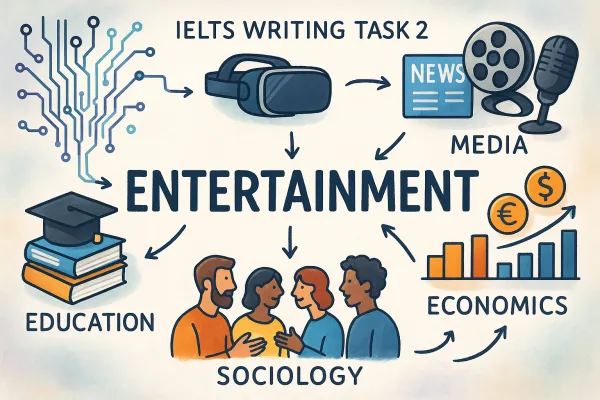
To achieve a high score in IELTS Writing Task 2, it is crucial to understand the various dimensions of the topic. For the Entertainment theme, you may encounter questions revolving around the following points:
- The impact of entertainment on people: Including both positive and negative effects on individuals and the community.
- Entertainment and education: The relationship between entertainment and the learning process, and whether entertainment can support education.
- Spending on the entertainment industry: Issues related to public or private investment in the industry and its economic role.
- The income of entertainers: The reasons for the high salaries of stars and whether they are justified.
- The social impact of mass media & pop culture: The influence of media and popular culture on social values and behavior.
- Traditional vs. modern entertainment: Comparing and evaluating the pros and cons of entertainment forms across different eras.
Common Question Types and Examples
The Entertainment topic can appear in various question formats in IELTS Writing Task 2. Familiarizing yourself with these types will help you structure your essays and develop ideas effectively.
Opinion Essay
This type requires you to present your personal view on an issue and support it with specific arguments and examples.
Example: Some people believe entertainers such as actors, singers or sports stars are paid too much money. To what extent do you agree or disagree?
Discussion Essay
This type requires you to discuss both sides of an issue and then provide your own opinion.
Example: Some people think the government funding should not be used for supporting art and culture, while others think supporting cultural activities may be beneficial for the population and the culture. Discuss both these views and give your own opinion.
Advantages/Disadvantages
You need to analyze the benefits and drawbacks of a given trend or issue. Sometimes, you will be asked to compare which side is more significant.
Example: Many children today are exposed to entertainment devices from a young age. Do the advantages of this trend outweigh the disadvantages?
Problem/Solution
This type requires you to identify the problems arising from a situation and propose feasible solutions.
Example: Modern entertainment often includes violent or inappropriate content. What problems does this create and what can be done about them?
Common Ideas for the Entertainment Topic
Equipping yourself with pre-planned ideas will help you develop your essay coherently and persuasively. Below are the key ideas for the Entertainment topic:
1. The impact of entertainment on people
- Positive:
- Stress relief and improved mental health: Entertainment helps people relax and alleviate the pressures of work and life (reduces stress and improves mental health).
- Connecting people: Entertainment activities like watching movies, playing music, or attending events help connect people and strengthen social bonds.
- Enhancing creativity and imagination: Movies, art, and games can breed/enhance creativity and imagination.
- Negative:
- Distraction from study/work: Overuse may lead to distraction from studying or working.
- Influence on behavior and values: Inappropriate content can negatively influence behavior and values.
- Sedentary lifestyle: Easily results in a sedentary lifestyle and lack of physical activity.
2. Entertainment and education
- Arguments for integration:
- Easier to absorb: Learning through entertainment (documentaries, educational games) is easier to absorb knowledge.
- Increased learning interest: Increases motivation and reduces boredom during the learning process.
- Delivering educational messages: Entertainment content can deliver strong educational messages (e.g., animated films about ethics or the environment).
- Note:
- Requires carefully selecting content to avoid misinterpretation.
- Should not completely replace formal education.
3. Spending on the entertainment industry
- Arguments for investment:
- Job creation: The entertainment industry is an industry that generates jobs.
- GDP contribution: Contributes significantly to GDP through film, music, and cultural tourism.
- Promoting national image: Promotes cultural identity and national image.
- Arguments against public investment:
- Prioritizing education and healthcare: Budgets should prioritize education and healthcare.
- Commercial nature: The entertainment industry is commercial and should sustain itself.
4. The income of entertainers
- Reasons it is deserved:
- High pressure: They work under pressure and sacrifice privacy.
- Brand promotion: Play key roles in promoting brands and culture.
- Huge revenue: Generate huge revenues from tickets, advertising, and media.
- Reasons it is not deserved:
- Income gap: Income gap with essential industries like healthcare and education.
- Disproportionate social contribution: Not all celebrities contribute much to society.
- Misleading idolization: Can encourage false role models for the youth.
5. Social impact of mass media & pop culture
- Positive:
- Sharing viewpoints: Creates platforms to share opinions and emotions.
- Inspiration: Inspires social movements and causes (environmental protection, gender equality).
- Cultural exposure: Exposes young people to diverse cultures.
- Negative:
- Promoting materialism: Promotes materialism and hedonism.
- Spreading misinformation: Spreads misinformation and unrealistic ideals.
- Pressure on appearance/achievement: Puts pressure on appearance and success.
6. Traditional vs. modern entertainment
- Traditional entertainment:
- Linked to culture: Linked to national and cultural identity.
- Community-based: Community-based and intimate.
- Risk of disappearing: At risk of disappearing without preservation.
- Modern entertainment:
- Flexible and accessible: Flexible and widely accessible.
- Fits fast-paced lifestyles: Fits modern, fast-paced lifestyles.
- Risk of overshadowing traditional values: Might overshadow traditional values if not balanced.
Sample IELTS Writing Task 2 Essay on Entertainment
Below is a sample essay illustrating how to apply these ideas and vocabulary into a complete essay, based on the prompt:
Some people believe entertainers such as actors, singers or sports stars are paid too much money. To what extent do you agree or disagree?
It is widely believed that the salaries of celebrities, including singers, film stars and sports figures, are unjustifiably large. This essay will provide reasons for my firm opposition toward this viewpoint, on the grounds of the tremendous value these individuals contribute to the economy and the exceptional demands of their careers.
One key justification for the massive salaries rewarded to entertainers is attributed to their significant contribution to the economy through revenue generation. Specifically, with their talent and popularity, public figures tend to attract a large number of audiences, both domestically and worldwide, which converts into income from multiple sources, such as ticket sales, merchandise and advertising. For example, when the football star Lionel Messi joined Inter Miami, ticket prices, shirt sales and international media coverage dramatically rose, transforming both the club and local businesses. Similarly, in the music industry, “The Eras Tour” by Taylor Swift was reported to not only become the highest-grossing concert tour of all time but also boosted local economies through hotel bookings, restaurant sales, and increased tourism. Without their stardom, such impressive economic outcomes would not have been possible.
Another reason reflecting their excessive paycheck lies in the risky and stressful environment that they work in. Celebrities’ careers are often short-lived, highly competitive and unpredictable. Many have to spend years training with determination before achieving success, which can be fleeting due to factors such as injury or changes in public taste. A professional athlete, for example, may only perform at peak level for a decade, only for injuries to end their career overnight. Additionally, constant public scrutiny and a lack of privacy put serious mental and emotional pressure on entertainers, which many people often overlook. Pop star Britney Spears, for example, endured years of intense public attention and ridicule, which had a major impact on her mental health and showed how damaging fame can be.
In conclusion, I strongly disagree that public figures in the entertainment and sports industries are overpaid. Their high earnings are justified by the substantial economic value they generate and the difficult and unpredictable nature of their work. This comprehensive analysis highlights the multifaceted contributions of entertainers, solidifying their deserving compensation within a demanding and impactful field.
Key Vocabulary
- Celebrities = public figures = entertainers
- On the grounds of: based on the reason that
- Tremendous value: immense value
- Contribute to the economy
- Exceptional demands: extraordinary requirements
- Justification: a valid reason
- Massive salaries
- Revenue generation
- International media coverage
- Boost local economies
- Stardom (n): the state of being famous
- Short-lived (adj)
- Determination (n)
- Public scrutiny (n): intense public observation
- Lack of privacy (n)
- Put serious mental and emotional pressure on sb
- Intense public attention and ridicule
The Entertainment topic in IELTS Writing Task 2 is not just about fun; it is a multidimensional field that integrates social, economic, educational, and technological aspects. Mastering common question types, developing core ideas, and flexibly using vocabulary will help you confidently handle any prompt. Hopefully, the analysis and examples in this ECE article have provided you with a solid foundation to achieve a high score in IELTS Writing Task 2. Practice regularly to turn this knowledge into your own skill!





 Khai giảng Khóa học Hè cực HOT.
No comments yet!