


Tóm Tắt Nội Dung Bài Viết
Do you find that Culture is a topic that is “easy to understand but hard to talk about”? It’s easy because everyone has a culture, but it’s hard because when asked: “Describe the culture in your country,” most candidates simply list things: “Vietnam has Tet holiday, Pho, and Ao Dai.” This approach is far too simplistic and lacks the depth required to hit a Band 7.0+ score.
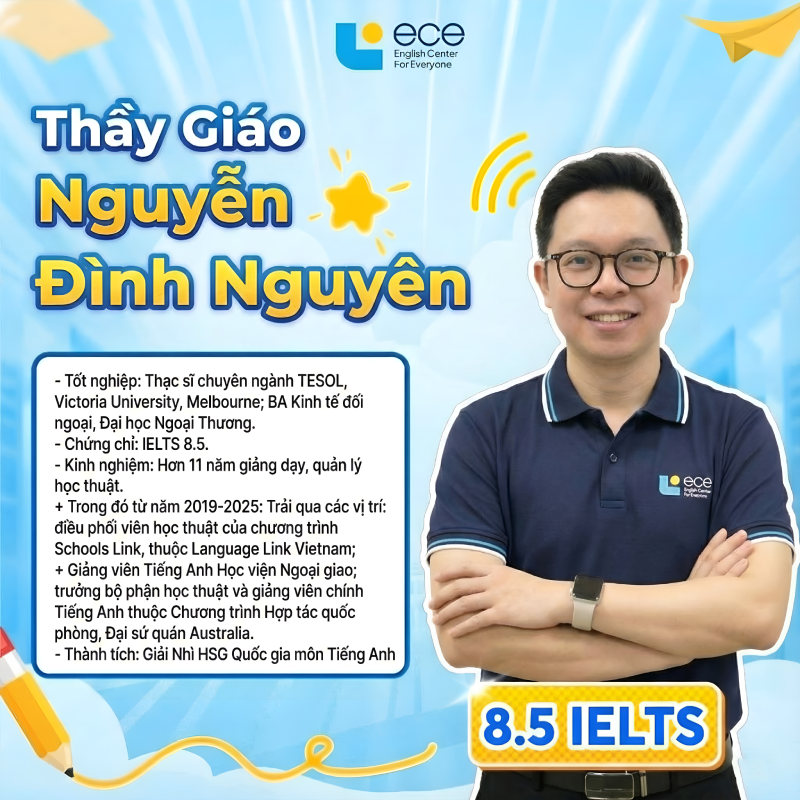
Examiners want to hear you discuss more abstract concepts like identity, values, and integration. Today, Mr. Dinh Nguyen—an instructor at ECE Language Center—will help you master the vocabulary and detailed sample answers for this topic. Let’s dive in!
Essential Vocabulary & Structures for Culture (IELTS Speaking)
To achieve a high band score, you need to use precise collocations rather than stringing individual words together. Below is a curated list of vocabulary:
Identity & Values
| Term | Meaning | Example |
| Cultural heritage | Cultural legacy | Vietnam possesses a rich cultural heritage, profoundly shaped by its historical trajectory. |
| Traditional values | Core traditional beliefs | Traditional values continue to command respect within numerous family structures. |
| Cultural identity | Sense of cultural self | Linguistic elements assume a pivotal role in the formation of cultural identity. |
| Sense of belonging | Feeling of connection | Participation in cultural activities fosters an enhanced sense of belonging among individuals. |
Society & Lifestyle
| Term | Meaning | Example |
| Customs and traditions | Established practices | Customs and traditions are systematically transmitted across successive generations. |
| Social norms | Societal standards | Social norms exert considerable influence upon public decorum and behavioural expectations. |
| A melting pot | A mix of cultures | Big cities like New York or London are often described as a melting pot of cultures. |
| Cultural diversity | Variety of cultures | Major metropolitan areas are notably distinguished by their significant cultural diversity. |
Idioms & Expressions for Natural Fluency
Don’t forget to weave in 1-2 idioms to make your speech sound more natural:
-
Passed down through generations: Handed down from ancestors to descendants.
-
Lose touch with traditions: Gradually drifting away from one’s cultural roots.
-
Culture shock: The feeling of disorientation experienced in a new cultural environment.
-
A strong sense of identity: A clear understanding of who you are and your cultural background.
IELTS Speaking Part 1 Sample – Topic: Culture
In Part 1, Mr. Nguyen’s strategy is: Answer directly + Expand using contrast or reasoning.
Q1: How would you describe the culture in your country?
Answer: “I would describe my country’s culture as a blend of traditional values and modern influences. On the one hand, people still respect customs such as family gatherings. On the other hand, lifestyles have become more modern, especially in big cities.”
* Using the structure On the one hand… On the other hand adds more depth than a simple list.
Q2: Is culture important to you?
Answer: “Yes, very much so. Culture helps shape who I am and gives me a strong sense of belonging. It also affects how I think, behave, and communicate with others.”
Q3: Do you think culture changes over time?
Answer: “Definitely. Culture is not something fixed. It gradually changes as society develops, although core values often remain the same.”
IELTS Speaking Part 2 Sample – Describe a cultural tradition in your country
Task: Describe a cultural tradition in your country.
You should say:
-
What it is
-
When it takes place
-
What people do
-
And why it is important
Sample Answer (Band 7.5+):
One cultural tradition that I find particularly meaningful is Tet, the Lunar New Year celebration in Vietnam. It usually takes place between late January and early February, depending on the lunar calendar, and it is considered the most important festival of the year.
In the weeks leading up to Tet, people clean and decorate their houses, buy new clothes, and prepare traditional food such as sticky rice cakes. During Tet itself, family members gather to share meals, visit relatives, and exchange good wishes for the new year. Younger people also receive lucky money from elders, which symbolises good fortune.
This tradition plays a vital role in Vietnamese culture because it strengthens family bonds and reminds people of traditional values such as respect, gratitude, and unity. Even people who live far away often try their best to return home during this time, which shows how deeply rooted this tradition is in our cultural identity.
* Mr. Nguyen avoids getting bogged down in trivial details (what to eat, what to play) and instead focuses on the spiritual significance (strengthens family bonds, deeply rooted) – this is the key to boosting your Lexical Resource score.
IELTS Speaking Part 3 Sample – Topic: Culture
Q1: Why is it important to preserve traditional culture?
Answer: “Traditional culture connects people to their roots and helps maintain a sense of identity. Without it, societies may lose valuable knowledge, customs, and values that have been passed down through generations.”
Q2: How has modern life affected traditional culture?
Answer: “Modern life has had both positive and negative effects. While technology makes it easier to promote culture globally, it also causes some people, especially the younger generation, to lose touch with traditions due to fast-paced lifestyles.”
Q3: Should young people be encouraged to learn about traditional culture?
Answer: “Yes, I believe so. Learning about traditional culture helps young people understand where they come from and develop respect for their community. It also allows them to balance modern influences with traditional values.”
We have now completed a full journey: from absorbing advanced vocabulary to observing how Mr. Dinh Nguyen transforms them into complete sample answers. We hope this combination of theory and practice helps you feel more confident when tackling the topic of Culture. Be sure to re-read the Part 2 and Part 3 samples to learn how to develop your ideas logically and coherently!





 Khai giảng Khóa học Hè cực HOT.
No comments yet!