


Tóm Tắt Nội Dung Bài Viết
In the IELTS Speaking test, Family is a familiar topic that often appears right in Part 1. However, this very familiarity can be a “double-edged sword.” If you rely only on basic vocabulary (such as father, mother, happy family…), it will be difficult to impress the examiner and achieve a high band score.
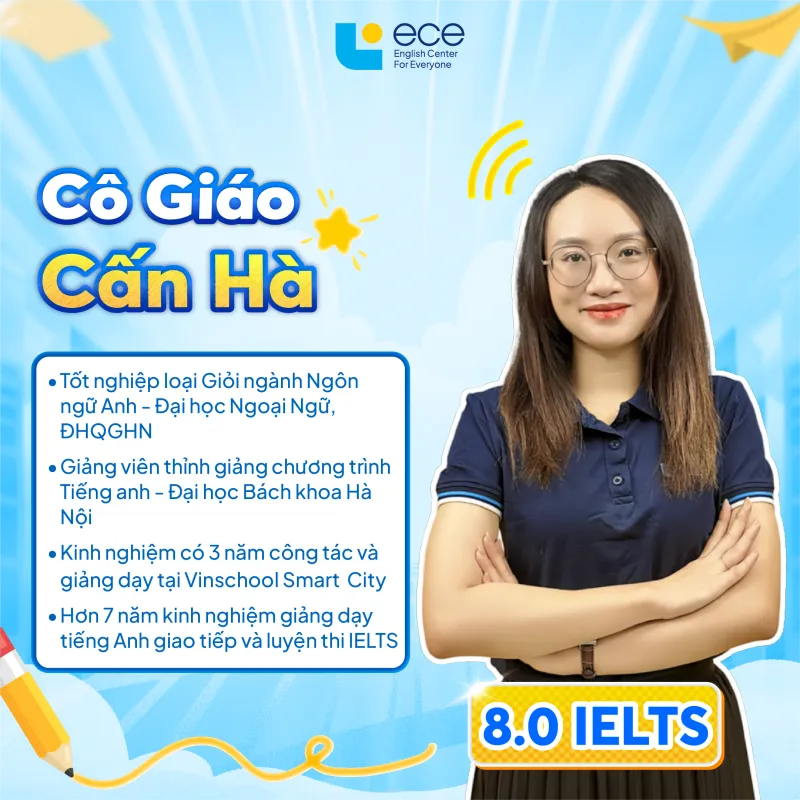
This article provides a complete collection of vocabulary, collocations, idioms, and model answers from Ms. Can Thu Ha – an 8.0 IELTS instructor at ECE, to help you confidently “level up” your responses.
High-Scoring Vocabulary & Structures for the Family Topic
To add depth to your speaking, you need to distinguish between different family structures and use relationship-related phrases accurately.
Family Types & Relationships (Vocabulary & Collocations)
| Vocabulary | Meaning | Sample Example |
| Close-knit family | A family with strong emotional bonds | I grew up in a close-knit family where everyone supports one another. |
| Extended family | A family including relatives beyond parents and children | We often have gatherings with our extended family during holidays. |
| Nuclear family | A family consisting only of parents and children | Many people in my city live in a nuclear family. |
| Foster family | A family that provides temporary care for children | He was raised by a foster family since childhood. |
| Single-parent family | A family with only one parent | Growing up in a single-parent family taught me resilience. |
| To get along well with | To have a good relationship with someone | I get along well with all my relatives. |
| To cherish someone | To love and protect someone dearly | I really cherish my grandparents. |
| Through thick and thin | Through all good and bad times | We support each other through thick and thin. |
Family Idioms
Using idioms in the right context is a great way to sound as natural as a native speaker.
- The apple of my eye: Someone you love and cherish most.
- Flesh and blood: Your own family/relatives.
- To run in the family: A trait or characteristic inherited by family members.
- A chip off the old block: Someone who is very similar to their parent (in personality or appearance).
- To wear the pants: The person who makes the main decisions in the family.
IELTS Speaking Part 1 Model Answers: Family
Q1: Can you describe your family?
I come from a close-knit family of five — my parents, an older sister, a younger brother and me. We live in a cozy home near the city centre. My father is an engineer and my mother is a physician, so they both have demanding jobs.
Q2: How much time do you spend with your family?
Although I’m quite busy with work, I make it a point to get together with them at least twice a week, especially for dinner. We often share and discuss things that happened during the day, which strengthens our bond.
Q3: Who are you closest to in your family?
I’d say I’m closest to my older sister — she’s not only my sibling but also my confidante. We have similar interests, and she always gives me valuable advice when I’m facing difficulties.
Q4: Is family important to you? Why?
Absolutely. Family is my support system — they’ve stood by me through thick and thin. Their unconditional support and encouragement have shaped who I am today.
IELTS Speaking Part 2 Model Answer: Family
Topic:
Describe someone in your family you admire.
You should say:
- Who this person is
- What they do
- How they influence your life
- And explain why you admire them
Sample Answer:
The person I admire most in my family is my grandmother. She has lived through many hardships but still remains optimistic and compassionate. She spent most of her life as a schoolteacher, shaping the minds of countless students, and now she volunteers at a local community centre to help underprivileged children.
What impresses me most is her resilience — she always faces challenges with a calm and positive attitude, which has taught me to stay composed under pressure. More importantly, she always puts others first and is the apple of everyone’s eye in our family because of her selflessness and kindness.
I admire her not only because of what she has achieved but also because she has been a moral compass for all of us. Her lessons about empathy and perseverance have significantly influenced my outlook on life.
IELTS Speaking Part 3: Discussion
Part 3 questions expand into social trends and the roles of family members.
Q1: In what ways have families in your country changed recently?
Families today are generally smaller compared to the past, mainly due to modern lifestyles and economic pressures. In the past, extended families living together were more common, whereas now nuclear families are more prevalent. Moreover, traditional roles within families are shifting as both spouses often share household responsibilities and pursue careers.
Q2: What roles do elderly people play in families?
In many families, elderly relatives still play a pivotal role as moral guides and sources of wisdom. They often provide emotional support and help in raising grandchildren, which strengthens intergenerational bonds. Their life experience offers valuable guidance to younger members.
Q3: Should husbands and wives share responsibilities equally?
Yes, I believe equal sharing of responsibilities is essential. It not only fosters mutual respect but also sets a positive example for children. When both partners contribute to household duties and career aspirations, it promotes balance and reduces stress for both sides.
Q4: What is more important: family or romantic relationships?
While romantic relationships can be deeply fulfilling, family is often considered foundational because it provides long-lasting support and stability. Friends and partners might come and go, but family – being flesh and blood – tends to stay a constant source of encouragement throughout life.
Advice from Ms. Thu Ha
The Family topic may seem easy, but to get a high score, try to incorporate idioms (such as flesh and blood, through thick and thin) naturally into your speech. Also, don’t forget to express personal emotions when talking about your loved ones; this will make your speaking much more fluent and persuasive. Good luck with your studies!





 Khai giảng Khóa học Hè cực HOT.
No comments yet!