


Tóm Tắt Nội Dung Bài Viết
Technology is one of the most common and high-probability topics in the IELTS Speaking test. For this topic, examiners don’t expect you to be a tech expert well-versed in technical specifications; what matters is how you describe their impact on our lives, work, and society.
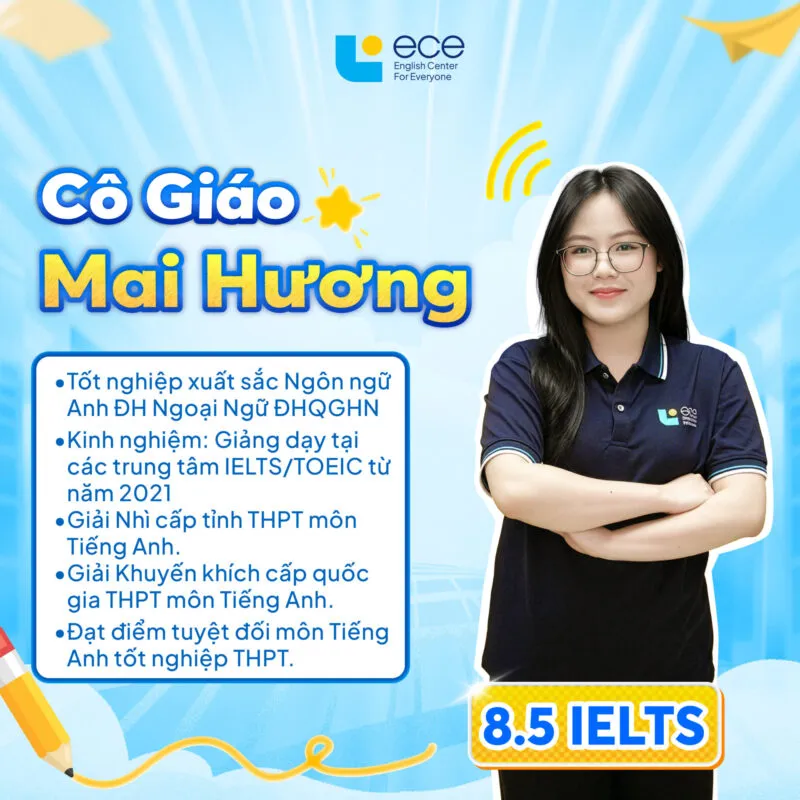
To help you navigate questions from Part 1 through Part 3 smoothly, Ms. Nguyen Mai Huong (an 8.0 IELTS instructor at ECE Language Center) has compiled a list of high-scoring vocabulary and a complete sample response for the prompt “Describe an important technological product you bought”. Let’s dive in!
High-scoring vocabulary & structures for the Technology topic
Instead of using simple terms like “good machine” or “use phone a lot,” elevate your answers with the following academic collocations:
| Vocabulary / Phrase | Meaning & Usage |
| Cutting-edge technology | The most advanced or modern technology. (Use instead of “new technology”) |
| A must-have device | An essential piece of equipment. |
| Have access to information at one’s fingertips | To be able to access information instantly. |
| A worthwhile investment | An investment that is well worth the cost. |
| Boost productivity | To increase efficiency in work or study. |
| Be glued to one’s phone/screen | To be constantly looking at a phone or screen (indicating tech addiction). |
| Do without something | To manage or live without something (usually used in the negative: “can’t do without…”). |
| Transform the way we live and work | To completely change how we go about our daily lives and careers. |
| Keep up with the latest technology | To stay updated with the newest tech trends. |
| Stay connected with others | To maintain communication with people. |
| Be dependent on technology | To rely heavily on technology. |
| Make life more convenient | To make daily life easier and more efficient. |
IELTS Speaking Part 1 Sample – Daily Technology Use
In Part 1, aim for a natural tone, relate your answers to your personal daily habits, and skillfully weave in 1-2 collocations.
Q1: Do you use a lot of technology in your daily life?
Sample: Yes, quite a lot actually. I use my phone and laptop for almost everything—from studying and working to staying connected with friends and family. I think cutting-edge technology has genuinely transformed the way I live and work, to the point where it’s hard to imagine doing without these devices.
Q2: What is your favourite electronic device?
Sample: Without a doubt, it’s my smartphone. It’s basically a must-have device for me because I use it to communicate, navigate, take photos, and even manage my schedule. What I appreciate most is that I have access to information at my fingertips wherever I go, which makes daily life so much more convenient.
Q3: Do you think people spend too much time on their phones?
Sample: Honestly, yes—myself included. A lot of people are constantly glued to their screens, whether it’s scrolling through social media or watching videos. I think it’s becoming harder to put the phone down, especially because apps are designed to keep us engaged. It’s something I’m trying to be more mindful about.
Q4: Did you use a lot of technology when you were younger?
Sample: Not as much as now. When I was a child, technology wasn’t as advanced or accessible, so I spent more time outdoors or reading physical books. These days, children grow up surrounded by devices from a very young age, which is quite different from my experience.
IELTS Speaking Part 2 Sample
Topic: Describe an important technological product you bought.
You should say:
-
What it is
-
When and why you bought it
-
How you use it
-
And explain why it is important to you
Sample Answer (Band 8.0+):
I’d like to talk about the laptop I bought about two years ago, which is probably one of the most worthwhile investments I’ve ever made.
I decided to buy it when I started my current job, as I needed a reliable device to work from home and handle a heavy workload efficiently. Before that, I had been sharing a family computer, which was often inconvenient, especially during busy periods when everyone needed it at the same time.
I use this laptop for almost everything in my daily life. During work hours, I use it to write documents, attend online meetings, and boost my productivity by keeping all my tasks organised in one place. In my free time, I also use it to watch films, take online courses, and stay connected with friends through social media and messaging apps.
What makes this device truly important to me is how much it has transformed the way I work and learn. Before I had it, I felt like I was always falling behind and struggling to keep up with the demands of my job. Now, having access to information and tools at my fingertips has made everything far more manageable. I honestly can’t imagine trying to do without it at this point. It’s become a must-have device in both my professional and personal life, and I think it will continue to be so for many years to come.
💡 Strategy analysis from Ms. Mai Huong:
The highlight of this response is the Past vs. Present contrast structure. Instead of wasting time describing technical specs like chips or RAM (which often leads to vocabulary blocks), focus on the “pain points” of the past (sharing a family computer, falling behind) and the improvements in the present (boost productivity, far more manageable). This approach keeps your speech fluent, emotive, and allows you to showcase high-level vocabulary.
IELTS Speaking Part 3 Sample – Technology and Society
Part 3 requires you to provide a multi-dimensional perspective (both pros and cons) on the development of technology in society.
Q1: How has technology changed the way people work?
Sample: Technology has completely transformed the way we work, and I think mostly for the better. Cutting-edge technology like cloud storage and video conferencing means that people can now work remotely from anywhere, which was almost unimaginable a decade ago. It has also boosted productivity enormously by automating repetitive tasks. However, a downside is that many people now struggle to switch off from work because they are always connected and reachable.
Q2: Do you think people are too dependent on technology nowadays?
Sample: Yes, I do think so. Many people can no longer do without their smartphones or the internet even for a few hours, which suggests a level of dependency that wasn’t there before. While technology does make life more convenient, becoming too reliant on it can be a problem. For instance, people’s ability to remember information or navigate without GPS has noticeably declined. I think the key is finding a healthy balance between using technology and maintaining basic life skills.
Q3: What are the negative effects of technology on society?
Sample: There are quite a few concerns worth mentioning. First, many people have become so glued to their screens that face-to-face relationships have weakened. Second, being constantly connected means people rarely have time to truly rest or unwind. There are also growing concerns about privacy, as so much of our personal data is collected by the apps and platforms we use every day. That said, I believe these problems can be managed if individuals and governments take responsibility for how technology is used.
In summary, to conquer the Technology topic, you don’t need to be a “hacker” or a tech enthusiast. What the examiner is looking for is your ability to use language to discuss the convenience, changes, and implications of technology. Apply the vocabulary set from Ms. Nguyen Mai Huong to practice with confidence. ECE Language Center wishes you effective study sessions and success in achieving your target band score!




 Khai giảng Khóa học Hè cực HOT.
No comments yet!