


Tóm Tắt Nội Dung Bài Viết
The animal kingdom, particularly in-depth scientific research, is a frequent topic in IELTS Reading. The passage “Elephant Communication” is a classic example, delving into the complex and fascinating ways elephants communicate. This article from the ECE language center provides the full reading text, a complete set of questions, detailed answer keys with explanations, and an analysis of key academic vocabulary.
Reading Passage and Detailed Questions: Elephant Communication
Reading Passage
(Paragraph A) A postdoctoral fellow at Stanford University, O’Connell Rodwell has come to Namibia’s premiere wildlife sanctuary to explore the mysterious and complex world of elephant communication. She and her colleagues are part of a scientific revolution that began nearly two decades ago with the stunning revelation that elephants communicate over long distances using low-frequency sounds, also called infrasounds, that are too deep to be heard by most humans.
(Paragraph B) As might be expected, the African elephant’s ability to sense seismic sound may begin in the ears. The hammer bone of the elephant’s inner ear is proportionally very large for a mammal, but typical for animals that use vibrational signals. It may therefore be a sign that elephants can communicate with seismic sounds. Also, the elephant and its relative the manatee are unique among mammals in having reverted to a reptilian-like cochlear structure in the inner ear. The cochlea of reptiles facilitates a keen sensitivity to vibrations and may do the same in elephants.
(Paragraph C) But other aspects of elephant anatomy also support that ability. First, their enormous bodies, which allow them to generate low-frequency sounds almost as powerful as those of a jet takeoff, provide ideal frames for receiving ground vibrations and conducting them to the inner ear. Second, the elephant’s toe bones rest on a fatty pad that might help focus vibrations from the ground into the bone. Finally, the elephant’s enormous brain lies in the cranial cavity behind the eyes in line with the auditory canal. The front of the skull is riddled with sinus cavities that may function as resonating chambers for vibrations from the ground.
(Paragraph D) How the elephants sense these vibrations is still unknown, but O’Connell Rodwell who just earned a graduate degree in entomology at the University of Hawaii at Manoa, suspects the pachyderms are “listening” with their trunks and feet. The trunk may be the most versatile appendage in nature. Its uses include drinking, bathing, smelling, feeding and scratching. Both trunk and feet contain two kinds of pressure-sensitive nerve endings—one that detects infrasonic vibrations and another that responds to vibrations with slightly higher frequencies. For O’Connell-Rodwell, the future of the research is boundless and unpredictable: “Our work is really at the interface of geophysics, neurophysiology and ecology,” she says. “We’re asking questions that no one has really dealt with before.”
(Paragraph E) Scientists have long known that seismic communication is common in small animals… But O’Connell Rodwell was the first to suggest that a large land animal also is sending and receiving seismic messages. O’Connell Rodwell noticed something about the freezing behavior of Etosha’s six-ton bulls that reminded her of the tiny insects back in her lab. “I did my masters thesis on seismic communication in planthoppers,” she says. “I’d put a male planthopper on a stem and play back a female call, and the male would do the same thing the elephants were doing: He would freeze, then press down on his legs, go forward a little bit, then freeze again. It was just so fascinating to me, and it’s what got me to think, maybe there’s something else going on other than acoustic communication.”
(Paragraph F) Scientists have determined that an elephant’s ability to communicate over long distances is essential for its survival, particularly in a place like Etosha… The difficulty of finding a mate in this vast wilderness is compounded by elephant reproductive biology. Females breed only when in estrus, a period of sexual arousal that occurs every two years and lasts just a few days… These powerful estrus calls carry more than two miles in the air and may be accompanied by long-distance seismic signals, she adds. Breeding herds also use low-frequency vocalizations to warn of predators. Adult bulls and cows have no enemies, except for humans, but young elephants are susceptible to attacks by lions and hyenas. When a predator appears, older members of the herd emit intense warning calls that prompt the rest of the herd to clump together for protection, then flee.
(Paragraph G) Reacting to a warning call played in the air is one thing, but could the elephants detect calls transmitted only through the ground? To find out, the research team in 2002 devised an experiment using electronic equipment that allowed them to send signals through the ground at Mushara. The results of our 2002 study showed us that elephants do indeed detect warning calls played through the ground,” O’Connell Rodwell observes. “We expected them to clump up into tight groups and leave the area, and that’s in fact what they did…”
(Paragraph H) An experiment last year was designed to solve that problem by using three different recordings—the 1994 warning call from Mushara, an anti-predator call recorded by scientist Joyce Poole in Kenya and an artificial warble tone. Although still analyzing data from this experiment, O’Connell Rodwell is able to make a few preliminary observations: “The data I’ve seen so far suggest that the elephants were responding like I had expected… But what’s really interesting is that the unfamiliar anti-predator call from Kenya also caused them to clump up, get nervous and aggressively rumble—but they didn’t necessarily leave. I didn’t think it was going to be that clear cut.”
Questions
Questions 28-31
Complete the following summary of the paragraphs of Reading Passage, using no more than three words from the Reading Passage for each answer.
Write your answers in boxes 28-31 on your answer sheet.
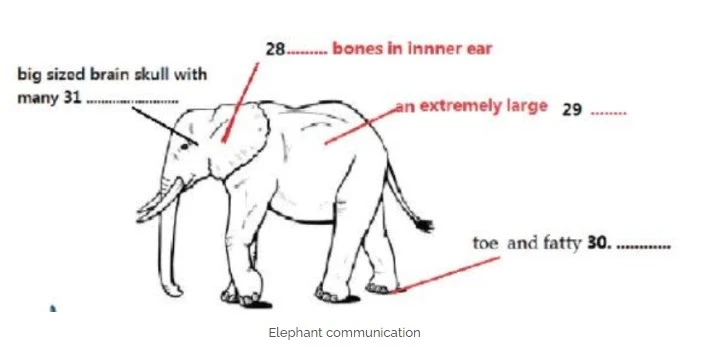
28………….
29………….
30………….
31………….
Questions 32-38 (Summary Completion)
Complete the following summary… using NO MORE THAN THREE WORDS OR A NUMBER from the Reading Passage for each answer.
How the elephants sense these sound vibrations is still unknown, but O’Connell Rodwell, a fresh graduate in entomology at the University of Hawaii, proposes that the elephants are “listening” with their 32…………., by two kinds of nerve endings—that responds to vibrations with both 33………….frequency and slightly higher frequencies. O’Connell Rodwell’s work is at the combination of geophysics, neurophysiology and 34………….and it also was the first to indicate that a large land animal also is sending and receiving 35………….,. O’Connell-Rodwell noticed the freezing behavior by putting a male planthopper communicative approach other than 36…………. Scientists have determined that an elephant’s ability to communicate over long distances is essential, especially, when elephant herds are finding a 37…………., or are warning of predators. Finally, the results of our 2002 study showed us that elephants can detect warning calls played through the 38………….
Questions 39-40 (Multiple Choice) Choose the correct letter. A, B, C or D.
39. According to the passage, it is determined that an elephant needs to communicate over long distances for its survival A. When a threatening predator appears. B. When young elephants meet humans. C. When older members of the herd want to flee from the group. D. when a male elephant is in estrus.
40. What is the author’s attitude toward the experiment by using three different recordings in the paragraph? A. the outcome is definitely out of the original expectation B. the data can not be very clearly obtained C. the result can be somewhat undecided or inaccurate D. the result can be unfamiliar to the public
Summary of the Reading Passage
This passage introduces the research of scientist O’Connell Rodwell regarding the communication abilities of elephants.
- The research focuses on how elephants use low-frequency sounds (infrasounds) and seismic signals (ground vibrations) to communicate over long distances.
- The article analyzes anatomical features of elephants that support this ability, such as large inner ear bones, reptile-like cochlear structures, massive bodies, and fatty pads in their feet.
- O’Connell Rodwell suspects that elephants “listen” to these vibrations using their trunks and feet, which contain pressure-sensitive nerve endings.
- This long-distance communication is essential for elephant survival, particularly for finding mates and warning of predators.
- Experiments have proven that elephants can indeed detect and react to warning signals transmitted through the ground, although their reactions to familiar and unfamiliar signals differ.
Key Vocabulary and Structures
- Postdoctoral fellow (noun phrase): A researcher who has recently completed their doctoral studies.
- Infrasounds (noun): Sounds with frequencies too low for human hearing.
- Seismic sound/messages (noun phrase): Sounds or signals transmitted through the ground.
- Proportionally (adverb): In a way that relates to a specific scale or ratio.
- Anatomy (noun): The study of the physical structure of organisms.
- Versatile appendage (noun phrase): A multi-purpose body part (referring to the trunk).
- Interface (noun): A point where two or more systems meet.
- Example: “Our work is really at the interface of geophysics, neurophysiology and ecology.”
- Be susceptible to (adjective phrase): Likely to be influenced or harmed by something.
- Example: “…young elephants are susceptible to attacks by lions and hyenas.”
- Preliminary observations (noun phrase): Initial findings or observations.
Answer Key and Detailed Explanations
Questions 28-31 (Diagram Completion)
28. hammer bone
- Keywords: bones, inner ear.
- Evidence (Paragraph B): “The hammer bone of the elephant’s inner ear is proportionally very large for a mammal…”
- Explanation: The diagram asks for the name of the bone in the inner ear. Paragraph B identifies it as the “hammer bone.”
29. body
- Keywords: an extremely large. (Arrow points to the elephant’s body).
- Evidence (Paragraph C): “First, their enormous bodies…”
- Explanation: “Enormous” is synonymous with “extremely large.” While the text uses the plural “bodies,” the diagram points to a single elephant, so the singular “body” is used for grammatical accuracy.
30. pad
- Keywords: toe, fatty. (Arrow points to the foot).
- Evidence (Paragraph C): “Second, the elephant’s toe bones rest on a fatty pad…”
- Explanation: The text describes the elephant’s toe bones resting on a “fatty pad.”
31. sinus cavities
- Keywords: skull, with many. (Arrow points to the front of the skull).
- Evidence (Paragraph C): “The front of the skull is riddled with sinus cavities…”
- Explanation: “Riddled with” means “full of.” The text states the front of the skull is full of “sinus cavities.”
Questions 32 – 38
32. trunks and feet
- Keywords: listening with their.
- Evidence (Paragraph D): “…suspects the pachyderms are “listening” with their trunks and feet.”
- Explanation: The text explicitly states that O’Connell Rodwell suspects elephants “listen” with their trunks and feet.
33. infrasonic vibrations
- Keywords: responds to vibrations, both… frequency.
- Evidence (Paragraph D): “Both trunk and feet contain two kinds of pressure-sensitive nerve endings—one that detects infrasonic vibrations and another that responds to vibrations with slightly higher frequencies.”
- Explanation: The text describes two types of nerve endings: one for “infrasonic vibrations” and another for slightly higher frequencies.
34. ecology
- Keywords: combination of geophysics, neurophysiology and.
- Evidence (Paragraph D): “Our work is really at the interface of geophysics, neurophysiology and ecology,” she says.”
- Explanation: “Interface” is synonymous with “combination.” The text lists three fields, with “ecology” being the final one.
35. seismic messages
- Keywords: large land animal, sending and receiving.
- Evidence (Paragraph E): “…O’Connell Rodwell was the first to suggest that a large land animal also is sending and receiving seismic messages.”
- Explanation: This sentence confirms O’Connell Rodwell was the first to suggest that a large land animal sends and receives “seismic messages.”
36. acoustic communication
- Keywords: communicative approach other than.
- Evidence (Paragraph E): “…it’s what got me to think, maybe there’s something else going on other than acoustic communication.”
- Explanation: The “freezing behavior” led the scientist to consider methods other than “acoustic communication.”
37. mate
- Keywords: elephant herds are finding a.
- Evidence (Paragraph F): “The difficulty of finding a mate in this vast wilderness is compounded by elephant reproductive biology.”
- Explanation: Long-distance communication is essential for finding a “mate.”
38. the ground
- Keywords: detect warning calls played through the.
- Evidence (Paragraph G): “…elephants do indeed detect warning calls played through the ground,” O’Connell Rodwell observes.”
- Explanation: The 2002 study showed that elephants can detect warning calls transmitted through “the ground.”
Questions 39-40
39. A. When a threatening predator appears.
- Keywords: need to communicate, survival.
- Evidence (Paragraph F): “Breeding herds also use low-frequency vocalizations to warn of predators… When a predator appears, older members of the herd emit intense warning calls…”
- Explanation: Paragraph F lists two main reasons for long-distance communication: finding a mate (not an option) and warning of predators. Option A matches this perfectly. Option D is incorrect because females, not males, are in estrus.
40. C. the result can be somewhat undecided or inaccurate
- Keywords: author’s attitude, experiment, three different recordings.
- Evidence (Paragraph H): “I didn’t think it was going to be that clear cut.”
- Explanation: “Clear cut” means unambiguous. By saying she didn’t think it would be “that clear cut,” the scientist implies the results were complex or not entirely definitive. Option A is incorrect because the results were expected. Option B is incorrect because data was obtained. Option D is irrelevant. Thus, C best reflects the scientist’s attitude.
Successfully analyzing the “Elephant Communication” passage demonstrates a vital IELTS Reading skill: the ability to link information across paragraphs. The anatomical details in paragraphs B and C are not isolated; they provide the basis for the hypothesis about “listening” with feet and trunks in paragraph D.
This is the core mindset for conquering complex scientific passages. Instead of just searching for isolated keywords, focus on the logical flow of the entire text: Where is the problem stated? What is the hypothesis? Where is the evidence?
Practicing this holistic reading-comprehension skill will help you effectively tackle not only this passage but many other difficult texts in the IELTS exam.





 Khai giảng Khóa học Hè cực HOT.
No comments yet!