


Tóm Tắt Nội Dung Bài Viết
In the IELTS Writing Task 2, the “Agree or Disagree” essay type is one of the most common and significant formats. This task requires candidates to express their personal opinion on a specific issue presented in the prompt, while providing logical arguments and evidence to support that stance.
Mastering how to write an Agree or Disagree essay will help you confidently express your views, construct logical arguments, and achieve a high score. This article from ECE provides a detailed guide on how to approach this task, analyzes common mistakes, and offers a sample essay to give you a comprehensive understanding and the best possible preparation for your IELTS exam.
1. Introduction to the Agree or Disagree format in IELTS Writing Task 2
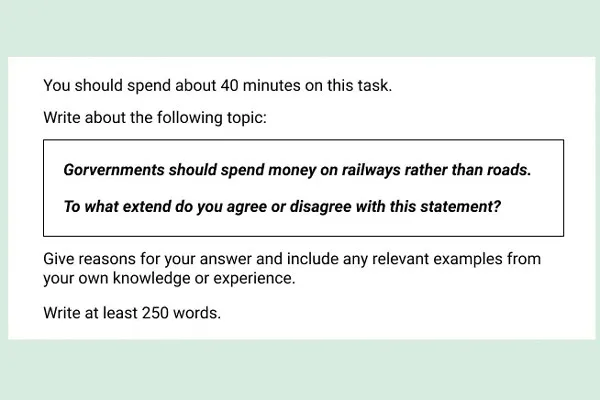
The Agree or Disagree format in IELTS Writing Task 2 requires candidates to express their personal opinion on a social, economic, cultural, or educational issue provided in the prompt. The question is typically phrased in one of the following ways:
- To what extent do you agree or disagree?
- Do you agree or disagree?
- What is your opinion? (Even if the question asks “What is your opinion?”, you still need to clearly state whether you agree or disagree.)
For this task, you will need to:
- Clearly define your stance: Fully agree, fully disagree, or partially agree/disagree.
- Provide reasons to support your position.
- Provide specific examples and evidence to illustrate your points.
Example of an Agree or Disagree prompt:
“Some people believe that it is best to accept a bad situation, such as an unsatisfactory job or shortage of money. Others argue that it is better to try and improve such situations. Discuss both these views and give your own opinion.” (While this is a “Discuss both views and give your opinion” prompt, it is essentially an Agree or Disagree task because you must clearly state which side you favor.)
“International travel is becoming increasingly common, but some people believe it creates more problems than it solves. To what extent do you agree or disagree?”
Related article: How to approach the “Discuss both views” task in IELTS Writing Task 2
2. How to write an Agree or Disagree essay & key tips

Below is a detailed guide on how to write an Agree or Disagree essay for IELTS Writing Task 2:
2.1. Essay Structure
An IELTS Writing Task 2 Agree or Disagree essay typically follows a 4-5 paragraph structure:
- Introduction:
– Paraphrase the prompt (restate the issue in your own words).
– State your position clearly (Thesis statement): Fully agree, fully disagree, or partially agree/disagree.
- Body Paragraph 1:
– Topic sentence: State your first reason supporting your position.
– Supporting ideas: Explain and analyze the reason.
– Examples: Provide specific, real-world examples to illustrate your point.
- Body Paragraph 2:
– Topic sentence: State your second reason supporting your position.
– Supporting ideas: Explain and analyze the reason.
– Examples: Provide specific, real-world examples to illustrate your point.
- (Optional) Body Paragraph 3: (If you choose to partially agree/disagree)
– Topic sentence: Acknowledge the opposing view (if you fully agree, state the opposing view; and vice versa).
– Supporting ideas: Explain and analyze that perspective.
– Examples: Provide specific examples.
– Refutation: Explain why you find that perspective less convincing and reaffirm your own position.
- Conclusion:
– Summarize your position.
– Reiterate the main points presented.
– Optionally, provide a recommendation, prediction, or broader observation.
2.2. Steps to follow
- Step 1: Analyze the prompt: Read the question carefully, identify the core issue, and understand the requirements (agree or disagree, and to what extent). Underline key terms.
- Step 2: Outline: This is the most important step in writing an Agree or Disagree essay. Spend 5-7 minutes creating a detailed outline, including:
- Your position (Thesis statement).
- Main reasons (2 – 3 reasons).
- Examples for each reason.
- (If needed) Opposing view and refutation.
- Step 3: Write the essay: Based on your outline, write the complete essay. Pay attention to vocabulary, grammatical structures, and ensure your ideas are well-connected.
- Step 4: Review and edit: Spend the final 2-3 minutes proofreading for spelling and grammar errors, and ensuring the essay is logical and coherent.
2.3. Important tips
- Be clear about your stance: State your position clearly in the introduction. Avoid vague phrases like “I partly agree” without further explanation. If you partially agree/disagree, specify which aspects you agree with and which you do not.
- Logical argumentation: Your reasons must be logical, persuasive, and well-connected.
- Specific examples: Use concrete, real-world examples to support your points. Avoid vague or generalized examples.
- Vocabulary and grammar: Use a wide range of accurate vocabulary suitable for the context. Use varied grammatical structures to avoid repetition and demonstrate your language proficiency.
- Cohesion: Use linking words and phrases to connect sentences and paragraphs smoothly. For example:
- Adding ideas: Furthermore, Moreover, In addition, Additionally,…
- Contrasting: However, On the other hand, Conversely, In contrast,…
- Cause and effect: Therefore, Consequently, As a result, Thus,…
- Examples: For example, For instance, Such as,…
- Word count: Aim for 250 – 300 words. Writing too little will not allow you to develop your ideas, while writing too much may lead to rambling or going off-topic.
- Time management: You have 40 minutes for Task 2. Allocate your time wisely: Analyzing the prompt (2-3 minutes), Outlining (5-7 minutes), Writing (25-30 minutes), Reviewing (2-3 minutes).
Check out our article on IELTS Writing Band 9 if that is your goal.
3. Common mistakes to avoid
Here are some common mistakes in IELTS Writing Task 2 Agree or Disagree essays that you should avoid:
- Unclear stance: This is the most serious error. If you do not clearly state whether you agree or disagree, your essay will receive a lower score for Task Response.
- Illogical or unpersuasive arguments: Your reasons must be well-connected to each other and to your overall position. Avoid vague, irrelevant, or contradictory reasons.
- Lack of specific examples: Failing to provide specific examples makes your essay less persuasive. Try to include real-world examples, personal experiences, or information from reliable sources.
- Grammar and spelling errors: These will negatively impact your scores for Grammatical Range and Accuracy and Lexical Resource.
- Going off-topic: Ensure you are directly answering the question and not drifting into unrelated issues.
- Inappropriate tone: Avoid overly informal or colloquial language; maintain an academic tone.
- Repetitive vocabulary and structures: Use synonyms and varied sentence structures to make your writing more engaging and demonstrate higher proficiency.
Explore our IELTS preparation courses at ECE Language Center.
4. IELTS Writing Task 2 Agree or Disagree Sample Essay
Prompt: Some people believe that the best way to improve public health is by increasing the number of sports facilities. Others, however, believe that this would have little effect on public health and that other measures are required. Discuss both views and give your opinion.
Sample Essay:
Introduction:
The issue of enhancing public health is a complex one, with diverse opinions on the most effective strategies. While some individuals advocate for the expansion of sports facilities as the primary solution, others contend that such an approach would yield minimal impact and that alternative measures are necessary. This essay will examine both perspectives before presenting my own viewpoint, which leans towards the latter argument.
Body Paragraph 1:
Proponents of increasing sports facilities often argue that it directly encourages physical activity, a cornerstone of a healthy lifestyle. They posit that readily available gyms, swimming pools, and playing fields will motivate individuals to engage in regular exercise, thus reducing the risk of obesity, cardiovascular diseases, and other health problems associated with sedentary lifestyles. For instance, a city that invests in building new cycling paths and basketball courts may witness a surge in the number of people cycling and playing basketball, leading to improved fitness levels within the community.
Body Paragraph 2:
However, I am inclined to believe that simply increasing the number of sports facilities will not suffice to address the multifaceted issue of public health. While access to such facilities is undoubtedly beneficial, other factors such as socioeconomic status, dietary habits, and access to healthcare play equally, if not more, significant roles. For example, individuals from disadvantaged backgrounds may lack the financial resources or the time to utilize these facilities, even if they are readily available. Moreover, a poor diet high in processed foods and sugary drinks can negate the positive effects of exercise. A comprehensive approach that tackles these underlying issues is, therefore, crucial.
Body Paragraph 3: Furthermore, public health campaigns promoting healthy eating habits, smoking cessation programs and improved access to healthcare services are likely to have a more profound and lasting impact. Education on nutrition and preventive healthcare measures can empower individuals to make informed choices about their lifestyle, leading to a sustainable improvement in overall well-being. For example, implementing a nationwide campaign against smoking has resulted in decreased numbers of smokers and therefore lowered the rates of lung cancer and other related diseases in several countries.
Conclusion:
In conclusion, while increasing the number of sports facilities can contribute to improving public health, it is unlikely to be the most effective solution on its own. A more holistic approach that addresses factors such as socioeconomic disparities, dietary habits, and access to healthcare, alongside promoting healthy lifestyles through education and awareness campaigns, is essential for achieving significant and sustainable improvements in public health.
Analysis of the sample essay:
Introduction:
- Paraphrase: Instead of “Some people believe…”, the essay uses “While some individuals advocate…”. Instead of “Others, however, believe…”, it uses “others contend that…”.
- Thesis statement: “This essay will examine both perspectives before presenting my own viewpoint, which leans towards the latter argument.” (Clearly indicates a preference for the second view).
Body Paragraph 1:
- Topic Sentence: “Proponents of increasing sports facilities often argue that it directly encourages physical activity, a cornerstone of a healthy lifestyle.” (Clearly states the view of those supporting more sports facilities).
- Supporting Ideas: “They posit that readily available gyms, swimming pools, and playing fields will motivate individuals to engage in regular exercise, thus reducing the risk of obesity, cardiovascular diseases, and other health problems associated with sedentary lifestyles.” (Logical and clear explanation).
- Examples: “For instance, a city that invests in building new cycling paths and basketball courts may witness a surge in the number of people cycling and playing basketball, leading to improved fitness levels within the community.” (Specific and easy to visualize).
Body Paragraph 2:
- Topic Sentence: “However, I am inclined to believe that simply increasing the number of sports facilities will not suffice to address the multifaceted issue of public health.” (Clearly states personal opinion and signals a counter-argument).
- Supporting Ideas: “While access to such facilities is undoubtedly beneficial, other factors such as socioeconomic status, dietary habits, and access to healthcare play equally, if not more, significant roles.” (Introduces other equally important factors).
- Examples: “For example, individuals from disadvantaged backgrounds may lack the financial resources or the time to utilize these facilities, even if they are readily available. Moreover, a poor diet high in processed foods and sugary drinks can negate the positive effects of exercise.” (Real-world examples showing that facilities alone are insufficient).
- Refutation (implicit): Integrated into the supporting ideas and examples, demonstrating that focusing solely on sports facilities is one-sided.
Body Paragraph 3:
- Topic Sentence: “Furthermore, public health campaigns promoting healthy eating habits, smoking cessation programs and improved access to healthcare services are likely to have a more profound and lasting impact.” (Emphasizes other more effective measures).
- Supporting ideas & Example: “Education on nutrition and preventive healthcare measures can empower individuals to make informed choices about their lifestyle, leading to a sustainable improvement in overall well-being. For example, implementing a nationwide campaign against smoking has resulted in decreased numbers of smokers and therefore lowered the rates of lung cancer and other related diseases in several countries.” (Provides evidence regarding community campaigns and their effectiveness).
Conclusion:
- Summary of position: “In conclusion, while increasing the number of sports facilities can contribute to improving public health, it is unlikely to be the most effective solution on its own.” (Reiterates the stance).
- Emphasis on main points: “A more holistic approach that addresses factors such as socioeconomic disparities, dietary habits, and access to healthcare, alongside promoting healthy lifestyles through education and awareness campaigns, is essential for achieving significant and sustainable improvements in public health.” (Highlights the importance of a comprehensive approach).
Conclusion:
We hope this article has provided you with useful knowledge on how to write an Agree or Disagree essay for the IELTS exam. Practice regularly, apply the skills and tips mentioned, and you will improve your writing ability and achieve your desired score. Don’t forget to analyze the prompt carefully, create a detailed outline, and proofread your essay before submitting. Good luck!





 Khai giảng Khóa học Hè cực HOT.
No comments yet!