


Tóm Tắt Nội Dung Bài Viết
The conclusion in IELTS Writing Task 2 is far more than just the final paragraph of your essay. It is a golden opportunity to reinforce your arguments, leave a lasting impression on the examiner, and directly impact your final score. A well-crafted conclusion can help you secure higher marks in criteria such as Task Response (TR) and Coherence and Cohesion (CC).
So, how do you write a conclusion that is both polished and effective? This article will dive deep into the structure, common pitfalls to avoid, and optimal strategies to help you confidently complete your IELTS Task 2 essay.
I. The True Importance of a Conclusion in IELTS Writing Task 2

Many candidates rush through their conclusion because they have spent too much time on the body paragraphs. However, underestimating the importance of the conclusion is a major mistake. It serves several critical roles:
- Completing the essay: It provides a sense of closure and wholeness, showing the reader (the examiner) that you have presented your ideas in a complete and organized manner.
- Reinforcing the main argument: The conclusion is where you restate your position and summarize the strongest arguments developed in the body, ensuring the reader remembers your core message. This directly influences the Task Response criterion—your ability to answer the prompt and develop your arguments clearly and persuasively throughout the essay.
- Enhancing Coherence and Cohesion: A strong conclusion demonstrates a tight connection between all parts of the essay, from the introduction to the body and the final summary. It proves that you can organize and present ideas logically and consistently.
- Leaving a final impression: These are the last lines the examiner reads. A strong, clear, and concise conclusion creates a positive impression, contributing to a higher overall score.
II. The Golden Structure of an Effective Conclusion
Although there is some debate about whether a conclusion should be one or two sentences, the most effective structure centers on two key elements:
1. Sentence 1: Restate Your Thesis Statement
This is the backbone of your conclusion. You need to paraphrase the thesis statement you provided at the end of your introduction. The goal is to convey the same central idea but with different wording, using a wider range of vocabulary and grammatical structures.
- Why is paraphrasing key? It demonstrates your flexibility with language (Lexical Resource) and helps you avoid repetitive phrasing.
- Note: Do not copy your thesis statement word-for-word. Vary the sentence structure, use synonyms, or change word forms (e.g., changing a verb to a noun).
2. Sentence 2 (Optional): Summarize Main Supporting Ideas
After restating your main argument, you can add a concise sentence to summarize the main ideas developed in your body paragraphs.
- Pros of a two-sentence conclusion: It allows you to encapsulate your entire message more clearly, which is especially helpful if you have multiple main points to emphasize. This can further strengthen your Task Response score.
- Pros of a one-sentence conclusion: It is simple, concise, and easy to manage, making it ideal if you want to avoid errors and save time. This is particularly effective if you have only one main argument and your supporting points are simply extensions of that idea.
Advice: If you are aiming for a Band 6.0–7.0, focusing on paraphrasing your thesis statement into one clear, concise sentence is a safe and effective strategy. If you are aiming for Band 7.5+ and are confident in your language skills, you might consider adding a second sentence to summarize your supporting points more elegantly.
III. Best Practices for a Perfect Conclusion
1. Always Start with Signaling Language
Using transition phrases that signal the conclusion helps the examiner identify it easily and adds to the flow of your writing.
- Common phrases:
- In conclusion,
- To conclude,
- In summary,
- To summarize,
- Overall,
- All in all, (less formal, but still acceptable)
- Therefore, (if the conclusion is a logical consequence)
2. Paraphrase Skillfully
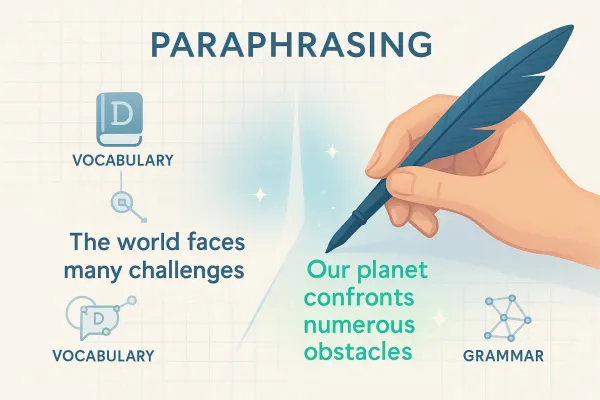
This is a vital skill.
- Use synonyms: Replace keywords with synonyms (e.g., problems = challenges, benefits = advantages, disadvantages = drawbacks).
- Vary sentence structure:
- Switch between active and passive voice.
- Change the position of clauses.
- Use more complex grammatical structures (e.g., turning simple sentences into complex ones with relative or adverbial clauses).
- Change word forms: Convert verbs to nouns or adjectives and vice versa (e.g., develop (v) development (n)).
3. Ensure Consistency with the Introduction and Body
The conclusion must reflect what you have already presented. The thesis and summary points in the conclusion must not contradict or deviate from your introduction and body paragraphs. This reinforces the Coherence and Cohesion criterion.
IV. What You Absolutely Should Not Do
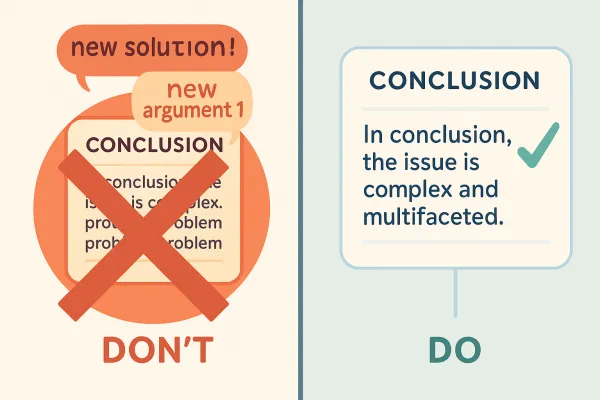
Avoid these mistakes to prevent unnecessary point deductions:
1. Never introduce new information or arguments
This is the most common and serious mistake. The conclusion is for summarizing, not introducing. Any new ideas must be fully developed in the body paragraphs. If you have a great new point, find a way to weave it into a body paragraph or leave it out.
2. Do not repeat words or sentences verbatim
As mentioned, repetition signals a limited vocabulary and poor paraphrasing skills, which will negatively impact your Lexical Resource and Grammatical Range and Accuracy scores.
3. Do not write too much or get too detailed
The conclusion should be concise, usually just 1–2 sentences. Avoid diving into specific examples, statistics, or detailed explanations already covered in the body.
4. Do not introduce sudden or new opinions
If your essay requires a personal opinion (Opinion Essay, Discussion + Opinion), ensure your stance is clear from the introduction and supported throughout the body. The conclusion is only for restating it. Do not change your mind or introduce a surprise perspective.
5. Limit overly forceful or prescriptive language
Avoid using words like “must,” “have to,” or “should” (unless the prompt specifically asks for solutions). Instead, use softer phrases like “it is advisable that…”, “it is important to…”, or “governments have a responsibility to…”.
V. Application by IELTS Writing Task 2 Essay Type
While the general structure is the same, how you paraphrase and emphasize points may vary slightly depending on the question type.
1. Opinion Essay (Agree/Disagree, To What Extent)
Goal: Clearly restate your position (agree, disagree, or agree/disagree to a certain extent).
Example:
- Introduction Thesis: “I completely agree that governments should prioritize public transportation over private car ownership.”
- Conclusion: “In conclusion, I firmly believe that investing in public transport infrastructure is more beneficial for urban environments than promoting individual vehicle use.”
2. Discussion Essay (Discuss Both Views and Give Your Opinion)
Goal: Summarize both views discussed and restate your personal opinion.
Example:
- Introduction Thesis: “While some argue that technology hinders social skills, others contend it fosters new forms of communication, and I believe the latter holds more truth.”
- Conclusion: “To summarize, although technology’s impact on traditional social interaction is debated, I maintain that its role in facilitating modern communication and connection is ultimately more significant.”
3. Causes/Effects/Solutions (Problems/Solutions)
Goal: Summarize the causes/problems and the proposed solutions.
Example:
- Introduction Thesis: “This essay will outline the main reasons behind rising obesity rates and propose several governmental and individual measures to combat this trend.”
- Conclusion: “Overall, it is evident that increasing obesity stems from various lifestyle factors, and effective solutions require a multi-faceted approach involving both public health initiatives and personal responsibility.”
4. Two-Part Question
Goal: Concisely answer both questions posed in the prompt.
Example:
- Introduction Thesis: “This essay will discuss the reasons why young people are choosing to live abroad and explore the positive impacts this trend has on both individuals and their home countries.”
- Conclusion: “In conclusion, young people’s global mobility is largely driven by career opportunities and cultural exploration, a phenomenon which ultimately yields significant personal growth and brings diverse benefits to their countries of origin.”
VI. Practice Exercises & Analysis
To reinforce your knowledge, let’s analyze a specific example:
Prompt: Some people think that all teenagers should be required to do unpaid work in their free time to help the local community. They believe this would benefit both the individual teenager and society as a whole. Do you agree or disagree?
Suggested Outline:
- Introduction: Introduce the topic and state your complete agreement.
- Body 1: Unpaid work helps teenagers become more socially responsible and develops a sense of community.
- Body 2: Teenagers can expand their networks, learn soft skills, and gain practical experience.
Conclusion Example:
- Option 1 (1 sentence): “To summarize, I believe that requiring young people to conduct unpaid social work is highly beneficial, as it instills a sense of accountability and equips them with invaluable practical skills.”
- Analysis: This sentence paraphrases the main argument (highly beneficial) and summarizes the two key points (accountability, invaluable practical skills) in a single, concise, and effective sentence.
- Option 2 (2 sentences – more detailed): “In conclusion, it is my firm conviction that mandatory community service for teenagers offers considerable advantages. Not only does it cultivate a stronger sense of social responsibility, but it also provides crucial opportunities for skill development and networking.”
- Analysis: The first sentence restates the main position. The second sentence clearly lists the two main benefits developed in the body. This approach helps clarify and reinforce ideas thoroughly.
VII. A Few Final Tips
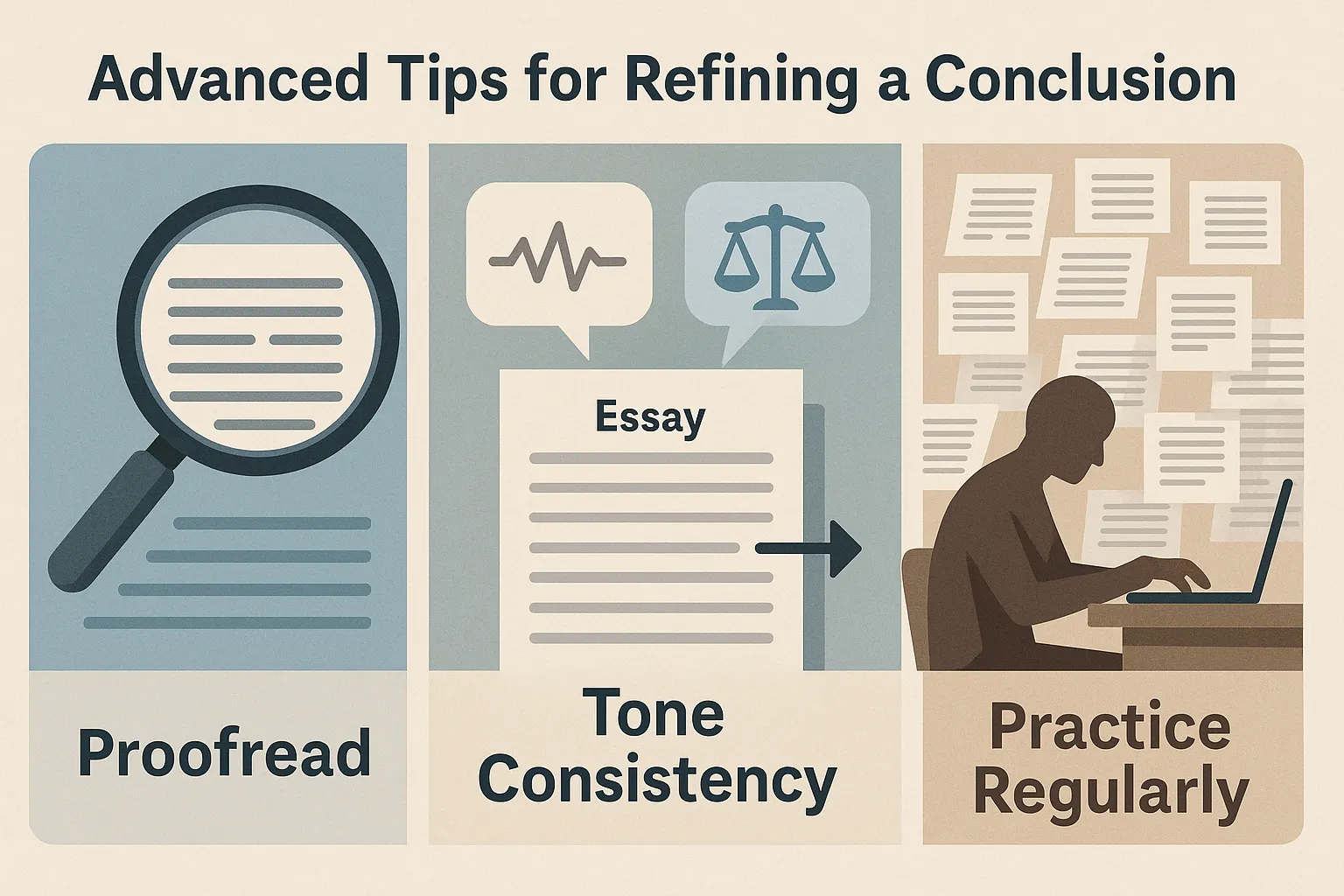
- Don’t forget to proofread: After finishing your essay, spend at least 2–3 minutes reading your conclusion. Focus on checking for grammatical errors (verb tenses, articles, singular/plural), spelling, punctuation, and ensuring you have paraphrased effectively without repetition. A small error in the conclusion can ruin the positive impression you have built.
- Maintain tone: The tone of your conclusion must be consistent with the rest of the essay. If your essay is academic and objective, your conclusion should maintain that stance. Avoid suddenly switching to an overly personal, emotional, or colloquial tone. This shows control over your language and writing style.
- Practice regularly and analyze sample essays: The best way to improve is to practice writing conclusions for different types of prompts. Then, compare your work with high-band sample essays. Analyze how they paraphrase, how they summarize points, and how they maintain conciseness. Try to emulate those techniques in your own writing.
- Consider a “Future Suggestion” (Optional): For certain essay types like Problems/Solutions or Causes/Effects, after summarizing the issues and solutions, you can consider adding a final sentence that offers a positive prediction or a general recommendation for the future. However, be extremely careful that this does not turn into a brand-new point. The goal is to provide an “open” and “positive” ending, not to introduce new information that requires further development.
Example: “…Ultimately, concerted efforts from all stakeholders will be crucial in fostering a healthier and more sustainable society.”
- Ensure appropriate length: While there is no hard rule for word count, a conclusion that is too short (a few words) or too long (over 40–50 words) is not ideal. A concise conclusion (1–2 sentences, about 25–40 words) is sufficient to fulfill its purpose without wasting time or risking errors.
Writing an effective conclusion is a skill that can be mastered. By understanding its purpose, following a clear structure, and avoiding common pitfalls, you will significantly improve the quality of your writing and your IELTS Writing Task 2 score.




 Khai giảng Khóa học Hè cực HOT.
No comments yet!