


Tóm Tắt Nội Dung Bài Viết
In a world where English proficiency is increasingly vital, the IELTS certificate has become an almost mandatory requirement for international study, employment, and immigration. Unfortunately, this has led to an alarming rise in fake IELTS certificates, which carry severe consequences for those who use them. So, how can you distinguish between a genuine and a fraudulent certificate? This article from ECE provides detailed verification methods to help you confidently authenticate your documents and protect the value of your credentials.
I. The Reality of Fake IELTS Certificates and Sophisticated Scams
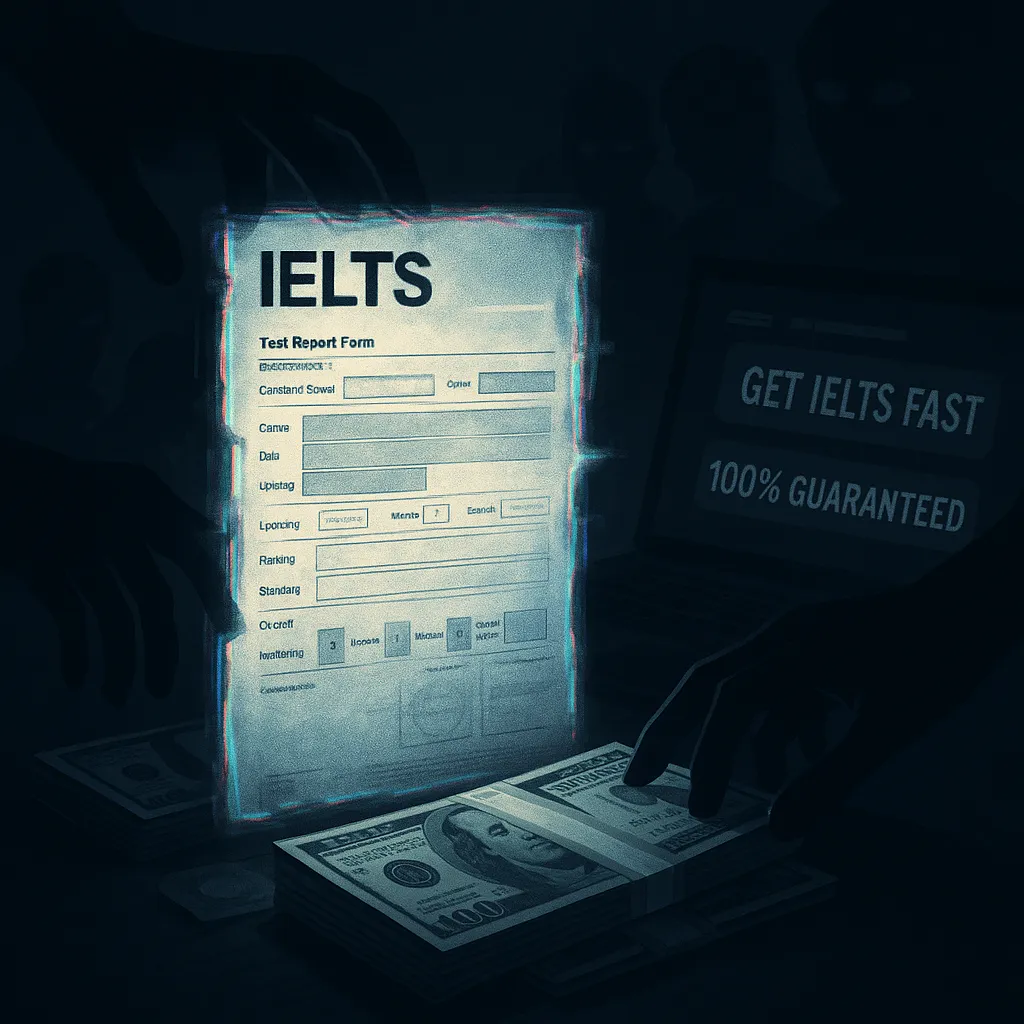
The high demand for IELTS certification has created loopholes for scammers. You may easily encounter enticing offers such as: “Get your certificate in 1-3 days, no study required,” “100% confidential, 100% authentic,” or “Guaranteed pass, original records included.” These advertisements often surge during peak periods like university admissions or graduation seasons, preying on the desire for a quick and easy path to certification.
One of the more sophisticated tactics involves scammers impersonating test centers, claiming to be “IDP Australia AU110” or using non-existent center codes (such as VN015 or AU110). They may claim to organize “online IELTS exams at home” and issue certificates directly, bypassing official authorized bodies (the British Council and IDP Education). This is entirely fraudulent; the IELTS exam is always strictly organized and managed by the British Council and IDP at authorized test locations.
II. The Severe Consequences of Using a Fake IELTS Certificate

Using a fake IELTS certificate not only leads to financial loss but also carries serious repercussions for your personal reputation and legal standing:
- Destroying your reputation and future: If discovered by schools, employers, or organizations, you will face certificate revocation, disciplinary action, suspension from your studies or job, or even expulsion or termination. This stain on your record will significantly hinder your future academic and career prospects, making it difficult to secure suitable opportunities.
- Criminal liability: Under the 2015 Penal Code (Article 341), individuals who forge seals or documents, or use fake documents, may face fines ranging from 30,000,000 VND to 100,000,000 VND, non-custodial reform for up to 3 years, or imprisonment from 6 months to 3 years. For those using fake certificates, Decree 138/2013/NĐ-CP also stipulates fines between 10,000,000 VND and 20,000,000 VND. Civil servants or public employees who use illegal documents for recruitment may be subject to forced resignation.
III. How to Accurately Verify an IELTS Certificate
To protect yourself from these risks, you need to master effective methods for verifying the authenticity of an IELTS certificate.
1. Visual Inspection and Physical Indicators
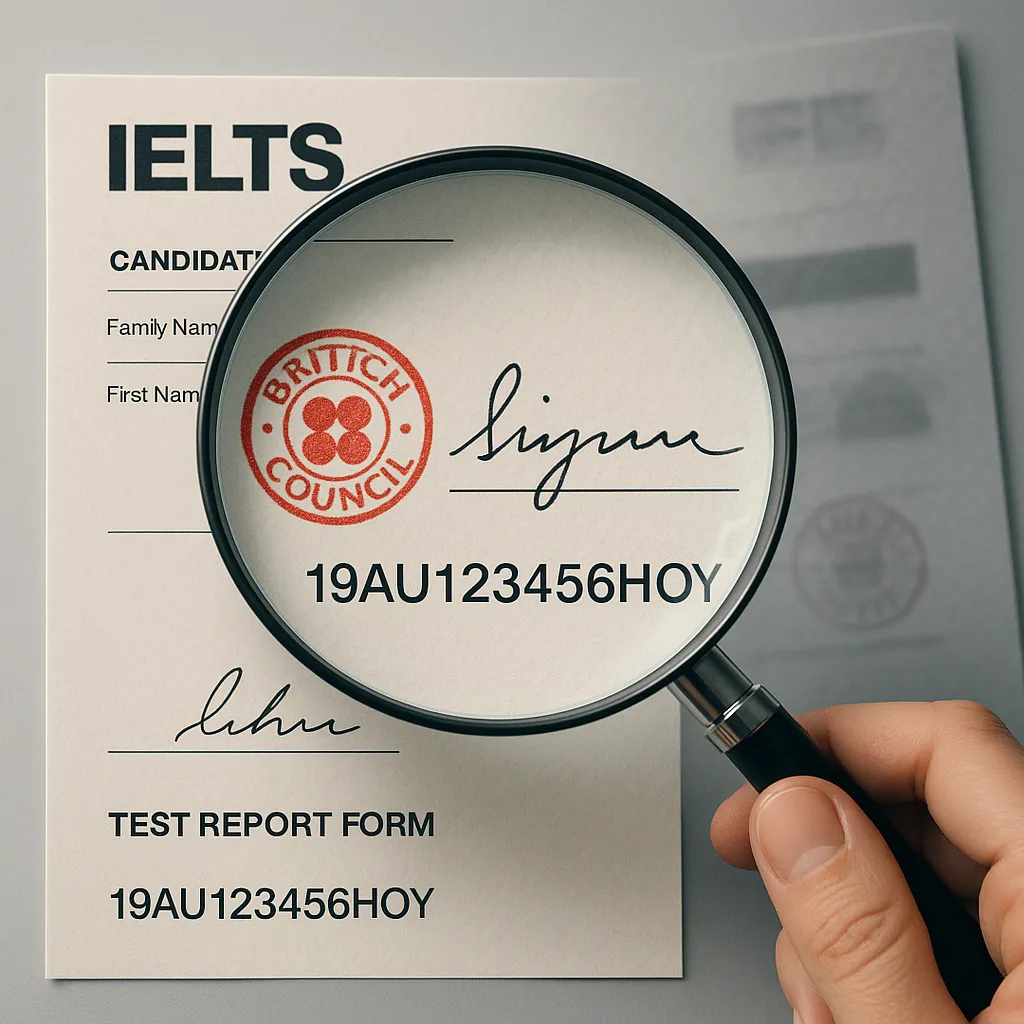
Although fake certificates can be quite sophisticated, there are still distinct features you can identify with the naked eye:
- Processing time: A genuine IELTS certificate typically takes at least 13 days (for paper-based tests) or 5-7 days (for computer-delivered tests) to complete grading, data entry, and delivery. If someone promises a certificate in 1-3 days, it is undoubtedly fake.
- Centre Stamp: The official stamp of the British Council or IDP Education is typically red ink, showing natural smudging from the manual stamping process. Fake stamps are often black or the wrong color, and because they are often printed, the ink lines appear perfectly uniform, lacking natural variation. Be wary of stamps from non-existent centers like “AU110” or “VN015.”
- Signature: Signatures on genuine certificates usually show natural, slight variations, unlike the perfectly uniform signatures found on printed or copied fakes.
- Font and sizing: Compare the document with images of genuine certificates online. Real certificates use consistent fonts and sizes. Fakes often have inconsistent, blurry, or pixelated text.
- Logo and underlining: The logo on a genuine certificate is clear and sharp, usually accompanied by an underline. Fakes may have blurry logos or missing underlines.
- Date format: Genuine certificates always display dates in numeric format (e.g., 13/11/1972 or 27/11/2020). Fakes may spell out the month (e.g., November).
- Candidate Number: The candidate number for both the British Council and IDP is always 6 digits. If the number does not follow this format, be suspicious.
- Test Report Form Number: This number is unique to each candidate and follows a specific logic related to candidate data. Fake certificates often feature numbers that do not follow these rules or do not correspond to the candidate’s actual information.
2. Online Verification via Official Systems
This is the most accurate and reliable method for verifying an IELTS certificate. All candidate results are stored in the official databases of the British Council and IDP.
- Visit the official British Council or IDP websites:
- British Council: Visit https://www.britishcouncil.vn/thi/IELTS/ket-qua
- IDP Vietnam: Visit https://ielts.idp.com/vietnam/results
- Or the global results verification system: https://results.IELTSessentials.com/
- Enter candidate information: You will need to provide details such as the candidate number, date of birth, and identification number (ID card/Citizen ID/Passport).
- Cross-check results: If the information on the certificate matches the system, it is genuine. If there is no record, the information is incorrect, or the verification website is not the official British Council/IDP portal, it is definitely a fake. Be cautious of phishing websites designed to mimic official portals.
3. Verification via Receiving Organizations
Universities, educational institutions, and major companies typically have strict background check procedures for IELTS certificates. They will contact the British Council or IDP directly to verify the validity of the certificate. Therefore, using a fake certificate will inevitably be exposed during this process.
IV. Advice for Candidates and Certificate Users
To avoid falling into the trap of fake IELTS certificates, always remember:
- Study hard, test honestly: The only way to obtain a valid, universally recognized IELTS certificate is through serious study and taking the exam at an official test center.
- Be wary of enticing offers: Do not trust advertisements promising “guaranteed passes,” “fast certificates,” “no testing required,” or “online exams at home” from unverified sources.
- Verify thoroughly: Before submitting a certificate or trusting an IELTS result, apply visual inspection methods and verify it online through the official British Council and IDP systems.
In summary, identifying fake IELTS certificates is a personal responsibility to protect your own rights and future. Stay vigilant, seek information from reliable sources, and say no to fake certificates so that your IELTS score remains a true testament to your English proficiency.
For those committed to honest study and testing, you can find information on IELTS course fees at the ECE language center here.




 Khai giảng Khóa học Hè cực HOT.
No comments yet!