


Tóm Tắt Nội Dung Bài Viết
The IELTS exam is one of the most popular English proficiency tests in the world. However, results don’t always meet a candidate’s expectations. If you feel your score doesn’t accurately reflect your ability, an Enquiry on Results (EOR) is an option worth considering. Let’s dive deeper into this topic with the ECE language center!
When should you request an IELTS Enquiry on Results (EOR)?

You should consider requesting an EOR if:
- Your score in one or more skills (Listening, Reading, Writing, Speaking) is lower than expected and shows a significant discrepancy compared to your previous test results.
- You are confident that you performed better than your score suggests, especially in the Writing and Speaking sections, which involve more subjective assessment.
- You need to improve your score to meet academic or professional requirements and believe that an EOR could lead to a positive change.
General regulations regarding IELTS EOR
- Application deadline: You must submit your EOR request within 6 weeks (42 days) of your test date.
- EOR fee: Approximately 2,310,000 VND (subject to change depending on the test center). This fee is fully refunded if your score changes after the re-mark.
- EOR process:
- Your entire test will be sent to a senior examiner who was not involved in the original marking to be re-evaluated.
- You can request an EOR for one or more skills, applicable to both paper-based and computer-delivered tests.
Processing time typically ranges from 2 to 21 working days, depending on the number of skills requested and the timing of your application.
Candidates must complete an Enquiry on Results (EOR) form at the IDP or British Council test center where they registered. You will need to pay the EOR fee and submit the following documents:
- Copy of your IELTS Test Report Form (TRF).
- ID card/Citizen ID/Passport (the one used during registration).
The EOR results will be sent directly via email or post.
Detailed guide to requesting an IELTS EOR
Guide to requesting an IELTS EOR at IDP
Step 1: Visit the official IDP website to download and complete the IELTS EOR form.
Download link: EOR form for IDP candidates
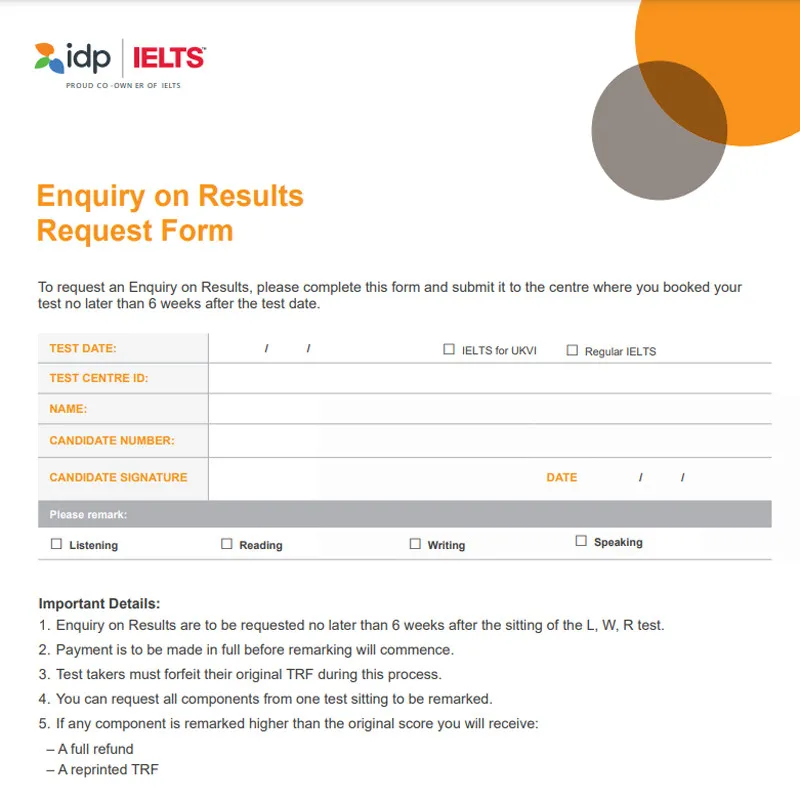
After filling in essential details such as the test date, test center ID, full name, and the skills you wish to have re-marked, you can submit the form through your test center or visit the office in person to complete the process.
Step 2: The EOR fee at IDP is 2,268,000 VND. After payment, keep your receipt, as you will be refunded the fee if your score changes.
Step 3: EOR results are typically announced within 1 to 3 weeks. If your score changes, congratulations on a successful EOR! You will need to visit the test center to collect your new Test Report Form. If your score remains the same, consider this a learning experience to better understand the process and identify more effective study methods.
Step 4: If your score changes, you will receive a refund of your EOR fee within 2 months.
Guide to requesting an IELTS EOR at the British Council
The EOR process at the British Council is quite convenient, with fewer complex requirements than at IDP. Candidates can contact the center directly via phone or email to notify them of their request instead of having to submit paper forms in person. However, you can still follow the traditional paper-based procedure at the British Council if you prefer.
The current IELTS EOR fee at the British Council is 2,160,000 VND. In addition to traditional cash payments, you can use bank transfers. For bank transfers, you must provide the following information:
Payment reference provided via your email (e.g., VN 0088800AAA). Phone numbers should be formatted as: 84-03XXXXXXXX.
Frequently Asked Questions about IELTS EOR

What should you keep in mind when requesting an IELTS EOR?
- IELTS EOR deadline: According to IELTS regulations, candidates can request an EOR within 6 weeks of the test date shown on their official Test Report Form. You may only request an EOR once per test date. You can request a re-mark for the entire test or for one or more individual skills (Reading, Writing, Listening, or Speaking).
- IELTS EOR processing time: Results are typically returned within 2 to 21 days, depending on the type of re-mark, the number of skills requested, and the test center.
- During the EOR process, your original IELTS certificate will be held by the test center. If your score increases, you will be issued a new certificate. If there is no change, your original certificate will be returned to you. This means you cannot use your IELTS score for any purpose while the EOR is in progress.
- When requesting an EOR for the Speaking section, you do not need to retake the test; the examiner will simply listen to the recording of your original test to re-evaluate it.
IELTS EOR fees in Vietnam
As of 2024, the IELTS EOR fees at IDP and the British Council are as follows:
- British Council: 2,160,000 VND
- IDP: 2,268,000 VND
The cost of an IELTS EOR is equivalent to 50% of the original exam fee. This is a significant amount, so think carefully before applying. Furthermore, the fee is only refunded if your score changes; if the result remains the same, the fee will not be returned.
Who should consider an IELTS EOR?
All candidates have the right to request an EOR if they have concerns about their results. If you feel there is a large discrepancy between your official score and your practice test results, you may choose to request an EOR. During the process, your test will be sent to a senior examiner who was not involved in your original assessment and has no knowledge of your previous score. If the EOR is successful, you will receive a new, valid score.
Which skills are most worth re-marking?
While you can request an EOR for any skill, ECE advises against requesting a re-mark for Listening and Reading. Because these sections are objective and based on fixed answer keys, the likelihood of a score change is extremely low.
Writing and Speaking are the skills you should consider for an EOR. Beyond the marking criteria, these sections involve a degree of subjective assessment by the examiners. Therefore, if you choose to have these skills re-evaluated, an increase in your band score is entirely possible.
Can my score decrease after an EOR?
Your IELTS score can decrease after an EOR if the senior examiner determines that your performance does not meet the standard of the original score.
When you request an EOR, your test is marked by an independent examiner who is not associated with the original one. Results can vary between examiners, and scores may increase by 0.5 to 1.0.
An increase of only 0.5 may not significantly change your overall band score. However, for candidates applying for study abroad or scholarships, even a small difference in the Writing score can be crucial. If you are confident in your ability, consider the EOR option carefully.
IELTS band score criteria
IELTS assesses four skills: Listening, Reading, Writing, and Speaking. Each skill has specific criteria and is graded on a scale of 0 to 9 to reflect a candidate’s English proficiency. Below is the assessment breakdown for each skill.
1. Listening
In the Listening section, candidates answer 40 questions based on conversations or short talks. Assessment is based on:
- Understanding main ideas: Grasping the core content of the conversation or talk.
- Identifying details: Accurately answering specific questions, such as names, numbers, or locations.
- Vocabulary comprehension: Understanding the meaning of words and phrases in context.
- Understanding tone and attitude: Grasping the speaker’s emotions and opinions through intonation and context.
Note: The number of correct answers determines your Listening band score. For example, 30-32/40 correct answers typically corresponds to a 7.0 band score.
2. Reading
The Reading section consists of 40 questions based on 3 passages of increasing difficulty. Assessment is based on:
- Finding main ideas and details: Identifying the main points and understanding specific details.
- Recognizing vocabulary and grammar: Understanding vocabulary meanings in various contexts.
- Inference and implication: Recognizing the author’s underlying meanings, opinions, and attitudes.
- Reading speed and accuracy: The ability to read quickly and locate correct answers within the time limit.
Similar to Listening, the number of correct answers determines your Reading band score.
3. Writing
The Writing section consists of two tasks: Task 1 (describing a chart, table, or process) and Task 2 (writing an essay). Assessment is based on four criteria:
- Task Achievement: For Task 1, accurately describing the data. For Task 2, addressing all parts of the prompt and clearly expressing your opinion.
- Coherence and Cohesion: The writing is logical, with well-connected sentences and paragraphs.
- Lexical Resource: Using a wide range of vocabulary accurately and appropriately.
- Grammatical Range and Accuracy: Using a variety of grammatical structures with few errors.
Each criterion is graded from 0 to 9, and the average determines your Writing band score.
4. Speaking
The Speaking section consists of 3 parts: an introduction, a topic-based talk (Cue Card), and an in-depth discussion. Assessment is based on four criteria:
- Fluency and Coherence: Speaking continuously without hesitation and connecting ideas logically.
- Lexical Resource: Using rich, accurate, and contextually appropriate vocabulary.
- Grammatical Range and Accuracy: Using diverse structures and avoiding basic errors.
- Pronunciation: Speaking clearly and naturally with appropriate intonation.
Below is the IELTS band score breakdown:
| Band Score | Level | Description |
| 9.0 | Expert User | Fully operational command of the language: appropriate, accurate, and fluent with complete understanding. |
| 8.0 | Very Good User | Fully operational command with only occasional unsystematic inaccuracies. Handles complex detailed argumentation well. |
| 7.0 | Good User | Operational command, though with occasional inaccuracies and misunderstandings in some situations. Generally handles complex language well. |
| 6.0 | Competent User | Generally effective command despite some inaccuracies and misunderstandings. Can use and understand fairly complex language. |
| 5.0 | Modest User | Partial command, coping with overall meaning in most situations, though likely to make many mistakes. |
| 4.0 | Limited User | Basic competence is limited to familiar situations. Frequent problems in understanding and expression. |
| 3.0 | Extremely Limited User | Conveys and understands only general meaning in very familiar situations. Frequent breakdowns in communication. |
| 2.0 | Intermittent User | No real communication is possible except for the most basic information using isolated words. |
| 1.0 | Non-user | Essentially has no ability to use the language beyond possibly a few isolated words. |
We hope that after exploring the IELTS EOR process with ECE, you have a clearer understanding of this aspect of the exam. You can now study with confidence. If you ever need to request a re-mark, don’t worry—just stay calm and follow the steps we’ve outlined together!
 Khai giảng Khóa học Hè cực HOT.
No comments yet!