


Tóm Tắt Nội Dung Bài Viết
Do you ever feel like your English still sounds “off,” even after studying grammar and vocabulary extensively? Does anxiety about your English pronunciation hold you back from speaking confidently? This is a common struggle for many English learners in Vietnam.
Clear pronunciation doesn’t just help you convey your message effectively; it’s a vital factor in improving your listening comprehension, boosting your confidence, and opening up new opportunities. In this article, featuring insights from the ECE English language center, we’ll explore an effective roadmap for mastering pronunciation, identify common pitfalls, and show you how to “transform” your English speaking skills.
1. Why is accurate English pronunciation so important?
Many people mistakenly believe that vocabulary and grammar are enough for English communication. However, accurate English pronunciation is a core foundation that offers significant benefits:
- Clear communication and avoiding misunderstandings: Incorrect pronunciation can leave listeners confused or, worse, lead to misinterpretations. For example, the difference between sheep /ʃiːp/ and ship /ʃɪp/ can be confusing if you don’t pronounce them accurately.
- Improved listening skills: When you know how a word is correctly pronounced, your brain finds it much easier to recognize that sound when listening to native speakers. Listening and speaking are closely linked.
- Increased speaking confidence: When you’re confident in your pronunciation, you’ll no longer feel shy or anxious when talking to foreigners, allowing you to express yourself freely and engage in conversations.
- Higher scores on international exams: In tests like IELTS Speaking, Pronunciation is one of the four key assessment criteria. Accurate pronunciation helps you achieve a higher band score and demonstrates professionalism.
- Expanded study and career opportunities: In a globalized world, the ability to communicate in English fluently and accurately is a major competitive advantage, helping you feel confident in interviews, presentations, or international negotiations.
2. Key elements of accurate English pronunciation and common mistakes made by Vietnamese learners

To achieve accurate English pronunciation, you need to master the following elements:
- Pronunciation: This includes Vowels, Consonants, and Diphthongs. These are the basic sounds that make up words.
- Word Stress: This involves emphasizing a specific syllable in a multi-syllable word. Misplacing stress can make you hard to understand or even change the meaning of a word. For example: PREsent (noun: a gift) and preSENT (verb: to show).
- Rhythm & Sentence Stress: This is how you emphasize important words in a sentence, creating the natural rise and fall of the language.
- Intonation: This is the pitch variation in a sentence, which conveys attitude and emotion (e.g., rising intonation at the end of Yes/No questions, falling at the end of statements).
- Linking Sounds, Assimilation, and Elision: These are natural phenomena that occur when native speakers talk quickly, causing sounds to blend or change. Mastering these rules helps you listen better and speak more naturally.
- Accent: This is the specific style of pronunciation from a region (British, American, Australian, etc.). The most important thing is to be accurate; choosing an accent is a matter of personal preference and goals.
Common pronunciation mistakes made by Vietnamese learners
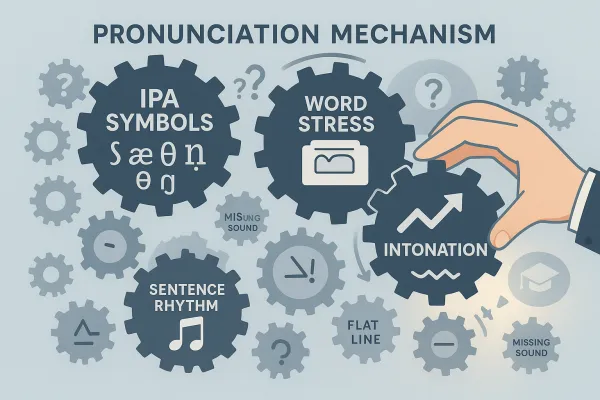
Due to the differences in phonological structure and intonation between Vietnamese and English, Vietnamese learners often encounter these issues:
- Dropping or mispronouncing Ending Sounds: Vietnamese doesn’t have the same aspirated or distinct ending sounds as English, so many learners skip or fail to clearly pronounce sounds like /t/, /d/, /s/, /z/, /f/, /v/, /θ/, /ð/. For example: cat /kæt/ is often pronounced as /kæ/.
- Ignoring word stress: Most English words have stress, but in Vietnamese, syllables are usually spoken with equal pitch and intensity. This makes English sound “flat” and difficult to understand.
- Lack of rhythm and sentence intonation: The habit of speaking in a “monotone” from Vietnamese makes English sentences sound robotic and unnatural, reducing communication effectiveness.
- Confusing similar sound pairs: Pairs like /s/ – /ʃ/, /z/ – /ʒ/, /tʃ/ – /dʒ/, /l/ – /n/, /θ/ – /ð/ are often mixed up.
- Being too rigid and not linking sounds: Pronouncing each word in isolation makes your speech slow and unnatural, creating difficulties for both the speaker and the listener.
3. How to learn accurate English pronunciation from A to Z for beginners
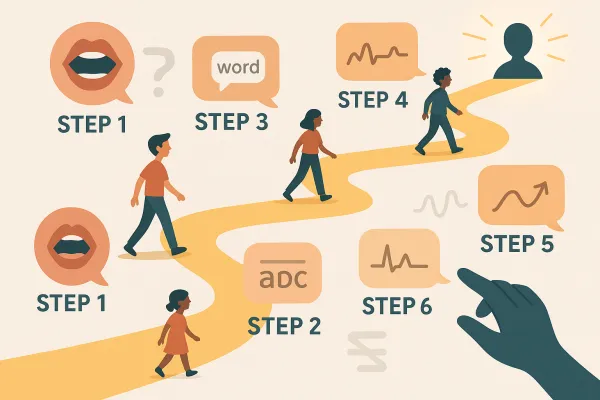
To overcome these mistakes and build a solid foundation, you need a structured learning path and consistent practice.
Get familiar with and master the International Phonetic Alphabet (IPA)
The IPA is an essential “map” for learning accurate English pronunciation. It consists of 44 sounds (20 vowels and 24 consonants). Instead of reading based on spelling (which often leads to errors), the IPA shows you exactly how a word is pronounced, regardless of how it is written.
- Vowels: Learn how to position your tongue and mouth to create 12 monophthongs (short /ɪ/, /e/, /æ/, /ʌ/, /ɒ/, /ʊ/, /ə/ and long /iː/, /ɜː/, /ɑː/, /ɔː/, /uː/) and 8 diphthongs (/eɪ/, /aɪ/, /ɔɪ/, /aʊ/, /əʊ/, /ɪə/, /eə/, /ʊə/).
- Consonants: Distinguish between voiced consonants (vocal cords vibrate) and unvoiced consonants (just breath), and learn how to produce all 24 consonant sounds. Pay special attention to difficult sounds like /θ/, /ð/, /ʃ/, /ʒ/, /tʃ/, /dʒ/.
Advice from ECE: When learning IPA, don’t just look at the symbols. Find video tutorials showing native speakers’ mouth positions and practice along. Record yourself to compare and self-correct.
Master Word Stress
After mastering individual sounds, the next step is learning how to place stress correctly in every word.
- General rules: Learn common patterns, such as stress usually falling on the first syllable of 2-syllable nouns and the second syllable of 2-syllable verbs.
- Stress changes meaning: Pay special attention to pairs like record (noun /ˈrɛkɔːrd/) and record (verb /rɪˈkɔːrd/).
Practice Rhythm & Sentence Stress
This is where you turn isolated words into expressive, natural sentences.
- Emphasize keywords: In English, speakers emphasize content words (nouns, main verbs, adjectives, adverbs) and glide over function words (prepositions, articles, auxiliary verbs).
- Practice with model sentences: Practice speaking along with audio materials, mimicking how native speakers emphasize words to create natural rhythm.
Master Intonation for expressive communication
Intonation is what allows you to convey emotion, attitude, and the deeper meaning of your words.
- Rising/Falling intonation: Master when to raise your pitch (end of Yes/No questions, lists) and when to lower it (end of statements, Wh- questions).
- Distinguish English vs. Vietnamese: Recognize the differences in intonation to avoid the influence of your native language, making your speech sound more natural and “native-like.”
Apply rules for Linking, Assimilation, Elision, and Intrusion
To speak English as naturally as a native, you need to get used to these sound phenomena:
- Linking consonants to vowels: E.g., take_it /teɪk ɪt/ becomes /teɪkɪt/.
- Linking vowels to vowels: Usually by inserting a /w/ or /j/ in between.
- Elision: Dropping a sound when speaking quickly, e.g., next to /nekst tu/ becomes /neks tu/.
4. Effective solutions for learning English pronunciation from ECE
Self-study at home via books or apps is important, but for fast, accurate, and sustainable results—especially if you struggle to self-correct—you need a more comprehensive approach.
- Learn with a professional instructor: Experienced teachers can listen to you and point out specific mistakes, which apps or books cannot do. They provide personalized feedback and tailored exercises to help you overcome your weaknesses.
- Practice in an interactive environment: Practicing with peers or in a classroom helps you apply knowledge to real-life communication, receive feedback, and improve faster.
- Use standard materials and support tools: Combine scientific textbooks, dictionaries with phonetic transcriptions and audio, and pronunciation apps with AI technology.
“Transform” your pronunciation with the “Basic Pronunciation” course at ECE English!
If you are looking for a structured, in-depth, and effective English pronunciation roadmap, the “Basic Pronunciation” course at ECE English is the ideal choice. We understand the specific challenges Vietnamese learners face and have designed a comprehensive program to help you:
- Build a solid foundation: Master the English phonetic system (IPA), from vowels and consonants to stress, rhythm, and intonation in just 5 intensive sessions.
- Thoroughly fix pronunciation errors: Experienced ECE teachers will closely monitor, listen, and provide personalized corrections for each student, helping you eliminate ingrained mistakes caused by native language interference.
- Improve confident communication: Accurate pronunciation helps you speak clearly and fluently, enabling you to communicate confidently with native speakers and in international environments.
- Achieve high scores in exams: Improve your Pronunciation score in IELTS Speaking and other international tests.
The Basic Pronunciation course at ECE stands out with:
- Scientific, structured curriculum: Combining theory and practice, compiled by language experts.
- Focus on practice & personalized correction: Ensuring every student receives maximum support.
- Visual and engaging methods: Learning through images, videos, audio, and interactive games.
- Interactive, open learning environment: Small class sizes (10-20 students) facilitate interaction and learning.
- Dedicated, experienced faculty: Providing knowledge and inspiration.
ECE’s exclusive 5-session roadmap:
- Session 1: Vowel Foundation – Master mouth positioning, distinguish between monophthongs and diphthongs, and long/short vowels.
- Session 2: Conquering Consonants – Decode difficult consonants and combine them naturally.
- Session 3: Syllables & Word Stress – Stress correctly, sound great.
- Session 4: Mastering Rhythm & Sentence Stress – Speak with natural intonation and emphasis.
- Session 5: Intonation – Be more expressive, sound more “native,” and distinguish between English and Vietnamese intonation.
After the course, you will not only pronounce words clearly and accurately but also speak English with natural rhythm, stress, and intonation, allowing you to communicate with total confidence and boost your Speaking scores in international exams.
Accurate English pronunciation is a journey that requires persistence and the right methods. With the knowledge and scientific roadmap provided by ECE English’s pronunciation course, you can completely “transform” your communication skills and open doors to success in both your studies and career.
Contact ECE today for a consultation on the right roadmap and discover your communication potential!
ECE English contact information:
- Hotline: 0971.217.556 – 098.216.6634 – 0985.649.466.
- Website: https://ece.edu.vn.
- Email: info@ece.edu.vn – marketing@ece.edu.vn.
- Campus 1: No. 43, Alley 91 Tran Duy Hung, Cau Giay, Hanoi.
- Campus 2: 16N8B, Alley 7 Hoang Minh Giam, Thanh Xuan, Hanoi.
- Campus 3: House CL11-A2, Alley 118 Nguyen Khanh Toan Street, Quan Hoa, Cau Giay, Hanoi.
 Khai giảng Khóa học Hè cực HOT.
No comments yet!