


Tóm Tắt Nội Dung Bài Viết
Ever wondered why, despite learning so much vocabulary and grammar, your English speaking skills still lack confidence? Or why native speakers sometimes don’t understand you, even when you try your best? The reason likely lies in English pronunciation – and the International Phonetic Alphabet (IPA) is the “guide” to help you solve this problem.
Unlike Vietnamese, where you can often guess pronunciation from spelling, English has significant differences between how words are written and how they are spoken. Therefore, mastering the English IPA chart is not just a foundational skill but also a crucial factor in transforming your communication abilities, listening comprehension, and overall confidence in any situation.
1. What is the IPA Chart?
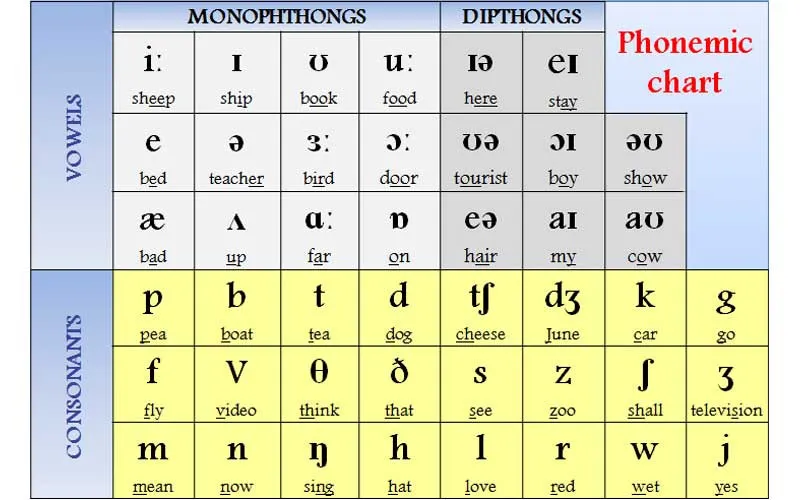
The International Phonetic Alphabet (IPA) is a system of phonetic symbols developed by linguists worldwide to accurately represent each sound in spoken language. Simply put, IPA is the “language of sounds,” enabling you to know exactly how to pronounce a word without having heard it before.
The English IPA chart consists of 44 basic sounds, divided into 20 vowel sounds and 24 consonant sounds. When you look up a word in a dictionary, you’ll always find its IPA transcription enclosed in slashes (/ /) or square brackets ([ ]) next to it.
Why is Learning the English IPA Chart So Important?
- Pronounce Any Word Correctly, Even If You’ve Never Heard It: With IPA, you don’t need to guess pronunciation or rely on repeated listening. Just by looking at the phonetic transcription, you can accurately pronounce any word, even new ones.
Example: The word “read” is pronounced /riːd/ (long vowel) in the present tense but /red/ (short vowel) in the past tense. IPA clearly distinguishes this. Similarly, the word desert can be a noun /ˈdez.ət/ (a barren area) or a verb /dɪˈzɜːrt/ (to abandon), with completely different stress and vowel sounds.
- Significantly Improve Listening Skills: When you understand how a sound is produced and pronounce it correctly, your brain will more easily recognize that sound when listening to native speakers. This helps you understand faster and more accurately, avoiding the “muddled” or unclear listening experience.
- Break Down Communication Barriers and Boost Confidence: Correct pronunciation ensures your message is conveyed clearly and coherently, preventing misunderstandings. When you’re no longer worried about mispronouncing words, you’ll feel much more confident in conversations, opening the door to natural and effective interactions.
- A Solid Foundation for All Skills: Pronunciation is the root of speaking and listening. Mastering IPA is a crucial stepping stone for the comprehensive development of your other English skills.
2. Structure of the English IPA Chart: A System of 44 Standard Sounds
To master the International Phonetic Alphabet for English, we will delve into each sound group, how to pronounce them, and common mistakes made by Vietnamese speakers.
2.1. Vowels – 20 sounds
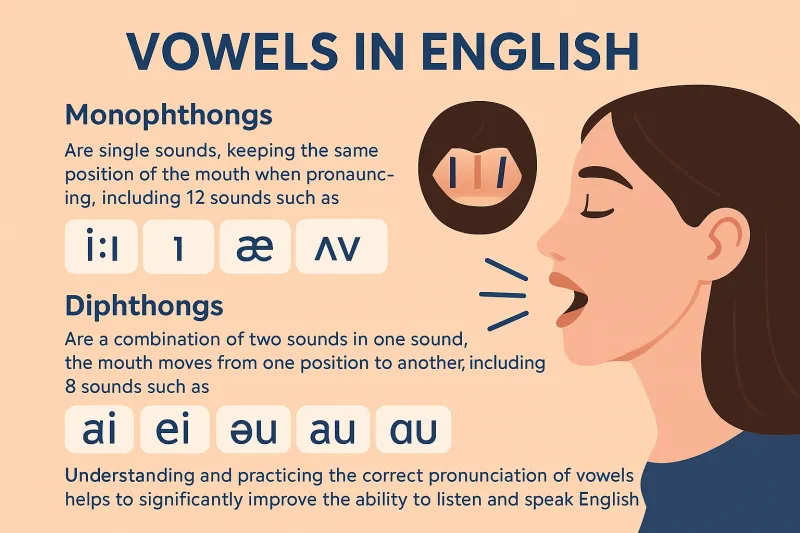
Vowels are sounds produced when the airflow from the lungs passes out without obstruction.
a. Monophthongs – 12 sounds
These are basic sounds pronounced with a single, fixed position of the tongue and lips.
- /ɪ/ (Short i):
How to pronounce: Similar to the “i” sound in Vietnamese but shorter and sharper. Lips are slightly spread sideways, tongue is lowered and relaxed.
Examples: sit /sɪt/, pin /pɪn/, fish /fɪʃ/
Common Vietnamese Mistakes & Solutions: Often prolonged into the /iː/ sound. You need to produce the sound very quickly and distinctly.
- /iː/ (Long ee):
How to pronounce: Prolong the “ee” sound, as in “see.” The sound comes from within the mouth, not expelled as air. Lips are spread wide sideways, as if smiling, and the tongue is raised high.
Examples: see /siː/, tree /triː/, sleep /sliːp/
Common Vietnamese Mistakes & Solutions: Often pronounced like the Vietnamese “i” without the length. You need to maintain a “tense” mouth shape and lengthen the sound.
- /e/ (Short e):
How to pronounce: Similar to the Vietnamese “e” but shorter. Lips are spread wider sideways than for /ɪ/, and the tongue is lowered more than for /ɪ/.
Examples: pen /pen/, bed /bed/, friend /frend/
Common Vietnamese Mistakes & Solutions: Easily confused with /æ/ or /ɪ/. Maintain a moderate mouth opening and keep it short.
- /æ/ (Flat a):
How to pronounce: A “flat a” sound, somewhat like a mix of “a” and “e,” feeling like the sound is compressed downwards. The mouth is opened wide, the lower lip is lowered, and the tongue is very low.
Examples: cat /kæt/, man /mæn/, bad /bæd/
Common Vietnamese Mistakes & Solutions: Often pronounced like the Vietnamese “a.” You need to open your mouth wide and flat, lowering your jaw more.
- /ʌ/ (Short u):
How to pronounce: A sound between the Vietnamese “ă” and “ơ,” leaning more towards “ă.” The sound must be expelled with a puff of air. The mouth is narrowed, and the tongue is slightly raised.
Examples: cup /kʌp/, love /lʌv/, sun /sʌn/
Common Vietnamese Mistakes & Solutions: Often pronounced as “a” or “ơ.” You need to expel the sound strongly, shortly, and decisively from the throat.
- /ɒ/ (Short o):
How to pronounce: Similar to the Vietnamese “o” but pronounced shorter. Lips are slightly rounded, and the tongue is lowered.
Examples: hot /hɒt/, dog /dɒɡ/, box /bɒks/
Common Vietnamese Mistakes & Solutions: Often prolonged into “o.” You need to maintain the shortness and moderate lip rounding.
- /uː/ (Long oo):
How to pronounce: The sound comes from the mouth but is not expelled as air; it’s a prolonged short “u” sound. Lips are rounded, and the tongue is raised high.
Examples: moon /muːn/, food /fuːd/, school /skuːl/
Common Vietnamese Mistakes & Solutions: Often pronounced like the Vietnamese “u” without length and lip rounding. You need to maintain lip rounding and lengthen the sound.
- /ʊ/ (Short oo):
How to pronounce: Quite similar to the Vietnamese “ư” sound. When pronouncing, do not use the lips but expel a very short puff of air from the throat. Lips are slightly rounded, and the tongue is lowered.
Examples: book /bʊk/, look /lʊk/, good /ɡʊd/
Common Vietnamese Mistakes & Solutions: Often confused with /uː/. You need to pronounce it shortly, relaxing your lips and tongue.
- /ɑː/ (Long a):
How to pronounce: A prolonged “ah” sound, originating from the mouth. Lips are spread wide, and the tongue is lowered.
Examples: car /kɑːr/, start /stɑːrt/, father /ˈfɑːðər/
Common Vietnamese Mistakes & Solutions: Often pronounced like the Vietnamese “a” without depth and length. You need to open your mouth comfortably, relax your tongue, and lengthen the sound.
- /ɔː/ (Long o):
How to pronounce: Like the Vietnamese “o” but then curling the tongue up (if there’s an R). The sound comes from deep within the mouth. Round your lips and curl your tongue up to touch the roof of your mouth at the end of the sound.
Examples: talk /tɔːk/, law /lɔː/, door /dɔːr/
Common Vietnamese Mistakes & Solutions: Often pronounced as a regular “o.” You need to round your lips and feel the sound deep in your throat, prolonging it.
- /ɜː/ (Long er):
How to pronounce: A long “er” sound. Pronounce it as “ơ” but curl your tongue up (for American English), with the sound originating from the mouth. Lips are slightly spread, the tongue curls up, touching the roof of your mouth at the end of the sound.
Examples: bird /bɜːrd/, word /wɜːrd/, first /fɜːrst/
Common Vietnamese Mistakes & Solutions: Often pronounced as a regular “ơ.” Pay attention to curling your tongue inward (r-colored vowel) and lengthening the sound.
- /ə/ (Schwa – unstressed “ơ”):
How to pronounce: The schwa sound (ə) is a short, unstressed sound, commonly found in unstressed syllables. The lips and tongue are in a neutral position, without muscle tension.
Examples: about /əˈbaʊt/, banana /bəˈnænə/, doctor /ˈdɒktər/
Common Vietnamese Mistakes & Solutions: Often stressed or pronounced too clearly. You need to pronounce it very lightly, relaxed, almost “swallowing” the sound.
b. Diphthongs – 8 sounds
These are combinations of two monophthongs, where the first sound is stronger and smoothly glides into the second.
- /eɪ/ (ei):
How to pronounce: Glides smoothly from the /e/ sound to the /ɪ/ sound. Lips gradually spread sideways, and the tongue gradually moves upward.
Examples: face /feɪs/, day /deɪ/, make /meɪk/
Common Vietnamese Mistakes & Solutions: Often pronounced like the Vietnamese “ây.” You need to feel the slight glide from “e” to “i.”
- /aɪ/ (ai):
How to pronounce: Glides from the /ɑː/ sound to the /ɪ/ sound. Lips spread sideways gradually, and the tongue raises and moves forward slightly.
Examples: my /maɪ/, light /laɪt/, time /taɪm/
Common Vietnamese Mistakes & Solutions: Often pronounced rigidly. You need to glide the sound smoothly without interruption.
- /ɔɪ/ (oi):
How to pronounce: Glides from the /ɔː/ sound to the /ɪ/ sound. Lips spread sideways gradually, and the tongue raises and moves forward slightly.
Examples: boy /bɔɪ/, choice /tʃɔɪs/, noise /nɔɪz/
Common Vietnamese Mistakes & Solutions: Pronounced rigidly or lacking the glide. Pay attention to the initial lip rounding and tongue movement.
- /əʊ/ (ou):
How to pronounce: Glides from the /ə/ sound to the /ʊ/ sound. Lips move from slightly open to slightly rounded, and the tongue moves backward.
Examples: go /ɡəʊ/, snow /snəʊ/, boat /bəʊt/
Common Vietnamese Mistakes & Solutions: Often pronounced as a single “ô” sound. You need to feel the lip movement from open to slightly rounded.
- /aʊ/ (au):
How to pronounce: Glides from the /ɑː/ sound to the /ʊ/ sound. Lips gradually round, and the tongue moves slightly backward.
Examples: cow /kaʊ/, house /haʊs/, mouth /maʊθ/
Common Vietnamese Mistakes & Solutions: Often pronounced like the Vietnamese “ao.” Pay attention to the lip rounding at the end of the sound and the glide.
- /ɪə/ (ea):
How to pronounce: Glides from the /ɪ/ sound to the /ə/ sound. Lips spread gradually but not too wide, and the tongue moves forward slightly.
Examples: near /nɪər/, here /hɪər/, idea /aɪˈdɪə/
Common Vietnamese Mistakes & Solutions: Often pronounced rigidly like “ia.” You need a smooth glide and relaxation.
- /eə/ (ea):
How to pronounce: Glides from the /e/ sound to the /ə/ sound. Lips slightly narrow, and the tongue moves backward.
Examples: hair /heər/, care /keər/, square /skweər/
Common Vietnamese Mistakes & Solutions: Often pronounced as a single “e” sound or lacking the glide.
- /ʊə/ (oo):
How to pronounce: Glides from the /ʊ/ sound to the /ə/ sound. Lips are rounded, slightly spread outwards. The middle of the tongue raises towards the hard palate, then the mouth opens slightly, and the tongue moves back to the middle of the mouth.
Examples: tour /tʊər/, cure /kjʊər/, sure /ʃʊər/
Common Vietnamese Mistakes & Solutions: This sound is less common and often pronounced rigidly like “ua.” You need to feel the smooth glide of the sound.
2.2. Consonants – 24 sounds
Consonants are sounds produced when the airflow from the lungs is obstructed by parts of the mouth (lips, teeth, tongue, palate).
- /p/ (Voiceless Plosive):
How to pronounce: Both lips close, blocking airflow, then release it sharply. No vocal cord vibration.
Examples: pen /pen/, stop /stɒp/, apple /ˈæpəl/
Common Vietnamese Mistakes & Solutions: Often lacks aspiration. Place your hand in front of your mouth; if you feel a strong puff of air, it’s correct.
- /b/ (Voiced Plosive):
How to pronounce: Similar to /p/ but with vocal cord vibration. Both lips close, release, and the throat vibrates.
Examples: back /bæk/, job /dʒɒb/, baby /ˈbeɪbi/
Common Vietnamese Mistakes & Solutions: Often pronounced as /p/ if vocal cord vibration is not noticed.
- /t/ (Voiceless Plosive):
How to pronounce: The tip of the tongue touches the alveolar ridge (behind the upper front teeth), blocking airflow, then releases it sharply. No vocal cord vibration.
Examples: time /taɪm/, get /ɡet/, water /ˈwɔːtər/
Common Vietnamese Mistakes & Solutions: Often lacks aspiration and the puff of air is weak.
- /d/ (Voiced Plosive):
How to pronounce: Similar to /t/ but with vocal cord vibration. The tip of the tongue touches the alveolar ridge, releases, and the throat vibrates.
Examples: day /deɪ/, end /end/, ladder /ˈlædər/
Common Vietnamese Mistakes & Solutions: Easily confused with /t/ if vocal cords are not vibrated.
- /k/ (Voiceless Plosive):
How to pronounce: The back of the tongue raises to touch the soft palate, blocking airflow, then lowers, releasing air sharply. No vocal cord vibration.
Examples: cat /kæt/, back /bæk/, kick /kɪk/
Common Vietnamese Mistakes & Solutions: Lacks aspiration.
- /g/ (Voiced Plosive):
How to pronounce: Similar to /k/ but with vocal cord vibration. The back of the tongue raises to touch the soft palate, releases, and the throat vibrates.
Examples: go /ɡəʊ/, dog /dɒɡ/, game /ɡeɪm/
Common Vietnamese Mistakes & Solutions: Easily confused with /k/.
- /tʃ/ (Voiceless Affricate):
How to pronounce: Lips are slightly rounded and protruded. The tip of the tongue touches the hard palate, then releases gently, expelling air. No vocal cord vibration.
Examples: chair /tʃeər/, watch /wɒtʃ/, match /mætʃ/
Common Vietnamese Mistakes & Solutions: Easily pronounced as “tr” in Vietnamese. Pay attention to rounding your lips and not curling your tongue too deeply.
- /dʒ/ (Voiced Affricate):
How to pronounce: Similar to /tʃ/ but with vocal cord vibration. Lips are slightly rounded, the tongue touches the palate, releases, and the throat vibrates.
Examples: judge /dʒʌdʒ/, age /eɪdʒ/, gym /dʒɪm/
Common Vietnamese Mistakes & Solutions: Easily confused with /tʃ/ or the Vietnamese “gi.”
- /f/ (Voiceless Fricative):
How to pronounce: The upper teeth lightly touch the lower lip, expelling a stream of air. No vocal cord vibration.
Examples: fish /fɪʃ/, leaf /liːf/, coffee /ˈkɒfi/
Common Vietnamese Mistakes & Solutions: Often pronounced as “p” if the airflow is not noticed.
- /v/ (Voiced Fricative):
How to pronounce: Similar to /f/ but with vocal cord vibration. The upper teeth lightly touch the lower lip, expelling air, and the throat vibrates.
Examples: van /væn/, love /lʌv/, move /muːv/
Common Vietnamese Mistakes & Solutions: Often pronounced as “ph.”
- /θ/ (Voiceless Th):
How to pronounce: Gently place the tip of your tongue between your front teeth and blow air out. No vocal cord vibration.
Examples: think /θɪŋk/, three /θriː/, bath /bɑːθ/
Common Vietnamese Mistakes & Solutions: Often pronounced as /t/ or /s/. Practice protruding your tongue slightly between your teeth and blowing air.
- /ð/ (Voiced Th):
How to pronounce: Similar to /θ/ but with vocal cord vibration. Gently place the tip of your tongue between your front teeth, blow air out, and vibrate your throat.
Examples: this /ðɪs/, that /ðæt/, mother /ˈmʌðər/
Common Vietnamese Mistakes & Solutions: Often pronounced as /d/ or /z/. Pay attention to vibrating your vocal cords.
- /s/ (Voiceless S):
How to pronounce: The tip of the tongue is placed lightly near the upper alveolar ridge, the soft palate is raised, and airflow escapes between the middle of the tongue and the ridge. No vocal cord vibration.
Examples: sun /sʌn/, bus /bʌs/, sister /ˈsɪstər/
Common Vietnamese Mistakes & Solutions: Easily confused with /ʃ/. Keep your tongue flatter and avoid rounding your lips.
- /z/ (Voiced Z):
How to pronounce: Similar to /s/ but with vocal cord vibration. The tongue is placed lightly near the upper alveolar ridge, air escapes between the tongue and the ridge, and the throat vibrates.
Examples: zoo /zuː/, lazy /ˈleɪzi/, buzz /bʌz/
Common Vietnamese





 Khai giảng Khóa học Hè cực HOT.
No comments yet!