
Tóm Tắt Nội Dung Bài Viết
The SAT Math section tests not only your computational skills but also your ability to apply theoretical concepts to real-world scenarios. By mastering fundamental concepts in arithmetic, algebra, geometry, and trigonometry, you can easily identify question types, apply the appropriate methods, and avoid common pitfalls.
To help you prepare, the ECE Language Center has compiled a comprehensive guide to the most common mathematical definitions and terms you will encounter on the SAT Math test. Let’s dive in!
What types of math problems appear on the SAT?
According to official information from the College Board, the math section lasts 70 minutes and consists of 44 questions divided into two 35-minute modules. Each module includes two types of questions: multiple-choice (75%) and student-produced responses (25%). You are permitted to use a calculator throughout the entire test.
There are four domains of math covered in the official SAT:
- Algebra: 13 – 15 questions. This domain requires you to analyze and solve linear equations and inequalities, as well as systems of linear equations and inequalities.
- Advanced Math: 13 – 15 questions. This domain requires you to solve and analyze equivalent expressions, nonlinear equations in one variable, and systems of nonlinear equations.
Note: Nonlinear functions include quadratic, polynomial, exponential, absolute value, rational, and radical functions.
- Problem Solving and Data Analysis: 5 – 7 questions. This third domain requires you to work with percentages, ratios, rates, proportions, and data interpretation. You must be able to calculate probability, conditional probability, and evaluate statistical data tables. Additionally, this section may include questions related to calculating and comparing the mean, median, mode, range, and standard deviation of a dataset.
- Geometry and Trigonometry: 5 – 7 questions. For this final domain, you will be asked to solve problems involving perimeter, area, and volume for various shapes, as well as answer questions about angles, triangles, right triangles, trigonometry, and circles.
Glossary of SAT Math Terms, Definitions, and Concepts
1. Arithmetic
- Natural numbers: Positive integers starting from 1 and increasing infinitely (1, 2, 3, 4, 5, …). The set of natural numbers is often denoted by ℕ.
- Integers: Whole numbers without fractional parts, including negative integers, zero, and positive integers.
Example: -3, 0, 5.
- Real numbers: All numbers that can be represented on a number line, including both rational and irrational numbers.
- Rational numbers: Numbers that can be written as a fraction a/b, where a and b are integers and b≠0.
Example: 3/5, 4/6, 2/7.
- Irrational numbers: Numbers that cannot be expressed as a simple fraction.
Example: π ≈ 3.14159 is an irrational number because it cannot be represented exactly as a fraction (its decimal digits continue infinitely without repeating).
(Euler’s number): An important mathematical constant, approximately 2.71828, which is also an irrational number.
- Prime numbers: Integers greater than 1 that have only two factors: 1 and themselves.
Example: 2, 3, 5, 7.
- Greatest Common Divisor (GCD): The largest integer that divides two or more numbers without leaving a remainder.
Example: The GCD of 12 and 18 is 6.
- Least Common Multiple (LCM): The smallest number that is a multiple of two or more numbers.
Example: The LCM of 4 and 6 is 12.
- Exponents: A representation of a number multiplied by itself a specific number of times.
Example: 2^3 = .
- Square roots: A value that, when multiplied by itself, gives the original number.
- Percentage: A part per 100.
Example: 25% is equivalent to 25/100 or 0.25.
- Ratios: A comparison between two quantities.
Example: A 3:2 ratio means that for every 3 parts of one quantity, there are 2 parts of another.
- Proportions: An equation stating that two ratios are equal.
Example: a/b = c/d.
- Even number: An integer divisible by 2. Even numbers always end in 0, 2, 4, 6, or 8.
Example: 2, 4, 6, 8, 10.
- Odd number: An integer not divisible by 2. Odd numbers always end in 1, 3, 5, 7, or 9.
Example: 1, 3, 5, 7, 9.
- Perfect square: A natural number that is the square of an integer.
Example: 1, 4, 9, 16, 25.
- Positive number: A number greater than 0. Positive numbers are located to the right of 0 on the number line.
Example: 1, 2.5, 100, …
- Negative number: A number less than 0. Negative numbers are located to the left of 0 on the number line.
Example: -1, -3.14, -100, …
- Complex number: A number in the form a + bi, where a and b are real numbers and i is the imaginary unit (i² = -1).
Example: 2 + 3i, -1 – i, 5i
2. Algebra
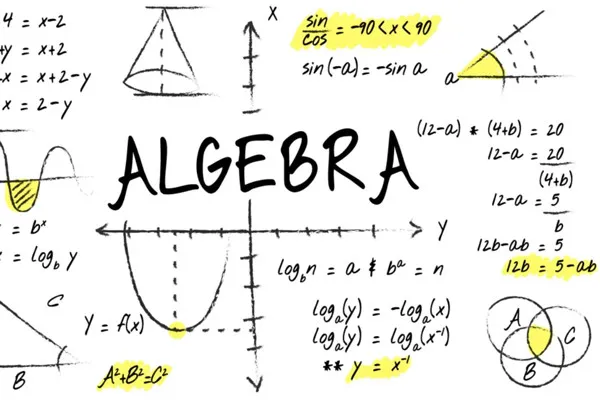
- Algebraic expressions: A mathematical phrase involving variables, numbers, and operations.
Example: 3x + 5
- Linear equations: Equations of the form ax + b = 0 where a and are constants.
Example: 2x + 3 = 7.
- Systems of linear equations: A set of two or more linear equations that must be solved simultaneously.
Example: {x + y = 6; 2x – y = 4
- Quadratic equations: Equations of the form ax^2 + bx + c = 0.
Example: x^2 – 5x + 6 = 0.
- Functions: A relationship between an input (x) and an output (y), denoted as f(x).
Example: f(x) = 2x + 3.
- Inequalities: Similar to equations but using inequality symbols (> , < , ≥ , ≤).
Example: 2x + 5 > 9.
3. Geometry

- Square: A quadrilateral with four equal sides and four right angles.
- Circle: The set of all points equidistant from a fixed point (the center).
- Triangle: A polygon with three sides. The sum of the interior angles is 180°.
- Pythagorean theorem: In a right triangle, the sum of the squares of the two legs equals the square of the hypotenuse: a^2 + b^2 = c^2
- Cube: A 3D shape with 6 equal square faces.
- Cylinder: A 3D shape with two parallel circular bases and a height h.
4. Trigonometry
-
Unit circle: A circle with a radius of 1 centered at the origin (0, 0). The unit circle is used to define the trigonometric functions sine, cosine, and tangent.
- Sine (sin): The ratio of the opposite side to the hypotenuse in a right triangle.
- Cosine (cos): The ratio of the adjacent side to the hypotenuse in a right triangle.
- Tangent (tan): The ratio of the opposite side to the adjacent side in a right triangle.
- Inverse trigonometric functions: arcsin, arccos, arctan.
5. Data Analysis
- Mean: The average of a set of values, calculated by dividing the sum of the values by the number of values.
- Median: The middle value in a dataset when arranged in ascending order.
- Mode: The value that appears most frequently in a dataset.
- Probability: The likelihood of an event occurring.
- Scatter plots: A graph showing the relationship between two variables.
6. Basic Operations
- Addition: The process of calculating the total of two or more numbers. Symbol: +.
Example: 3 + 5 = 8.
- Subtraction: The process of finding the difference between two numbers. Symbol: −.
Example: 7 − 4 = 3.
- Multiplication: The process of calculating the product of two or more numbers. Symbols: × or *.
Example: 6 × 4 = 24.
- Division: The process of splitting a number into equal parts. Symbols: / or ÷.
Example: 12 ÷ 3 = 4
- Exponentiation: The process of raising a number (the base) to a power (the exponent). Symbol: ^.
Example: 2^3 = 8.
- Root: The inverse of exponentiation. Common examples include square roots and cube roots.
Example: The square root of 16 is 4.
- Statistics: Methods for analyzing, summarizing, and drawing conclusions from data. Common measures include:
-
- Mean: The average of the values.
- Median: The middle value of an ordered set.
- Mode: The most frequent value in a set.
- Probability: Measuring the likelihood of an event occurring.
We hope this overview of the four SAT math domains and their associated definitions helps you feel more confident on your journey to conquering the SAT. Good luck!





 Khai giảng Khóa học Hè cực HOT.
Chưa có bình luận nào!