


Tóm Tắt Nội Dung Bài Viết
The IELTS Speaking test, with its face-to-face interaction with an international examiner, is always an exciting yet demanding challenge for many candidates. It is not a casual conversation but a strictly structured three-part test with a rigorous grading system. To achieve your target band score, it is crucial to fully understand the criteria examiners use for assessment. This article provides a detailed breakdown of the four official IELTS Speaking assessment criteria, helping you focus your preparation effectively and approach the test with confidence.
1. The four golden criteria that determine your IELTS Speaking score
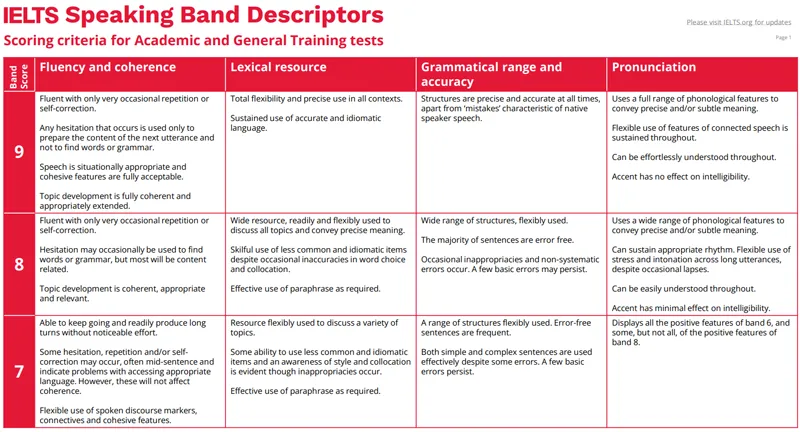
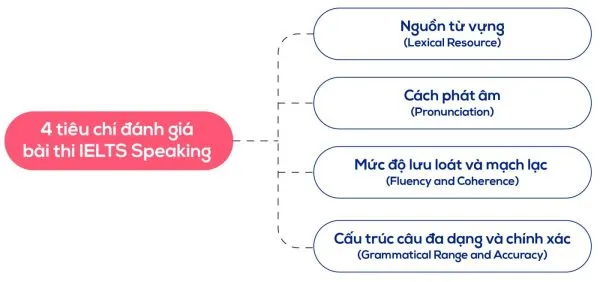
The IELTS Speaking test (both Academic and General) is evaluated based on four criteria, each weighted equally. Your final score is the average of these four criteria, calculated on a scale from 0 to 9.
- Fluency and Coherence (FC): The ability to speak fluently and naturally, connecting ideas logically and in a way that is easy to follow.
- Lexical Resource (LR): The ability to use a wide range of vocabulary accurately and flexibly, including idioms and less common words appropriate to the topic.
- Grammatical Range and Accuracy (GRA): The ability to use a variety of grammatical structures (from simple to complex) accurately and flexibly.
- Pronunciation (P): The ability to produce sounds and words clearly, using appropriate intonation and stress to convey meaning.
2. Detailed analysis of each criterion & how to improve
2.1. Fluency and Coherence
- This criterion assesses:
- Speaking rate: Speaking continuously and naturally, neither too fast nor too slow.
- Hesitation: Pausing to think is acceptable, but not too frequently or for too long. The ability to self-correct or repeat ideas reasonably to keep the answer flowing.
- Use of connectives/discourse markers: Using words/phrases (linking words, discourse markers) to connect ideas and organize answers logically, making it easy for the listener to follow (e.g., First, Next, However, Another thing is…, Well, I believe…).
- Length and relevance: Answers should be of appropriate length for each part of the test and stay focused on the question.
- Band Score Descriptions (Band 5 – 9):
- Band 9: Speaks extremely fluently with rare hesitation or repetition. Develops topics fully and coherently.
- Band 8: Speaks fluently with minimal hesitation/repetition. Develops topics coherently and accurately.
- Band 7: Speaks at length and fluently, occasionally hesitating to find words. Uses connectives flexibly.
- Band 6: Attempts to speak at length but is sometimes incoherent due to confusion, repetition, or self-correction. Uses connectives but not always appropriately.
- Band 5: Relatively coherent but frequently hesitates and repeats ideas. Overuses simple connectives. Handles short sentences well but struggles with complex ones.
- Tips for improvement:
- Expand your answers: Don’t just say “Yes/No.” Explain your reasons, provide examples, or tell a related story. Ask yourself “WH” questions (What, When, Where, Why, Who, How) to develop your ideas.
- Use connectives effectively: Learn and practice a variety of linking words/phrases, especially for Part 2, to give your speech a clear structure.
- Practice regularly: Speak on a wide range of topics to build confidence and improve your reflexes.
- Focus on coherence: Think about how to organize your ideas before speaking to ensure they flow logically.
- Be concise and stay on topic: Deliver content clearly, stay focused, and avoid unnecessary repetition or going off-topic.
2.2. Lexical Resource
- This criterion assesses:
- Vocabulary range: Using a wide enough vocabulary to discuss various topics.
- Accuracy & appropriateness: Choosing words with the correct meaning, in the right context, with the correct word form (e.g., bored vs boring) and collocations (e.g., environmental pollution).
- Use of less common words & idioms: Using advanced vocabulary and idioms naturally and accurately (crucial for band 7+).
- Paraphrasing ability: Effectively rephrasing questions or your own ideas when you can’t recall a specific word or to avoid repetition.
- Band Score Descriptions (e.g., Band 5-9):
- Band 9: Uses vocabulary with extreme flexibility, accuracy, and naturalness across all topics. Uses idioms skillfully.
- Band 8: Wide and flexible vocabulary, used accurately. Uses less common words/idioms well. Paraphrases effectively.
- Band 7: Uses vocabulary flexibly for various topics. Uses less common words/idioms, though occasionally with minor errors. Paraphrases effectively.
- Band 6: Sufficient vocabulary to discuss details and express meaning accurately. Occasional word choice errors. Paraphrasing is generally successful.
- Band 5: Can talk about topics but with limited vocabulary. Attempts to paraphrase but not always effectively.
- Tips for improvement:
- Learn vocabulary by topic: Systematize your vocabulary according to common themes (Education, Environment, Technology, Health, Culture…).
- Practice paraphrasing: Use synonyms/antonyms, change word forms (noun -> verb), and vary sentence structures.
- Learn collocations: Learn words that naturally go together to sound more native.
- Use idioms naturally: Learn common idioms and their correct context, avoiding overuse or misuse.
- Read and listen extensively: Expose yourself to English through books, articles, and films to absorb vocabulary and usage.
2.3. Grammatical Range and Accuracy
- This criterion assesses:
- Range of structures: The ability to use a mix of simple and complex sentence structures flexibly.
- Accuracy: The level of adherence to grammatical rules (tenses, word forms, sentence structure, articles, prepositions, subject-verb agreement, singular/plural…).
- Frequency and impact of errors: Examiners consider the number of errors and how much they hinder the listener’s understanding.
- Band Score Descriptions (Band 5-9):
- Band 9: Uses a wide range of grammatical structures naturally and with absolute accuracy.
- Band 8: Uses a variety of structures flexibly. Sentences are mostly error-free, with only rare, unsystematic minor errors.
- Band 7: Uses complex structures flexibly. Most sentences are error-free. Still has a few minor grammatical errors.
- Band 6: Combines simple and complex sentences but not always flexibly. Frequently makes errors in complex sentences, sometimes causing confusion.
- Band 5: Uses basic sentence structures correctly. Limited use of complex sentences, often with errors that make ideas less coherent.
- Tips for improvement:
- Master the basics: Ensure accurate use of simple sentence structures (S-V-O) and basic tenses.
- Learn and practice complex sentences: Focus on structures like relative clauses (who, which, that…), conditional sentences (If…), clauses of reason/result/contrast (because, so, although…), and compound sentences (using and, but, or…).
- Use a variety of tenses: Combine past, present, and future tenses accurately and logically when telling stories or presenting ideas.
- Pay attention to common errors: Identify your recurring mistakes (articles, prepositions, S-V agreement, singular/plural) and focus on correcting them.
- Check for accuracy: Record your speaking and check for grammatical errors yourself, or ask a professional for feedback.
2.4. Pronunciation
- This criterion assesses:
- Intelligibility: Whether the listener can understand you easily.
- Sound and word pronunciation: Pronouncing vowels, consonants, and ending sounds accurately and clearly.
- Other features: Using features such as word stress, sentence stress, intonation, and rhythm to clarify meaning and make your speech more natural. Examiners listen for how you use stress and intonation to emphasize points or create contrast.
- Influence of L1 accent: Whether your native accent affects your intelligibility.
- Band Score Descriptions (Band 5-9):
- Band 9: Pronunciation is accurate, natural, and sounds native-like.
- Band 8: Pronunciation is proficient and easy to understand. There may be a slight accent, but it does not hinder the listener.
- Band 7: Achieves the strengths of Band 6 and some of Band 8.
- Band 6: Uses many pronunciation features but lacks consistent control. Generally easy to understand despite some errors in word/sound pronunciation.
- Band 5: Pronunciation is generally intelligible. Has some strengths of Band 6 but with many limitations.
- Tips for improvement:
- Master the IPA chart: Learn to pronounce every vowel and consonant correctly. Pay special attention to ending sounds.
- Practice stress & intonation: Learn how to stress words and sentences correctly and use intonation to express emotion and meaning.
- Listen and shadow: Listen to native speakers (via films, podcasts, news…) and try to imitate their pronunciation, stress, and linking.
- Record and self-evaluate: Record your voice, listen back, and compare it with native speakers, or ask a teacher/friend for feedback.
- Correct errors immediately: If you realize you mispronounced a word during the test, stay calm and correct it.
- Speak clearly and control your speed: Don’t speak too fast; maintain a moderate, clear pace.
3. General tips for the IELTS Speaking test
Beyond mastering the four criteria above, keep these points in mind to optimize your performance:
- Never memorize answers: Examiners are experienced enough to spot memorized responses, which will negatively affect your score. Practice ideas and vocabulary for various topics instead.
- Stay on topic: Listen carefully to the question. If you are unsure, you can ask the examiner to repeat it (but don’t overdo it). If you go off-topic, try to steer the conversation back to the main point.
- Always expand your answers: Avoid “Yes/No” answers. Explain, provide reasons, and give illustrative examples to showcase your language ability.
- Maintain confidence and interaction: Although body language isn’t graded, maintaining eye contact, smiling, and appearing confident creates a comfortable atmosphere, helping you speak more naturally and fluently.
After reading this article, you should definitely check out:
Effective ways to study for IELTS Speaking with a detailed roadmap
Should you register for the Speaking test before or after the other sections?
Conclusion
Understanding and adhering to the four IELTS Speaking assessment criteria is the key to preparing in the right direction and achieving the best results. Remember that examiners evaluate your overall English communication ability through the harmonious combination of all four factors: Fluency & Coherence, Lexical Resource, Grammatical Range & Accuracy, and Pronunciation. By practicing regularly, focusing on improving each criterion, and applying these important test-day tips, you can confidently conquer the IELTS Speaking test and reach your target band score. Good luck with your preparation and success!





 Khai giảng Khóa học Hè cực HOT.
No comments yet!